 COPPER
What is the national dish of Luxembourg?
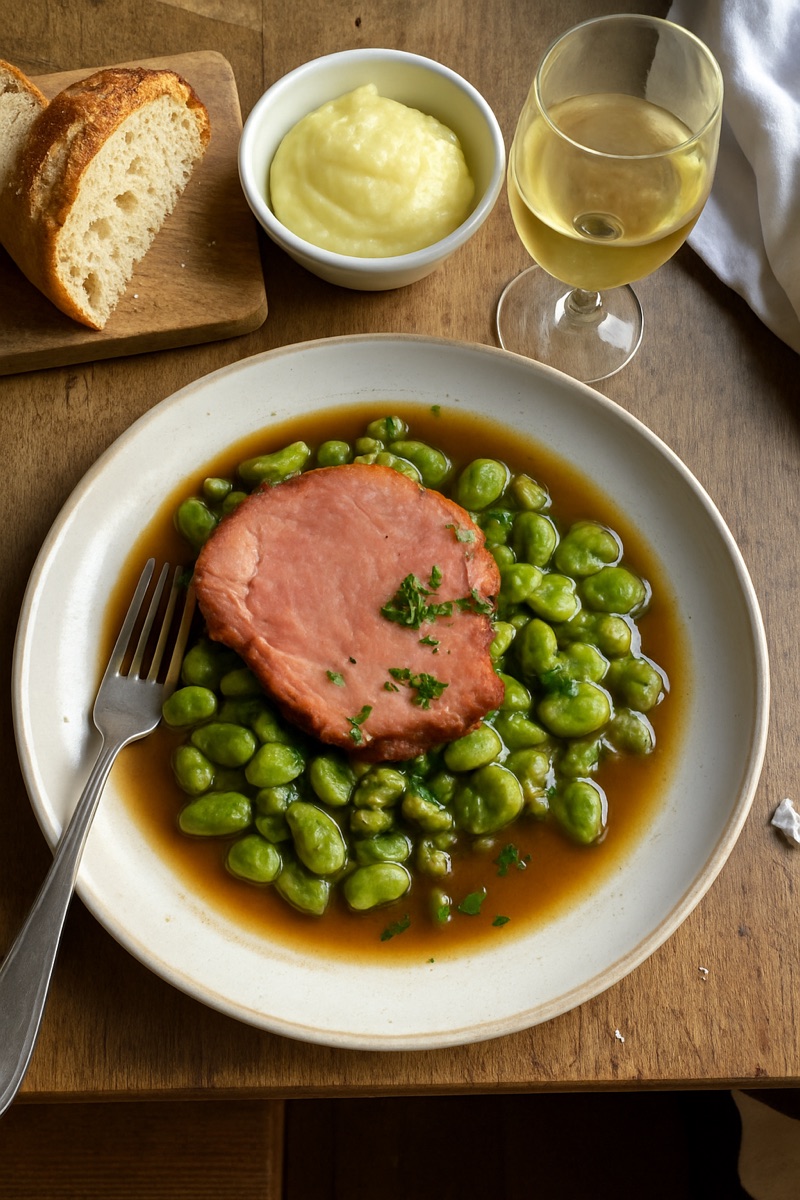
The national dish of Luxembourg is Judd mat Gaardebounen: smoked pork collar soaked overnight, gently poached with vegetables and cloves, then sliced and served under broad beans in a cream sauce flavoured with summer savory, with boiled potatoes. It has no legal status, but it is the dish most widely recognised as Luxembourg's national dish. Green bean soup, Bouneschlupp, is sometimes named too.
What is Judd mat Gaardebounen?
The name means smoked pork collar (*Judd*) with broad beans (*Gaardebounen*). The collar is cured and smoked, so it has to be desalted and poached rather than roasted. It is sliced thickly onto a large plate, the beans in their sauce are spooned over, and boiled potatoes go alongside, often with Luxembourg mustard.
Some cooks add a bouquet garni and a glass of Moselle wine to the poaching pot. Once cooked, the collar rests in its broth until serving so the slices stay moist.
It is often described as the most traditional Luxembourg meat dish, and is the dish reference works name as the country's national dish. No law makes it official.
It is a dish of peasant origin, like most traditional Luxembourg food. The cuisine sits between Latin and Germanic Europe and borrows from France, Belgium and Germany; more recently, Italian and Portuguese immigrants have added their own dishes.
How Judd mat Gaardebounen is made
Our Judd mat Gaardebounen recipe follows the classic method in three stages:
- Desalting: 1 kg of smoked collar soaks in cold water overnight, with the water changed twice, then is brought to the boil in fresh water and drained once more.
- Poaching: it simmers at a bare tremble for 2 hours with carrot, leek and an onion studded with cloves. It is never browned and never boiled hard.
- The beans: a blond roux of 30 g butter and 30 g flour is loosened with 100 ml white wine, 280 ml of the cooking broth and 40 ml cream, then 400 g of broad beans and 3 teaspoons of summer savory simmer in it for 10 minutes.
Why summer savory matters
Summer savory, called *Bounekräitchen* in Luxembourgish, is the herb that gives both of Luxembourg's bean dishes their taste. It goes into the broad-bean sauce of Judd and into the country's green bean soup. In Luxembourg, shops sell Judd ready-cooked or raw; outside the country, boneless smoked gammon is the usual substitute.
Where Judd mat Gaardebounen comes from
The dish is associated with Gostingen, a village in the south-east of the country whose broad beans are so well known that its inhabitants carry the nickname *Bounepatscherten*.
The origin of the word *Judd* is unclear. The linguist Jean-Claude Muller suggested it comes from the Spanish *judía*, meaning bean, and that the dish arrived with Spanish troops in the 16th or 17th century; in Galicia, pork with beans is also called judía. It remains a theory. The neighbouring Belgian kitchen, with its own national favourites, is covered in our article on the national dish of Belgium.
Bouneschlupp, the other Luxembourg candidate
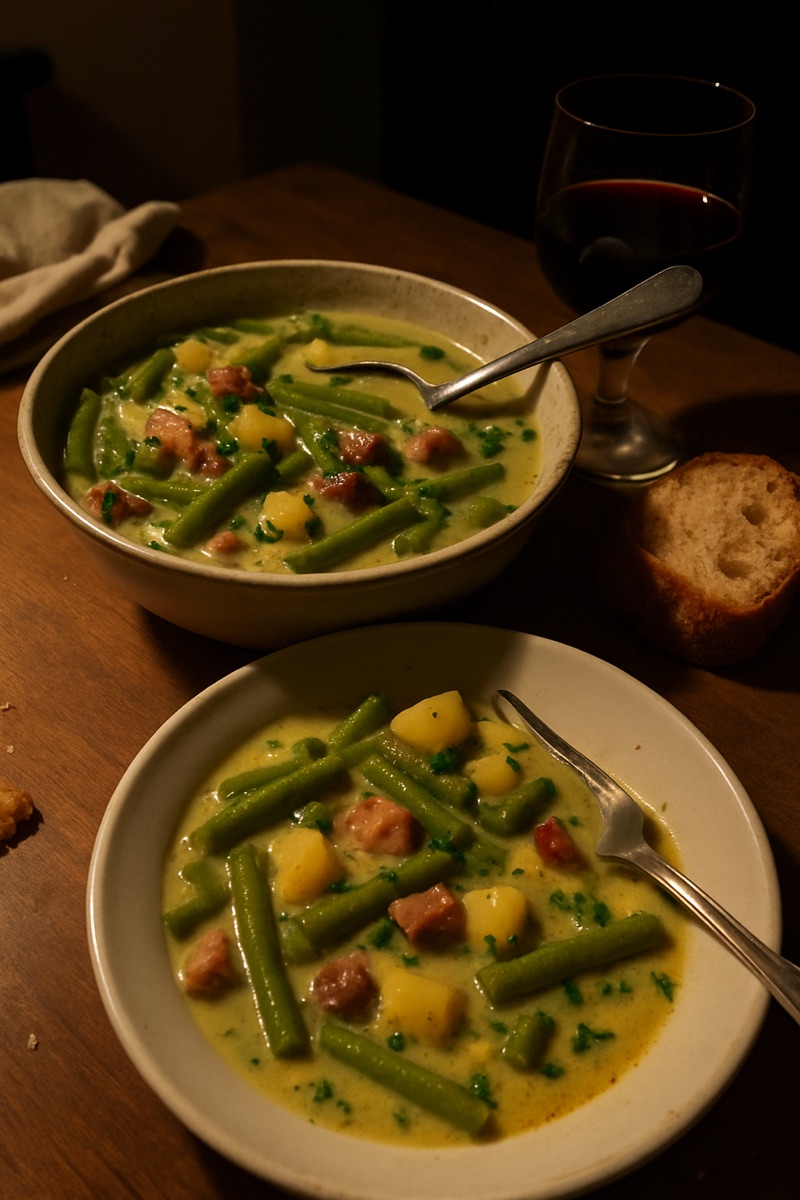
Some sources also call Bouneschlupp, a green bean soup, a Luxembourg national dish. In our Bouneschlupp recipe, 150 g of smoked bacon is rendered with onion and leek, then 600 g of green beans cut into 3 cm pieces and 500 g of diced potatoes simmer in 1.5 litres of water with dried summer savory for 30 to 40 minutes.
The beans are meant to be soft, not crisp. Part of the potato is crushed against the pot to thicken the soup, 100 ml of cream goes in off the heat, and smoked Mettwurst sausages warm on top for the last 15 minutes before being sliced over each bowl. The same soup is made across the borders, in Saarland, Lorraine and the Belgian Gaume and Arelerland.
Other dishes to know from Luxembourg
Beyond the two bean dishes, Luxembourg's best-known snack is the potato fritter.
Gromperekichelcher are deep-fried potato fritters with onion, shallot and parsley, served with apple sauce. They are a fixture of the Schueberfouer funfair, the eve of the National Day and the Christmas markets. The grated potato is wrung dry in a cloth first, or the fritters turn soggy. They are also eaten at the market of the Oktav pilgrimage.
All three recipes are on our page about the food of Luxembourg. For the neighbouring kitchens, see our guide to Western European food.
Other Luxembourg specialities that are not yet in our collection:
- Kachkéis: a soft cooked-cheese spread.
- F'rell am Rèisleck: trout in Riesling sauce.
- Rieslingspaschtéit: a loaf-shaped meat pie made with Riesling and aspic, served in slices.
- Quetschentaart: plum tart, found in every pastry shop in season.
- Éisleker Ham: ham from the northern Oesling, marinated, then smoked for several days.
- Hong am Rèisleck: chicken simmered in white wine with vegetables and mushrooms, close to the Alsatian coq au Riesling.
- Huesenziwwi: jugged hare, served in the hunting season.
The recipes
- Judd mat gaardebounen🇱🇺 Luxembourg · 15 hours
 Bouneschlupp🇱🇺 Luxembourg · 1 hour and 10 minutes
 Gromperekichelcher🇱🇺 Luxembourg · 1 hour and 5 minutes
Questions people ask
What does Judd mat Gaardebounen mean?
It means smoked pork collar with broad beans. "Judd" is the cured, smoked pork collar and "Gaardebounen" are broad beans, also called fava beans.
Is Judd mat Gaardebounen officially the national dish?
No law makes it official, but it is the dish most widely recognised as Luxembourg's national dish. Bouneschlupp, a green bean soup, is sometimes named as well.
What is served with Judd mat Gaardebounen?
Boiled potatoes and Luxembourg mustard, with either wine or beer to drink.
What can I use instead of Judd?
Outside Luxembourg, boneless smoked gammon is the usual substitute for smoked pork collar.
What herb is used in Judd mat Gaardebounen?
Summer savory, called Bounekräitchen in Luxembourgish. It flavours the broad-bean sauce.
Keep reading
- Traditional food of Luxembourg: 12 dishes to know
- What is the national dish of Andorra?
- What is the national dish of Austria?
- What is the national dish of Belgium?
- What is the national dish of Cyprus?
- What is the national dish of France?