 COPPER
What is the national dish of Cyprus?
Cyprus has no single official national dish. The names that come up most are souvla, large chunks of pork or lamb slow-turned on a long skewer over charcoal, and kleftiko, lamb sealed and baked for hours, which entered the register of Intangible Cultural Heritage of Cyprus in 2019. Halloumi, the grilling cheese protected as a PDO in the EU, is the island's national cheese.
Why Cyprus has several candidates
No law or decree in Cyprus names a national dish, and the lists disagree. Wikipedia's list of national dishes gives three for Cyprus: souvla, kleftiko and trachanas, a dried mix of cracked wheat and sour milk eaten as a soup. The same encyclopedia calls magarina bulli, bucatini cooked in chicken stock and topped with grated halloumi and dried mint, one of the national dishes, and halloumi the national cheese.
In practice, three of these are what visitors and Cypriots alike mean when they talk about the food of the island: souvla at every celebration, kleftiko from the village oven, and halloumi on almost every table.
Souvla: the celebration dish
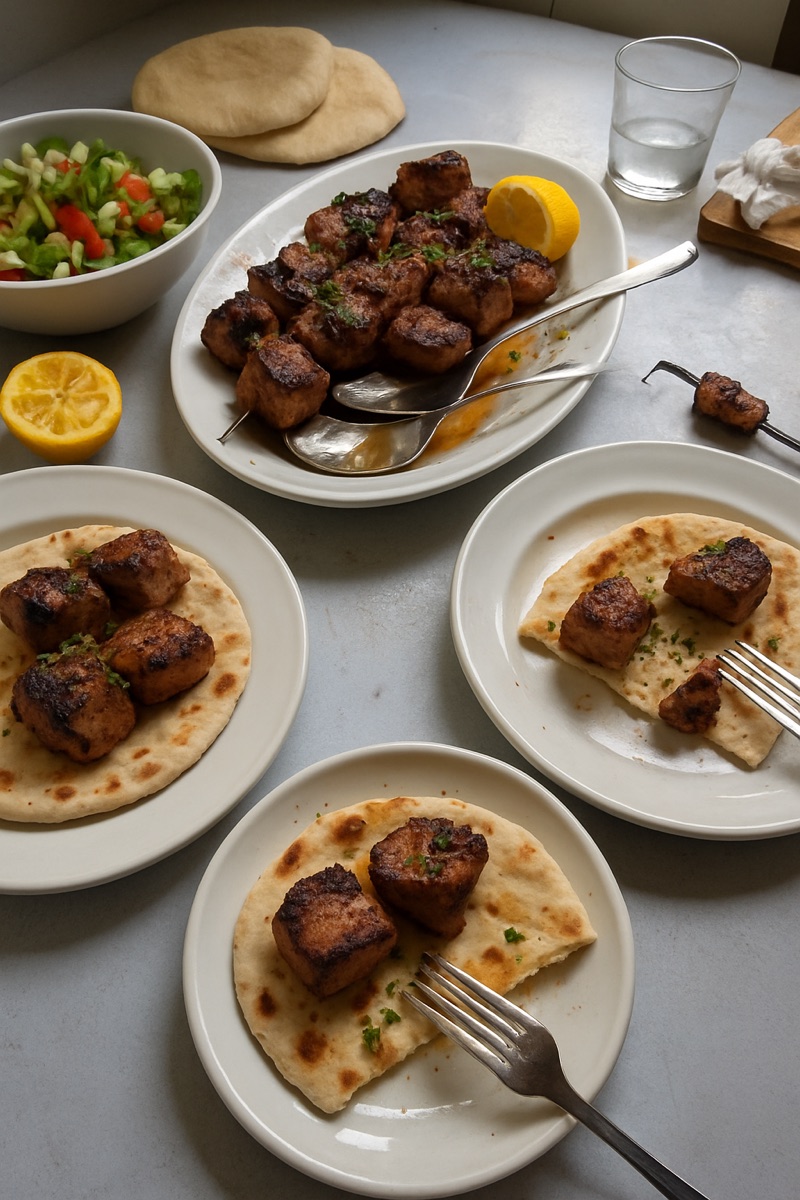
Souvla is large pieces of meat cooked on a long skewer over a charcoal brazier called a foukou. It is not souvlaki: the chunks are much bigger, about the size of a fist, and they cook far longer and much further from the coals. Cypriots make it above all for celebrations such as Christmas and Easter.
Our souvla recipe uses 2 kg of pork shoulder and 1 kg of pork neck, fat left on, seasoned only with coarse salt and pepper. The skewer turns high above grey coals for 2 to 3 hours and is lowered only at the end to colour the crust. Oil, lemon and dried oregano are brushed on from halfway, never before, because acid at the start tightens the surface.
Villages have their own versions. The best known is Lysiotiki souvla, from the village of Lysi.
Kleftiko: lamb in a sealed parcel
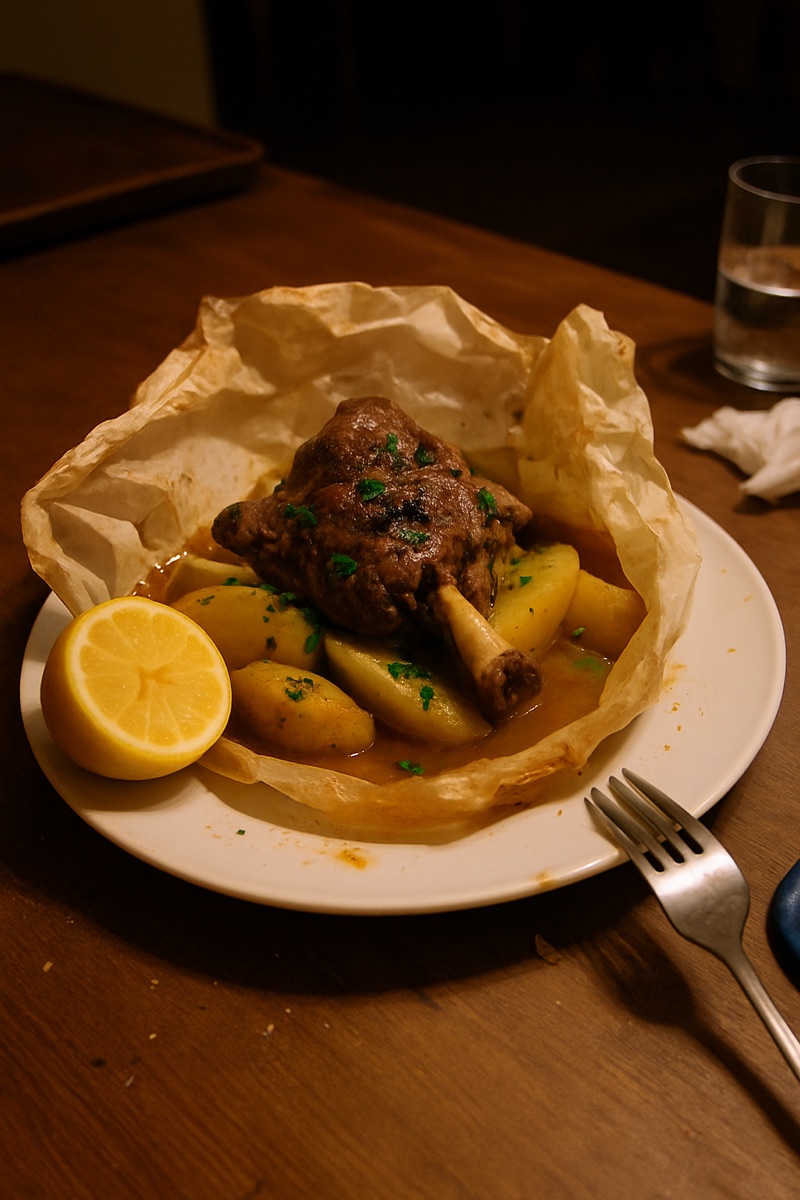
Kleftiko takes its name from the klephts, Greek outlaws of the Ottoman period who cooked meat in covered pits so the smoke would not give them away. Today it is lamb baked in a parcel that is never opened until it reaches the table. In 2019 kleftiko was included in the register of Intangible Cultural Heritage of Cyprus.
In our kleftiko recipe, a 1.5 kg bone-in lamb shoulder is marinated overnight with lemon, garlic and oregano, then wrapped with potatoes, onion, bay leaves and white wine in parchment and foil and baked 4 to 5 hours at 150 °C. The meat steams in its own juices and comes out pale and falling off the bone. In Cyprus it goes into a wood-fired clay oven sealed with flour-and-water paste.
Kleftiko is also a Greek mainland dish; see how it fits in our article on the national dish of Greece.
Halloumi: the national cheese
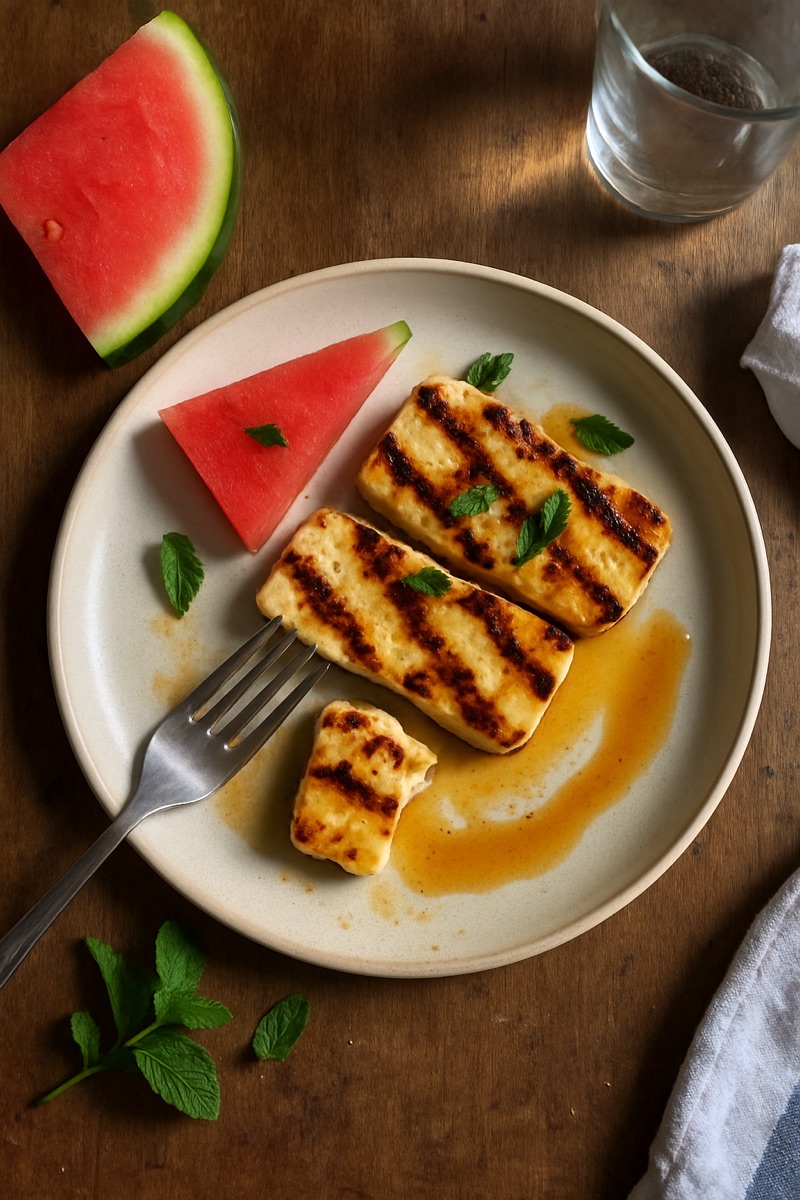
Halloumi is a semi-hard brined cheese made traditionally from sheep and goat milk. It browns on a grill instead of melting because of one step: the pressed curds are poached in their own hot whey for at least 30 minutes. They are then salted, folded over dried mint and stored in brine. Within the EU, only cheese made in Cyprus under its protected designation of origin may be called halloumi. Modern halloumi increasingly contains cow's milk because it is cheaper, and arguments between cattle, sheep and goat farmers over how much to allow held up that protection for years. The name itself traces back to Arabic.
Our halloumi recipe follows the farmhouse method from 4 litres of milk. Fresh halloumi rests 1 to 3 days in brine; mature halloumi needs at least 40 days and turns harder and saltier, good for grating over pasta. To eat it fresh, slice it 1 cm thick and dry-grill it 2 to 3 minutes a side, then add lemon.
How Cypriots eat them together
The three often meet on the same table in a meze, the long progression of small plates that Cypriots order for a group:
- Dips first: tahini, tzatziki (ttalattouri in Cypriot), taramosalata and skordalia, with bread and salad.
- Then grilled halloumi, lountza (smoked pork loin), sheftalia sausages and keftedes meatballs.
- Grilled meats such as kebabs, lamb chops and souvla towards the end.
- Fresh fruit or glyka, fruit preserved in syrup, to finish.
Other dishes to know from Cyprus
Cypriot cooking sits between Greece, Turkey and the Levant. Bulgur is the traditional grain besides bread, koupes are the Cypriot form of kibbeh, and makaronia tou fournou is a baked pasta topped with halloumi or anari cheese. Cyprus potatoes, long and waxy, are exported and roasted at home in the outdoor beehive oven, the fourni, with cumin and oregano.
All three dishes above are on our page about the food of Cyprus, with full methods. To compare it with the other kitchens of southern and western Europe, see our guide to Western European food.
The recipes
- Souvla🇨🇾 Cyprus · 3 hours and 30 minutes
 Kleftiko🇨🇾 Cyprus · 17 hours
 Halloumi🇨🇾 Cyprus · 1 day and 3 hours
Questions people ask
What is the difference between souvla and souvlaki?
Souvla uses much larger pieces of meat, cooked slowly for 90 minutes to 3 hours, far from the coals. Souvlaki uses smaller pieces and cooks much faster.
Is kleftiko Greek or Cypriot?
Both. It is a traditional Greek dish and is just as popular in Cyprus, which added it to its national intangible heritage register in 2019.
Is halloumi from Cyprus?
Yes. Halloumi originates in Cyprus and holds an EU protected designation of origin, so only halloumi made in Cyprus can use the name in the EU.
Why doesn't halloumi melt?
Because the pressed curds are poached in hot whey for at least 30 minutes before salting. This scalding sets the texture, so the cheese browns on a grill instead of melting.
Does Cyprus have an official national dish?
No. Souvla, kleftiko and trachanas are the dishes most often listed, and halloumi is considered the national cheese.
Keep reading
- Traditional food of Cyprus: 12 dishes to know
- What is the national dish of Andorra?
- What is the national dish of Austria?
- What is the national dish of Belgium?
- What is the national dish of France?
- What is the national dish of Germany?