 COPPER
What is the national dish of Uzbekistan?
The national dish of Uzbekistan is plov, also called osh or palov: rice steamed in a cast-iron kazan on top of a zirvak, a base of fatty lamb, onions and carrots cut into thick matchsticks, seasoned with cumin. It has no legal status as such, but it is universally named the national dish, and its culture was inscribed on UNESCO's intangible heritage list in 2016.
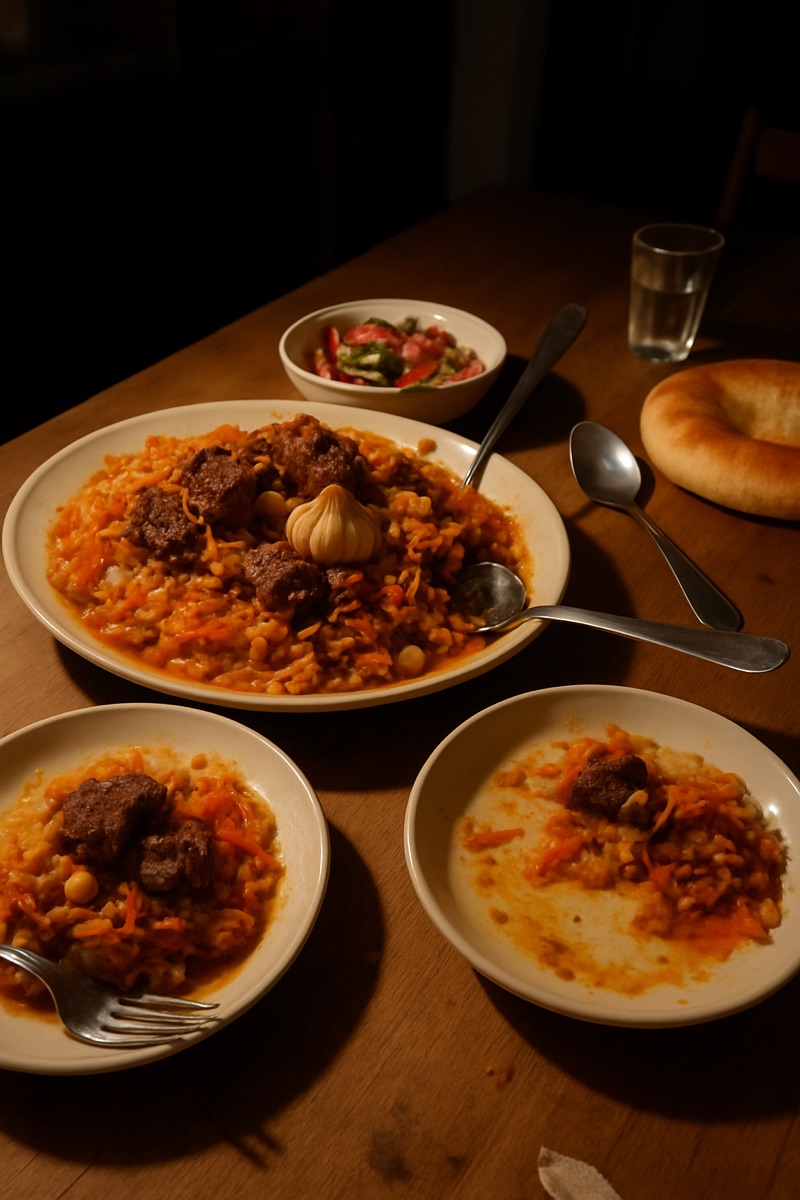
What is in Uzbek plov?
The core of plov is short: fatty lamb, carrots, onions and long-grain rice, cooked in oil or lamb fat. The rest varies from cook to cook:
- Carrots: yellow or orange, always cut into thick matchsticks by hand, never grated.
- Rice: devzira is the prized local variety; others are used too.
- Cumin seeds, rubbed between the palms before they go in.
- Whole heads of garlic, buried in the rice and served on top.
- Chickpeas, barberries or raisins, depending on the region and the occasion.
How plov is made
Uzbek plov is built in layers, and the rule is that the rice is never stirred into the meat. In our osh recipe, lamb is browned hard in shimmering cottonseed oil, onions are fried deep gold, then 1 kg of carrot sticks goes in. With cumin, chickpeas, barberries and water, this simmers uncovered for 40 minutes: that is the zirvak, and it carries all the flavour.
The soaked rice is then spread over it in an even layer. Boiling water goes in until it stands 1.5 cm above the grains, and the pot boils hard until the water drops. Finally the rice is mounded, pierced with a few holes, covered and steamed for 25 minutes on the lowest heat before the pot is turned out onto a platter.
Why plov matters in Uzbekistan
Plov is cooked at home, but for big occasions it is made by an oshpaz, a master plov cook, over an open fire, sometimes for up to 1,000 people from a single cauldron. At weddings, nahor oshi, "morning plov", is served to large gatherings between 6 and 9 am.
UNESCO inscribed "Palov culture and tradition" on its Representative List of the Intangible Cultural Heritage of Humanity in 2016. Its file describes plov served as hospitality, at weddings and New Year, to help people in need and to honour the dead, with skills passed from master to apprentice.
Each region has its own style: Fergana, Samarkand, Khorezm, Bukhara, Tashkent and Kashkadarya plov are all distinct.
Regional styles and variations
Fergana, Samarkand, Khorezm, Bukhara, Tashkent and Kashkadarya each have their own version, and the rice changes too: devzira, lazer, alanga and avangard are the varieties named for it.
The rule of cooking everything in one kazan has exceptions. In Bukhara's oshi sofi and Khorezm's suzma palov, the rice is boiled and drained separately, a method Bukharans call "Kabul style". Elsewhere, part of the rice may be replaced with chickpeas or mung beans, or the rice swapped entirely for wheat or dried noodles.
A badly cooked plov with sticky grains gets compared to shavla, a thick rice porridge with meat and carrots. That is the result the no-stirring rule exists to avoid.
UNESCO notes that large communal plov cooked in oversized kazans is usually prepared by men, while women more often cook it at home for the family.
Where plov comes from
Pilaf is generally traced to Persia and spread across Central Asia along the Silk Road. The Uzbek version developed its own method: the zirvak base and the layering in a kazan, where the rice steams on top of the meat rather than being fried first.
Neighbouring Tajikistan has its own UNESCO-listed plov, inscribed the same year; see the national dish of Tajikistan. Plov is also central in Turkmenistan.
The names travel with the dish: plov in Russian, pilav in Turkish, osh or palov in Uzbek and osh in Tajik, all related to the Persian polow.
Other dishes to know from Uzbekistan
Lagman is a bowl of hand-pulled noodles under a cumin-scented beef broth with daikon, celery, pepper and tomato; the stretching of the dough by hand is what the word refers to.
Samsa are flaky triangular pastries filled with raw chopped lamb, tail fat and onion that cook inside the dough, traditionally slapped against the wall of a tandoor. Our version bakes them at 220 °C for 25 to 30 minutes.
Other dishes Uzbeks count among their national dishes include shurpa, a soup of large pieces of mutton and fresh vegetables; norin, a noodle dish; manti and chuchvara dumplings; and dimlama, a slow stew of meat and vegetables. Green tea is the national drink, though Tashkent prefers black tea, and both are taken without milk or sugar.
Every meal comes with non, the round flatbread with a stamped centre and a thick rim, baked in a tandir clay oven. Obi non is the staple; in Samarkand, small thick shirma non are the favourite.
All three recipes are on our page about the food of Uzbekistan, and the neighbouring kitchens are in our guide to Central Asian food.
The recipes
- Osh🇺🇿 Uzbekistan · 14 hours and 40 minutes
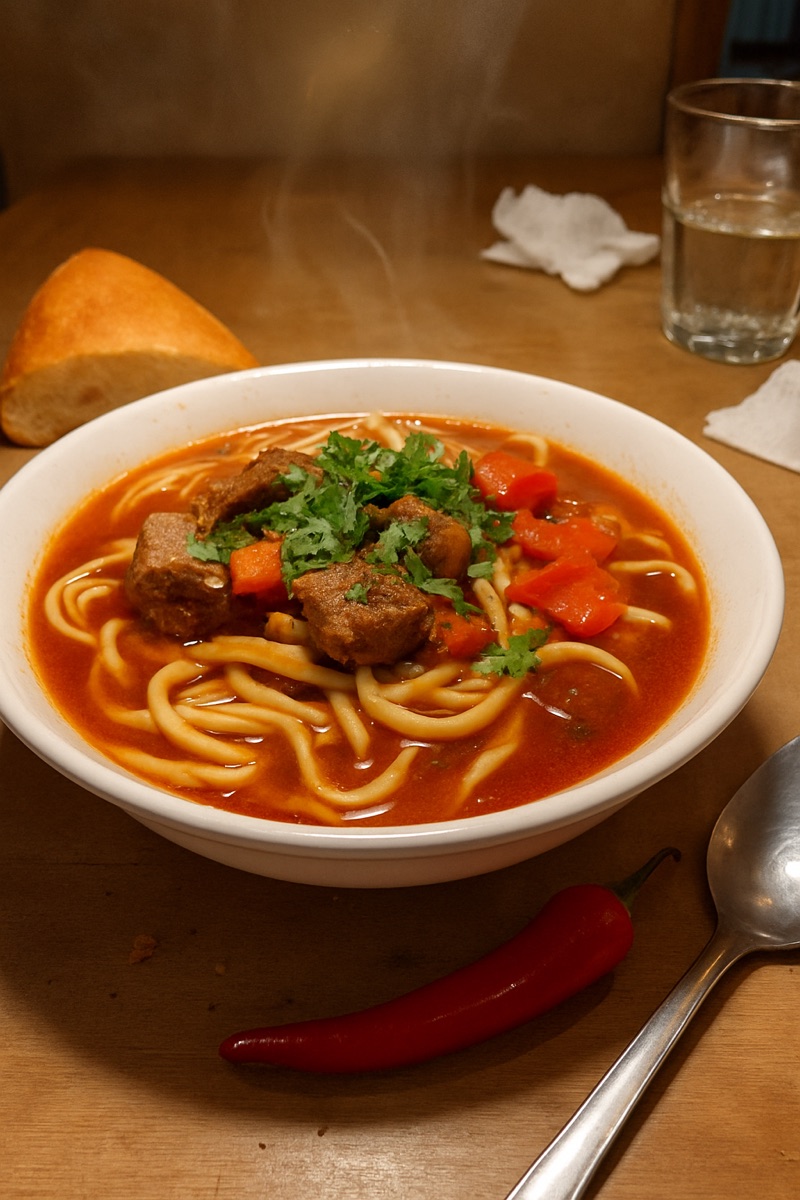 Lagman🇺🇿 Uzbekistan · 2 hours and 10 minutes
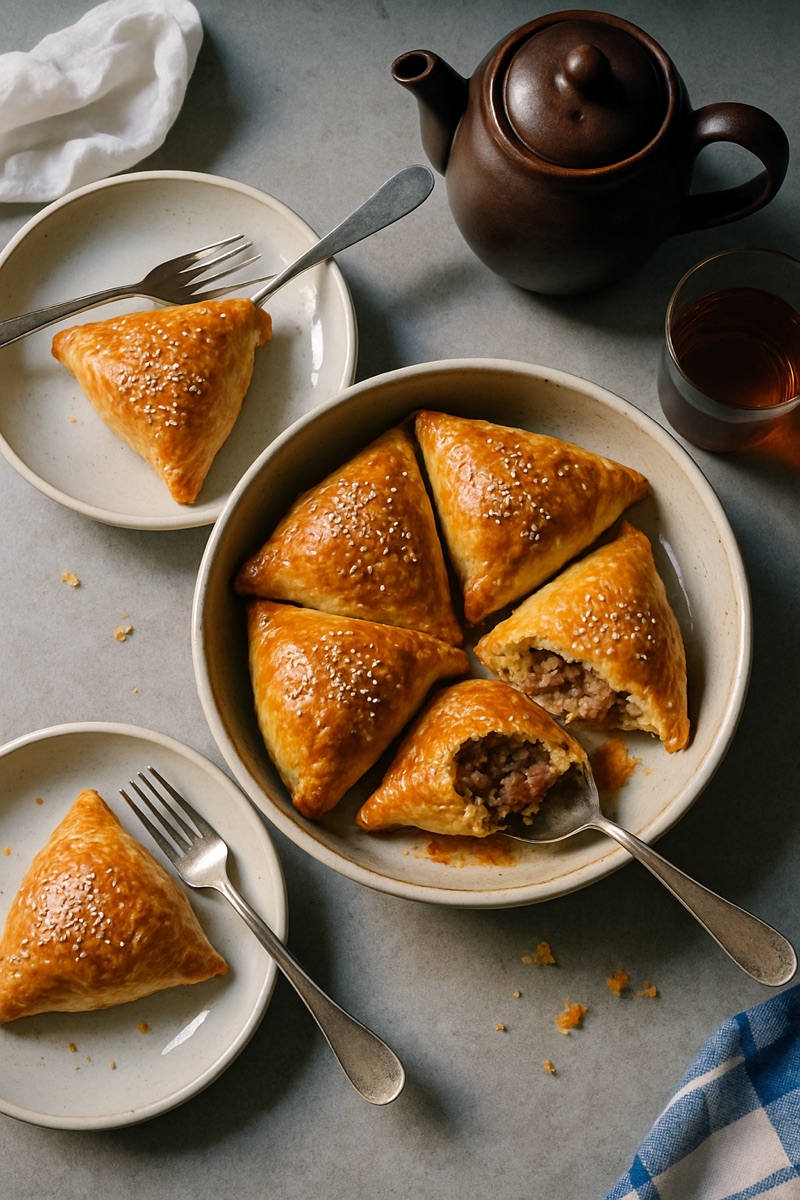 Samsa🇺🇿 Uzbekistan · 2 hours and 10 minutes
Questions people ask
Is plov the same as osh?
Yes. Plov is the Russian name, palov or osh the Uzbek ones, and all refer to the same rice, lamb and carrot dish.
Is plov Uzbek or Tajik?
Both countries claim it as their national dish, and UNESCO inscribed each country's plov tradition separately in 2016. Kazakhstan, Kyrgyzstan and Turkmenistan cook their own versions too.
What is an oshpaz?
An oshpaz is a master plov cook who prepares it for weddings and festivals over an open fire, sometimes for up to 1,000 guests from one cauldron.
Do you stir plov?
No. Once the rice is spread over the zirvak, it is not stirred; it cooks by absorption and then steams under a lid. The layers are only combined on the platter.
What is served with plov?
Plov is traditionally paired with kok choy, green tea served unsweetened in small piyola bowls. Garlic heads cooked in the rice are served on top of the platter.
Keep reading
- Traditional food of Uzbekistan: 12 dishes to know
- What is the national dish of Afghanistan?
- What is the national dish of Kazakhstan?
- What is the national dish of Kyrgyzstan?
- What is the national dish of Mongolia?
- What is the national dish of Tajikistan?