 COPPER
Traditional food of Tajikistan: 12 dishes to know
Tajik food is built on lamb, rice, wheat bread, sour milk products and summer fruit, cooked in a deg cauldron or a clay tanur oven and shared from one large plate. It is close to Uzbek and Persian cooking. The most emblematic dishes are oshi palav, the bread and dried cheese dish qurutob, the tanur-baked pastry sambusa and the round flatbread non, always with green tea.
What Tajik food is built on
Tajik cooking took shape over centuries in the oases of Fergana, Samarkand, Bukhara, Hisor and the Pamirs, crossroads of the trade between Asia and Europe. It has much in common with Uzbek, Iranian and Afghan cuisine, and differs clearly from the nomadic kitchens of the Kyrgyz, Kazakhs and Turkmen.
Lamb, goat and beef are the favourite meats, with chicken and sometimes quail or partridge. Rice, chickpeas, mung beans, lentils and wheat fill out the meal, and soups are thick and rich. Tajik cooks use pepper, barberries, cumin, saffron and garlic, plenty of fresh herbs, and sour milk products such as suzma, katyk and kaymak in both soups and main dishes.
Meals are eaten from a shared plate, often with the hand, and always with bread and tea. A professional cook is called an oshpaz, a word that in Tajik usually means a master of palav. That dish, and qurutob beside it, are covered in depth in our article on the national dish of Tajikistan.
Palav, qurutob and other main dishes
Palav is more than a meal in Tajikistan. Two sayings quoted by UNESCO show its weight: "No osh, no acquaintance", and "If you have eaten osh from somebody, you must respect them for 40 years".
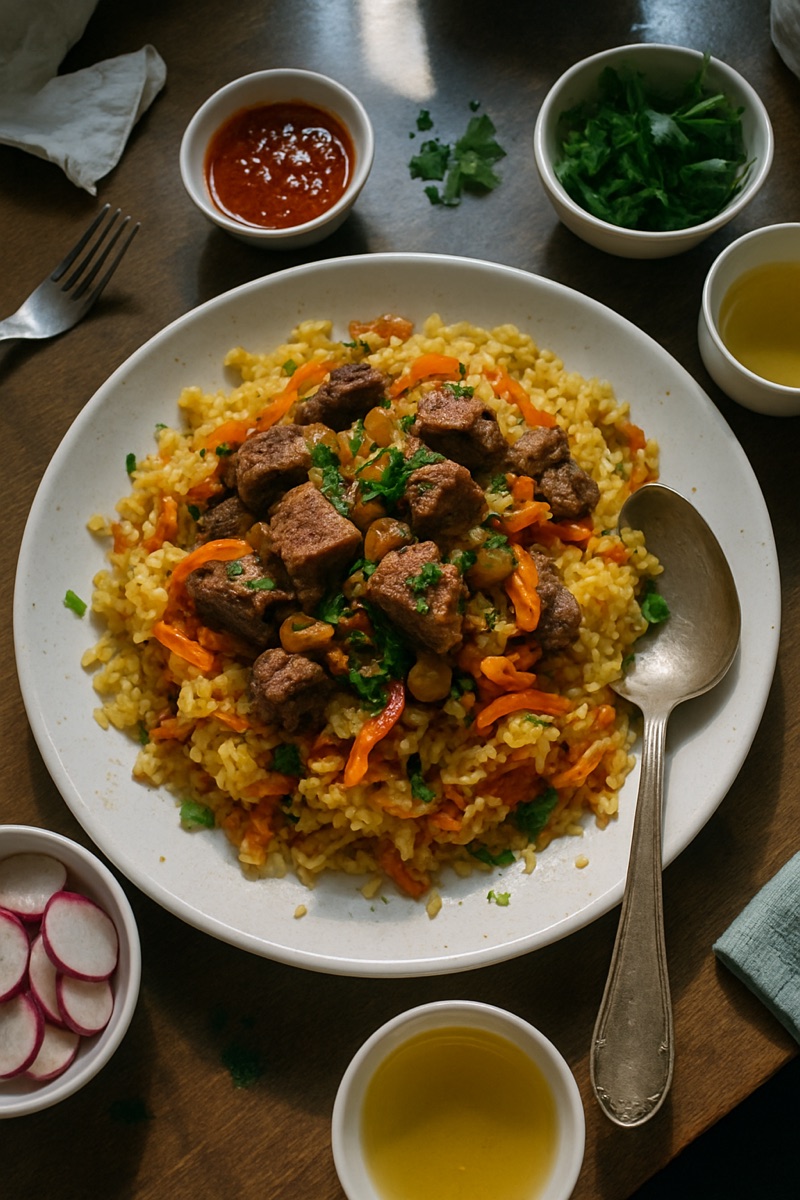
- Oshi palav — Rice steamed over lamb, onions and carrots cut into thick sticks in a deg, a wok-shaped cauldron, over an open flame, then shared from one large plate. UNESCO inscribed oshi palav as Tajik intangible heritage in 2016 and counts up to 200 varieties. It is eaten with shakarob, a salad of tomatoes, cucumbers and onion, and green tea.
- Qurutob — Qurut, dried balls of salty cheese, dissolved in water and poured over pieces of fatir, a flaky flatbread made with butter or tallow, then topped with onions fried golden in oil and fresh tomatoes, cucumbers and herbs. There is no meat. It is considered a national dish, eaten mostly in the south, from a shared wooden or clay plate.
- Tanur kabob — A leg of lamb cooked slowly in a tanur, the clay oven used for bread. The thin strips of meat that touched the walls of the oven are considered the best part.
- Damlama — Meat stewed with onions and other vegetables in a kazan, a homely dish found across Central Asia.
Soups, pastries and dumplings
- Shurbo — Meat and potato soup; the word simply means soup. Most Tajik soups start by frying the meat and vegetables in plenty of fat; in hom-shurbo, whose name means "raw soup", the ingredients go into the water raw instead.
- Laghmon — A meat soup with long noodles, made across Central Asia. Tajik kitchens also make ugro, a soup with small cut noodles, and other thick soups such as mastoba, with rice.
- Sambusa — A pastry filled with lamb and onion, or pumpkin and onion, baked against the inner wall of a tanur. Shapes and fillings vary, from triangles to four-cornered parcels with chicken, potato, greens or kaymak. It is sold as fast food and served as a starter.
- Mantu — Large dumplings filled with meat, pumpkin or mountain greens, cooked in a stacked steamer. Their small cousins, tushbera, are boiled like pelmeni.
Bread, dairy, sweets and tea
- Non — The round flatbread of Central Asia, baked in a tanur and served with every meal. If a Tajik has food but no non, they say they have no food. Non is never put upside down, and a piece dropped on the ground is set on a high ledge for birds. Fatir, a flaky bread, kulcha, the smallest loaf, and girdacha, the largest, are other common breads.
- Chakka and kaymak — Chakka is a thick, sour preparation of strained milk, and kaymak a high-fat clotted cream. With thick yogurt they are part of the spread at the start of a Tajik meal, scooped up with bread. Qurut balls are eaten on their own as a snack.
- Sumanak — A sweet paste made from the juice of sprouted wheat and flour, cooked for hours in a large kazan for Navruz, the spring new year. Its making is a gathering, traditionally of women, through the night.
- Green tea — Tea opens and closes every Tajik meal and is offered to every visitor. Green tea is the national drink, served in small handleless bowls called piola; black tea arrived only at the end of the 19th century. The choykhona, the teahouse, is the most common gathering place, and shirchoy, tea with milk, is a dish of its own. Tea is mostly drunk without sugar, with sweets such as nishallo, a whipped egg-white cream, or sugar-coated almonds.
Regional food in Tajikistan
Palav changes from region to region. In the north, Sughd and Khujand cook a palav close to the Uzbek one, and Khujand palav can come with stuffed vine leaves. Dushanbe palav mixes the valley style with that of Samarkand, and the Pamir, or Badakhshan, has its own version, also cooked across the border in Afghanistan. Qurutob is above all a dish of the south. In restaurants palav now often comes on individual plates with a spoon, but at home it is still shared from one dish.
Summer brings grapes and melons, once famous across the Soviet Union, with apricots, pomegranates, figs and persimmons in the bazaars. Compare Tajik food with the traditional food of Uzbekistan, which shares plov, samsa and non, and the traditional food of Afghanistan, home to many Tajiks and to its own palaw.
Cook Tajik food at home
Palav, qurutob and sambusa have full recipes with ingredients and step-by-step methods on our page about the food of Tajikistan. For plov, lagman and manti across the region, see our guide to Central Asian food.
The recipes
- Plov🇹🇯 Tajikistan · 2 hours and 55 minutes
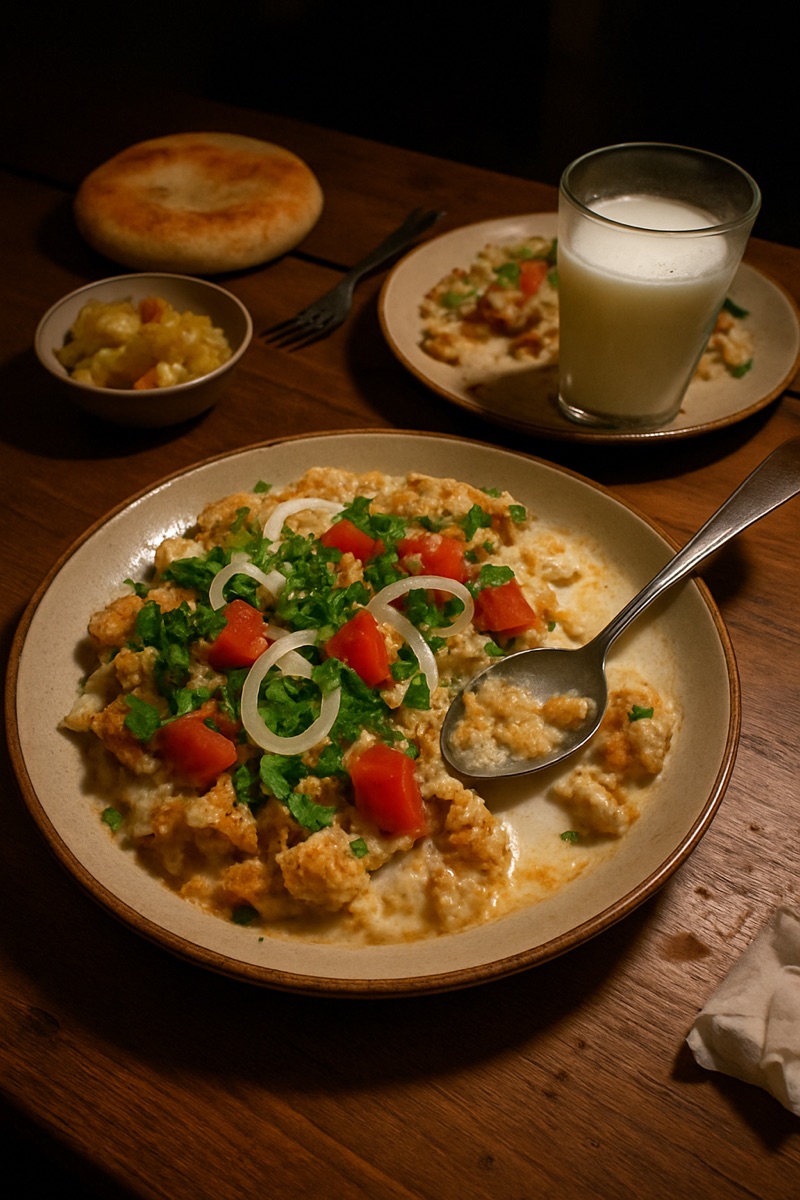 Qurutob🇹🇯 Tajikistan · 1 hour
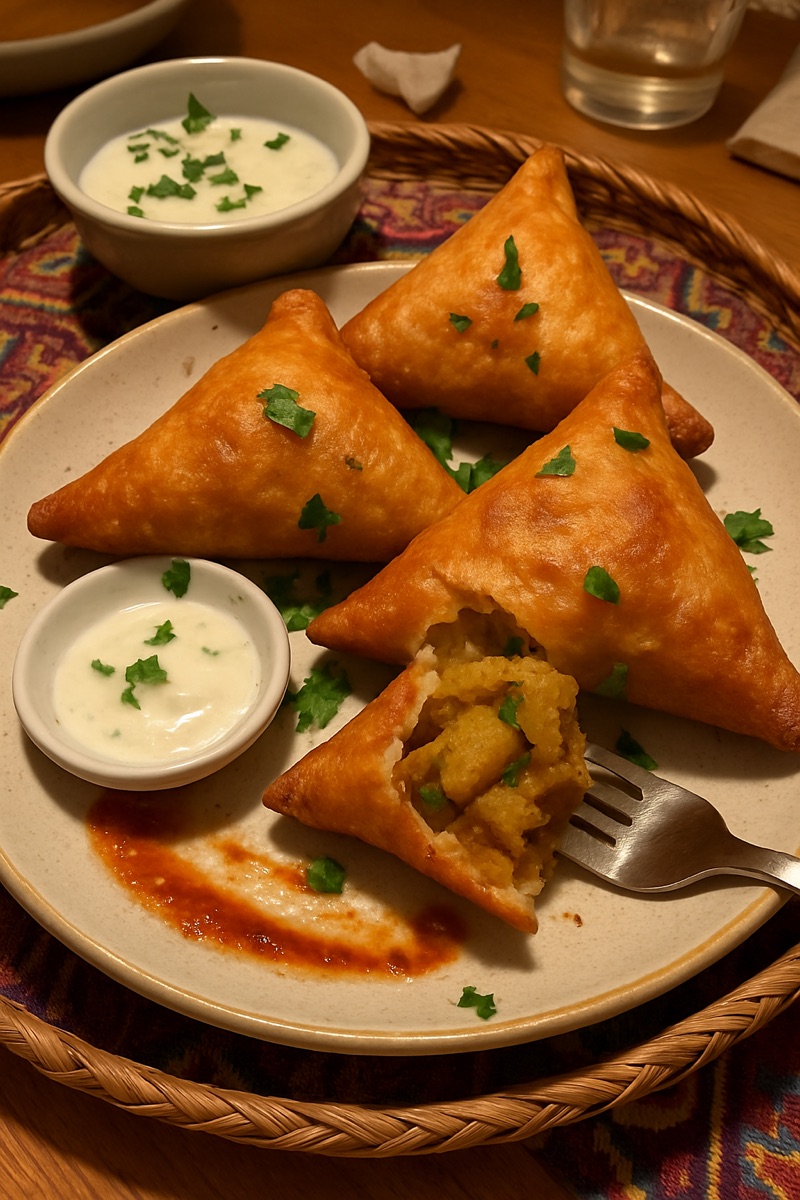 Samosa🇹🇯 Tajikistan · 2 hours and 35 minutes
Questions people ask
What is the most popular food in Tajikistan?
Oshi palav, rice steamed over lamb, onion and carrots, is the most popular and best-known Tajik dish, cooked for guests, weddings and holidays. Qurutob, sambusa, shurbo and laghmon are everyday favourites.
What do people in Tajikistan eat for breakfast?
Tea with kulcha or non and butter, sausage, white cheese, qaymoq cream, jam and omelettes, with fresh fruit in summer.
Is Tajik food spicy?
It is seasoned rather than hot: cumin, barberries, black and red pepper, garlic and plenty of fresh herbs, with sour milk products on the side.
Is plov Tajik or Uzbek?
Both countries count it as a national dish, and UNESCO inscribed each country's tradition separately in 2016: oshi palav for Tajikistan, palov culture for Uzbekistan.
What is the national drink of Tajikistan?
Green tea, served in piola bowls with every meal and to every guest.
Keep reading
- What is the national dish of Tajikistan?
- Traditional food of Afghanistan: 12 dishes to know
- Traditional food of Kazakhstan: 12 dishes to know
- Traditional food of Kyrgyzstan: 13 dishes to know
- Traditional food of Mongolia: 12 dishes to know
- Traditional food of Turkmenistan: 13 dishes to know