 COPPER
Traditional food of Oman: 11 dishes to know
Omani food grew on the old spice routes, so its rice, chicken, fish and lamb dishes carry Arab, Indian, Iranian and African influences. Meat is marinated in rich spice mixes, rice is cooked in meat broth and dried limes add a sour note. The most emblematic dishes are shuwa, majboos, harees and Omani halwa.
What Omani food is built on
Omani cuisine is part of the Khaleeji, or Gulf, kitchen. It reflects Oman's past as a trading empire at the crossing of the spice routes, with Arab, Indian, Iranian, Asian and African influences. Dishes are based on chicken, fish and lamb, with rice as the staple, and most carry a rich mixture of spices, herbs and marinades.
Although cooking varies between regions, most meals combine curry, cooked meat, rice and vegetables. Soups are common, usually made with chicken, lamb and vegetables such as smoked eggplant. The main meal is eaten in the middle of the day, and dinner is lighter.
Rice dishes and feast meats
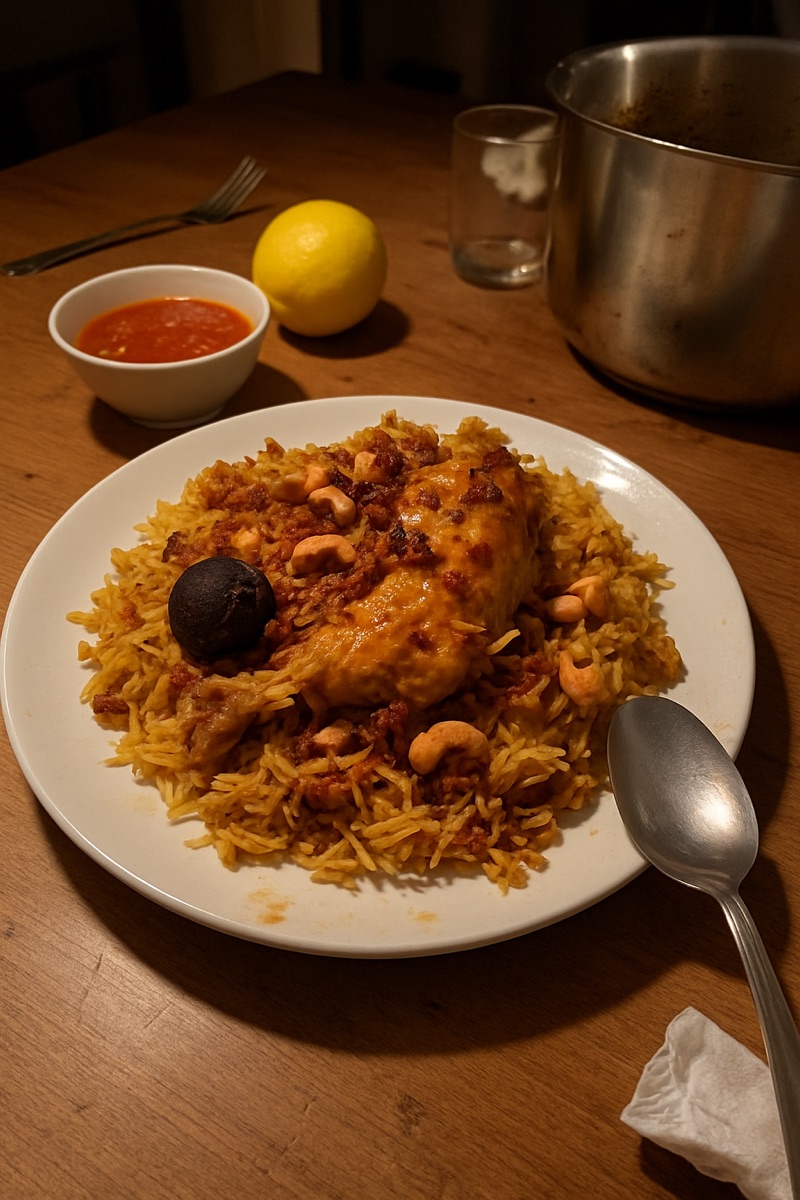
Kebabs of spiced, salted meat, usually chicken or beef, grilled on skewers and served with vegetables, are also popular. Majboos is served with daqqus, a tomato sauce, and on festive days the rice is dressed with cinnamon, cardamom, garlic, almonds and pine nuts.
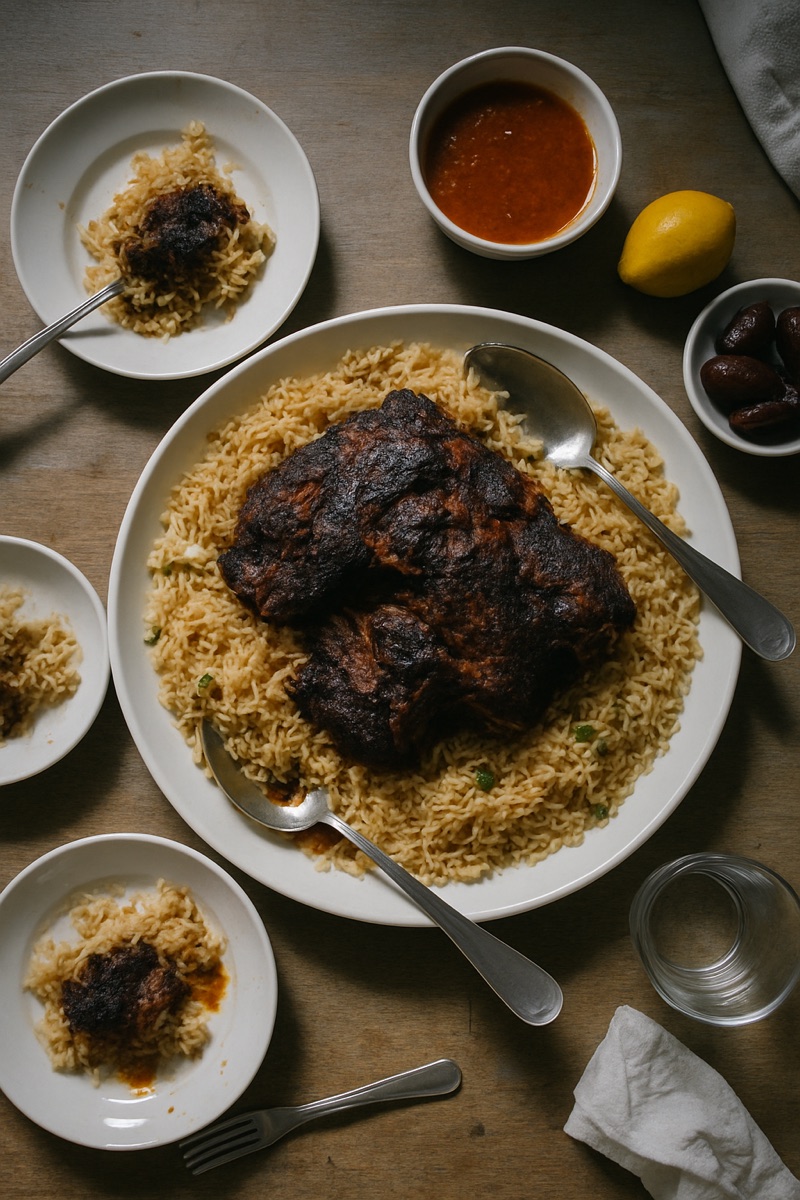
The shuwa paste is ground from cardamom, cumin, coriander, cloves, cinnamon and dried Omani lime with garlic, vinegar and oil, and some families add date paste. The meat is scored to the bone so the paste goes deep, marinated for a day, and cooked in the pit for anything from 12 to 72 hours depending on the family. It roasts in its own juices and is never boiled.
- Majboos — Spiced rice cooked in the same broth as its chicken or meat, sometimes flavoured with saffron. Our version simmers the chicken with whole dried black limes and the bezar spice mix, then finishes the rice with saffron steeped in rosewater.
- Qabuli — Rice cooked with camel meat or chicken until both are tender, then finished with ghee and eaten by hand.
- Shuwa — Goat, lamb, beef or camel rubbed with a spice paste, wrapped in leaves and sacking and cooked for at least a day in a sealed pit in the ground. It is a festive dish, prepared above all for Eid, and preparing it is often a job for the whole village.
- Mashuai — A whole kingfish roasted on a spit and served with lemon rice, in a cuisine where fish is one of the staples alongside chicken and lamb.
- Muqalab — Heart, liver, lungs and tripe cooked with cinnamon, cardamom, cloves, black pepper, ginger, garlic and nutmeg, a dish that uses the whole animal.
Wheat, soups and bread
Omani home cooking also has more unusual dishes, such as albadhinajan mae tawarikh, a cake of eggplant, dates and onions, and smoked eggplant goes into vegetable soups.
- Harees — Wheat cooked with meat or chicken until it forms a thick paste, served with ghee and eaten with the fingers or a spoon. UNESCO inscribed the harees tradition of Oman, the UAE and Saudi Arabia in 2023, noting that it is especially popular during Ramadan, at weddings and when honouring guests.
- Sakhana — A thick soup of wheat, dates, molasses and milk, typically eaten during Ramadan.
- Mushaltat — A wheat flatbread often stuffed with cheese, meat, honey or vegetables.
Halwa, coffee and drinks
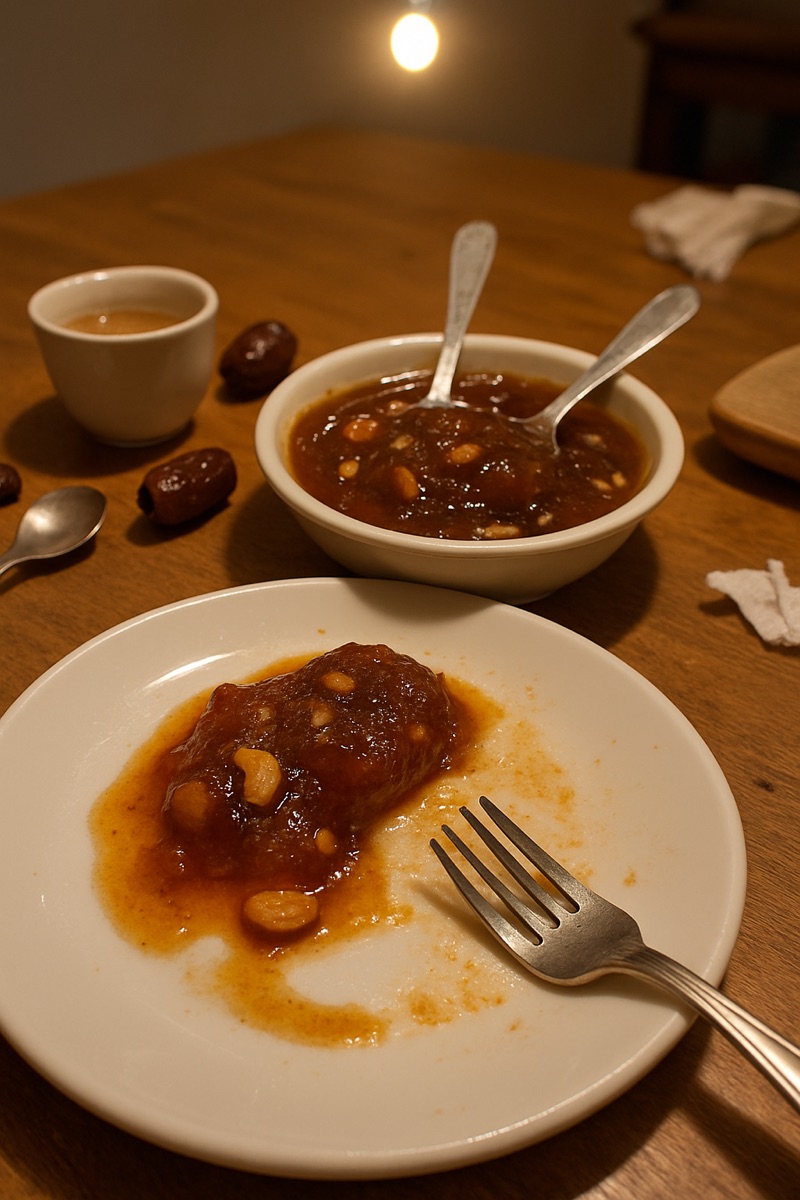
- Omani halwa — A translucent jelly of sugar, water, corn starch and ghee, stirred without stopping until it pulls away from the pan, and flavoured with saffron, rosewater and cardamom; some versions add nuts, dates or frankincense. It is served at Eid, Ramadan, graduations, births and weddings, and an old saying holds that whoever is invited into an Omani house deserves a bite.
- Kahwa — Omani coffee with cardamom, served as a sign of hospitality with dates and halwa.
- Laban — Salty buttermilk, drunk alongside yogurt drinks and tea, which Wikipedia describes as the national beverage, while coffee is the drink of hospitality.
Eid, Ramadan and the Omani table
Omani food follows the calendar. Ramadan brings harees and sakhana to the table, and halwa with kahwa is served at Ramadan, at Eid and to every guest. Eid is the time for shuwa: the meat is marinated, wrapped in leaves and lowered into the pit, a communal job often shared by an entire village.
Harees is served in large dishes shared by several people and, as UNESCO describes it, eaten with the thumb and forefinger while sitting on one knee. Its few ingredients make it easy to cook in large quantities, and the know-how is passed from mothers to daughters. Pork is forbidden to Muslims in Oman, and imported pork is restricted to non-Muslims.
Halwa is hard to get right. Chef Ahmed al-Habsi told Middle East Eye that recipes written in cookbooks are not enough: makers must know the techniques and blend the ingredients with care. Our recipe stirs the starch, caramelised sugar and ghee for 45 minutes to an hour until the paste turns translucent.
Making halwa is a trade that has stayed in families; the Barka halwa factory, founded in 1951, produces hundreds of kilograms a day and exports to the UAE, Qatar and Saudi Arabia. Shuwa is served on rice, often cooked with cinnamon, cardamom, garlic, almonds and pine nuts, with yogurt and cucumber, tomato salsa and vegetables on the side.
Cook Omani food at home
Shuwa is the dish most often called the national dish of Oman, with harees and halwa close behind. Copper has full recipes for shuwa, majboos and Omani halwa, with ingredients and step-by-step methods, on our page about the food of Oman, alongside other Middle Eastern recipes.
Oman shares harees and shuwa with the Emirates and has long borders with Yemen. Compare with the traditional food of the United Arab Emirates and the traditional food of Yemen.
The recipes
 Majboos
 Shuwa
ShuwaQuestions people ask
What is the most popular food in Oman?
Majboos, rice cooked in a spiced chicken or meat broth, is the everyday dish. Shuwa is the most famous feast dish, and halwa the best-known sweet.
What is Oman's national dish?
No dish is official, but shuwa, meat slow-cooked for a day or more in a sealed pit, is the one most often named. Harees and halwa are also strongly tied to Omani identity.
Is Omani food spicy?
It is richly spiced rather than hot. Dishes use mixtures of cardamom, cumin, coriander, cloves, cinnamon and dried lime, and many are described as curries.
What is Omani halwa made of?
Sugar, water, corn starch and ghee, cooked and stirred for a long time, then flavoured with saffron, rosewater and cardamom. Nuts, dates or frankincense are sometimes added.
What do Omanis drink?
Tea every day, and kahwa, cardamom coffee, to welcome guests with dates and halwa. Laban, a salty buttermilk, is also popular.
Keep reading
- What is the national dish of Oman?
- Traditional food of Bahrain: 13 dishes to know
- Traditional food of Iran: 14 dishes to know
- Traditional food of Iraq: 13 dishes to know
- Traditional food of Israel: 14 dishes to know
- Traditional food of Jordan: 13 dishes to know