 COPPER
Traditional food of Laos: 14 dishes to know
Traditional Lao food is built on sticky rice, eaten by hand at almost every meal, and seasoned with padaek (a chunky fermented fish sauce), lime, chilli, galangal and khao khua, toasted sticky rice powder. Dishes are grilled, steamed, stewed or pounded in a mortar and served with raw greens. The ones to know first are laap, tam mak hoong, khao piak sen and khao poon.
What Lao food is built on
Sticky rice, khao niao, is the base of everything. Laos has the highest sticky rice consumption per person in the world, about 171 kg a year, and the Lao sometimes call themselves luk khao niao, children of sticky rice. It is steamed in a bamboo basket set over a pot and eaten by hand, rolled into a small ball and used to pick up the other dishes. When a diner has finished, the custom is to close the rice basket.
Wikipedia's article on Lao cuisine names its trifecta: sticky rice, laap and green papaya salad. Around them, a typical meal brings a soup, a grilled dish, a dipping sauce, a plate of greens and a stew or a mixed dish like laap, all served at once and shared. The soup is sipped throughout the meal.
Three things set Lao cooking apart from its neighbours. Large amounts of raw greens, vegetables and herbs are served undressed on the side; savoury dishes are never sweet, and some are deliberately bitter; and coconut milk and noodles play a smaller part than elsewhere in the region, because the cooking leans so heavily on sticky rice. Padaek, the Lao fermented fish paste, and khao khua, raw glutinous rice toasted and pounded to a coarse powder, carry much of the flavour.
Salads and dips
Lao salads are pounded or mixed, and dips (jaew) are eaten with sticky rice and raw vegetables.
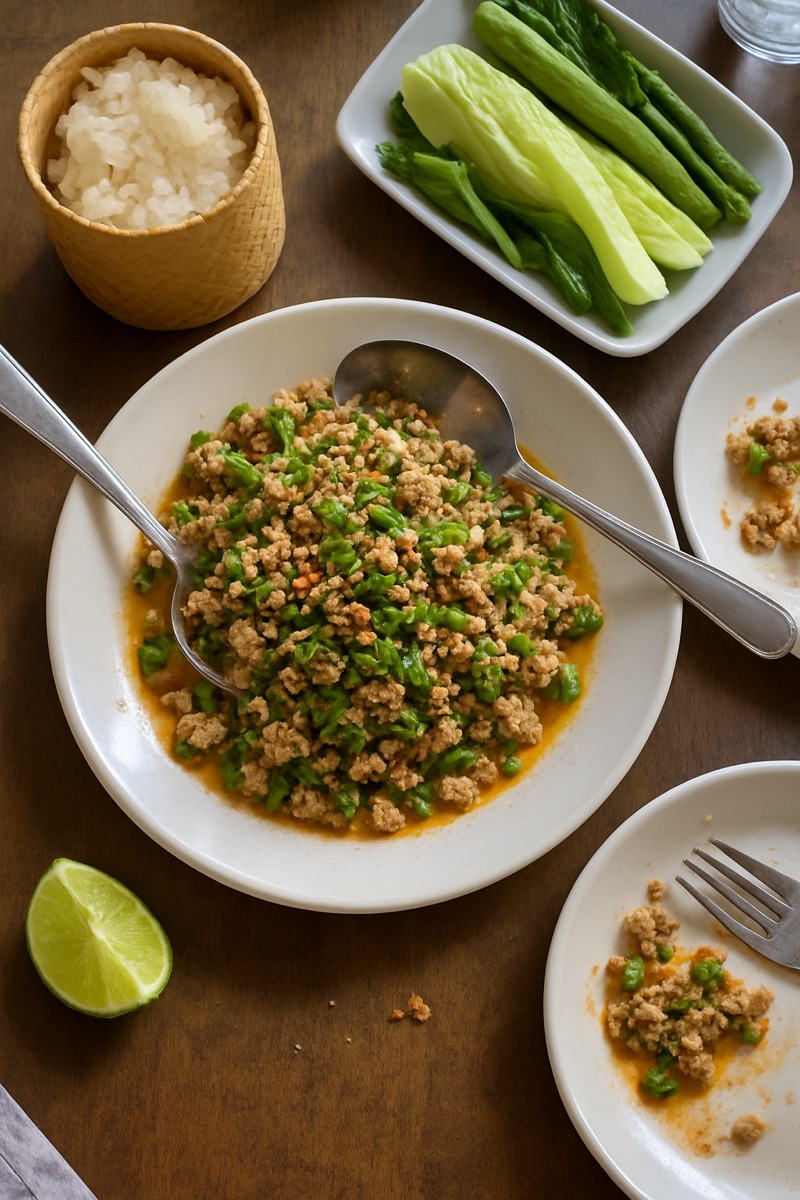
- Laap — Minced meat or fish dressed with lime juice, fish sauce, padaek and chilli, then tossed with khao khua and herbs such as mint and green onion. Pork, chicken, duck, beef, fish and even mushrooms are used, and some versions are left raw, like a ceviche. It is the dish most often called the national dish of Laos.
- Tam mak hoong — Green papaya salad, pounded in a khok, the deep mortar indispensable in a Lao kitchen, with garlic, chilli, tomato, lime and padaek. Tam means to pound, and the same method gives a whole family of tam salads made with cucumber, yardlong beans, eggplant or rice vermicelli.
- Nam khao — A crispy rice salad from Tha Deua, a port village in Vientiane. Cooked rice is seasoned with red curry paste and grated coconut, rolled into balls and deep-fried, then broken up and mixed with som moo (fermented pork sausage), peanuts, herbs, lime juice and fish sauce. It is eaten wrapped in lettuce leaves.
- Jaew bong — A sweet and spicy chilli paste from Luang Prabang made with sun-dried chillies, galangal, garlic and fish sauce; its distinguishing ingredient is shredded water buffalo or pork skin. It keeps for a long time and is eaten with sticky rice, raw vegetables or kaipen, the fried sheets of Mekong river weed.
Noodle soups and stews
Noodles are most popular in northern and central Laos, often as breakfast. They are the one place where chopsticks are traditionally used.
- Khao piak sen — Thick, chewy noodles of rice flour and tapioca starch cooked directly in a chicken or pork broth simmered with galangal, lemongrass and kaffir lime leaves. The starch they release thickens the soup. It is a common breakfast, finished with fried garlic, green onion and lime, and is often compared to the Vietnamese bánh canh.
- Khao poon — Rice vermicelli in a broth of pounded chicken, fish or pork, made with or without coconut milk and seasoned with padaek, galangal, lime leaves and chilli. Its red and golden colours earned it the name Lao royal vermicelli curry soup, and versions served to the royal family appear in the recipes of Phia Sing, the king's chef.
- Or lam — A thick, peppery stew from Luang Prabang, thickened with sticky rice and flavoured with lemongrass, chilli and sakhaan, a chilli wood that slightly numbs the tongue. It is cooked with dried buffalo skin, beef, game, quail or chicken, eggplant and yardlong beans; the original royal recipe used deer.
- Khao soi (Lao) — Not the coconut curry noodle soup of northern Thailand. Lao khao soi is wide, hand-sliced rice noodles in a clear broth, topped with a sauce of minced pork, tomato, garlic and fermented bean paste, and always served with fresh herbs. Luang Namtha and Luang Prabang are said to be its birthplace.
Grills, steamed dishes and street food
- Ping gai — Grilled marinated chicken, often a whole bird halved and flattened. It is a staple of street markets, paired with green papaya salad, sticky rice and jaew bong. The version from Seno, in Savannakhet province, carries a national One District One Product trademark and must use local chicken.
- Sai oua — A Luang Prabang pork sausage of coarsely chopped fatty pork seasoned with lemongrass, galangal, kaffir lime leaves, shallots, chilli, garlic, sticky rice and fish sauce. It is grilled, or fermented and dried before roasting, and eaten with sticky rice or as a snack. The name means stuffed intestine.
- Mok pa — Fish steamed in a banana-leaf parcel tied with bamboo string, flavoured with lemongrass, kaffir lime leaves, green onion, green chilli, fish sauce and fresh dill. It is served with sticky rice.
- Khao jee pâté — Baguettes, a legacy of French rule, are sold on the street in Vientiane. Stuffed with pâté, pork roll, raw vegetables and chilli sauce, they make the Lao version of the bánh mì, a popular breakfast with coffee.
Sticky rice sweets
Lao desserts, khong van or sweet things, mostly combine tropical fruit with glutinous rice.
- Khao lam — Sticky rice with red beans, coconut, coconut milk and sugar, roasted inside a section of bamboo. It is eaten as a sweet or alongside savoury food: in Laos, grilled chicken often comes with khao lam.
- Khao tom — Sticky rice and ripe banana, or a savoury filling of pork, wrapped in banana leaves and steamed. It is offered at the baci ceremony for weddings, births and Lao New Year, given to monks at temple festivals, and sold at markets.
Regional cooking in Laos
Luang Prabang, the old royal capital, is considered the cradle of Lao cooking: or lam, jaew bong, sai oua and khao soi all come from the north, and the palace recipes of Phia Sing (1898 to 1967) were published in 1981. Vientiane keeps the strongest French legacy, with baguettes on every street, and gave the country nam khao. In the south, Savannakhet is known for Seno grilled chicken, and the Bolovens Plateau around Pakxong grows the coffee Lao people drink from a glass over condensed milk, chased with green tea.
Lao food also crosses the Mekong. About six times more ethnic Lao live in Isan, northeastern Thailand, than in Laos itself, which is why laap, papaya salad and grilled chicken are so often sold as Thai food. According to the anthropologist Penny Van Esterik, Bangkok cooks adapted them by reducing the chillies and adding sugar.
Cook Lao food at home
Copper has laap, tam mak hoong and khao piak sen with ingredient lists and step-by-step methods. The techniques that matter: toast the raw glutinous rice slowly until deep golden before pounding it for laap; bruise the papaya in the mortar rather than tossing it in a bowl; and drop the fresh noodles straight into the broth so their starch thickens it. All three are on our page about the food of Laos.
Laos shares rice, herbs and fermented fish with the rest of Southeast Asian cooking. To compare, see the traditional food of Thailand and the traditional food of Vietnam.
The recipes
- Laap🇱🇦 Laos · 35 minutes
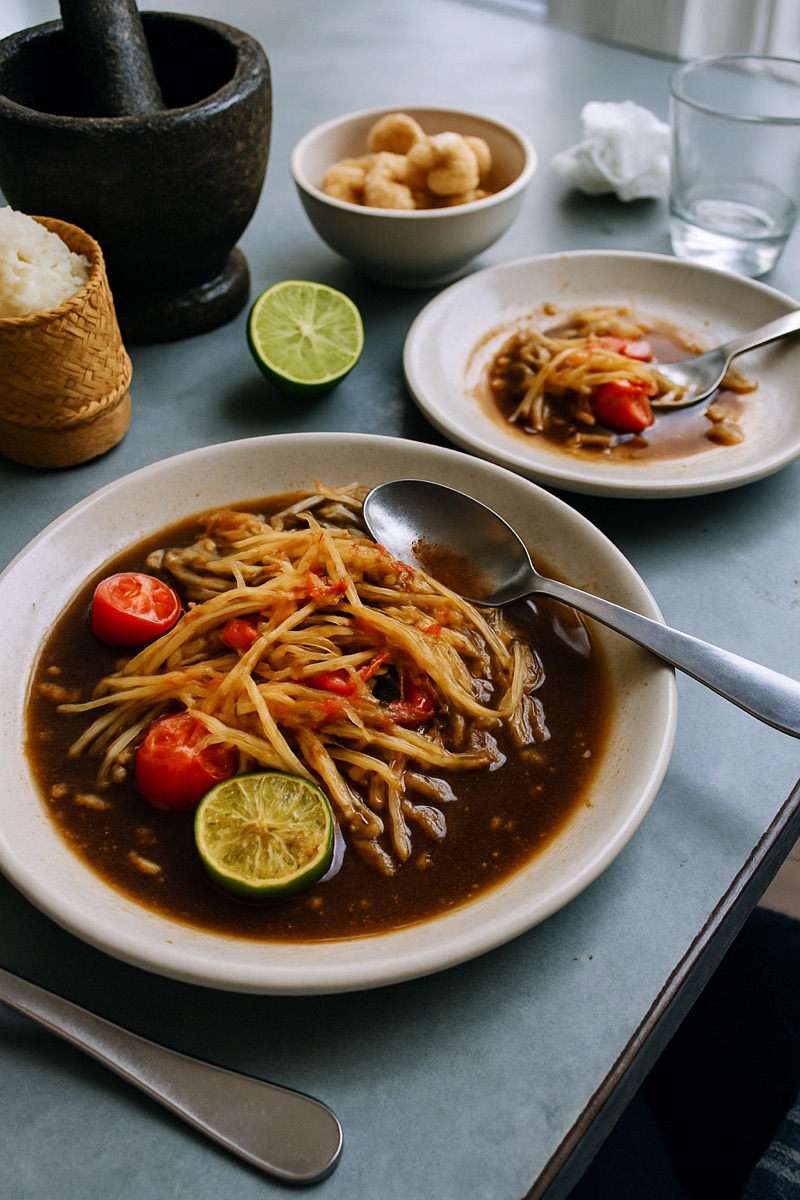 Tam mak hoong🇱🇦 Laos · 20 minutes
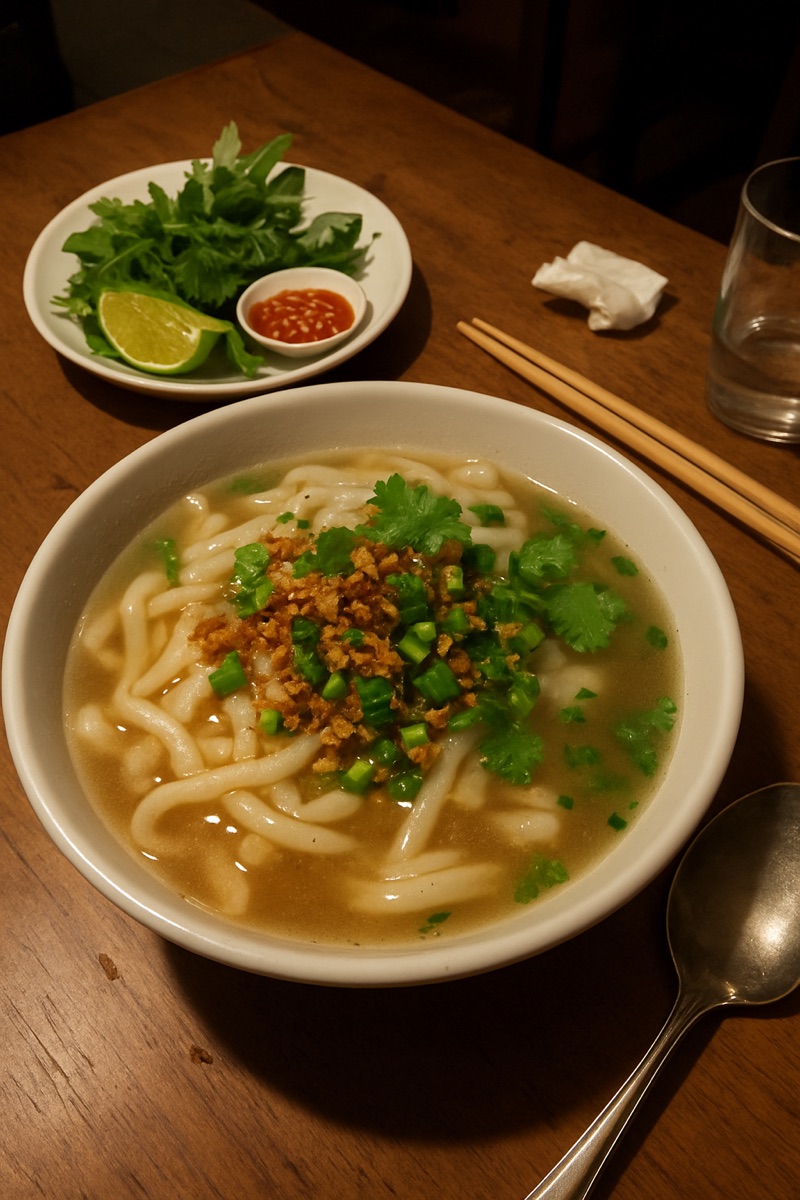 Khao piak sen🇱🇦 Laos · 1 hour and 30 minutes
Questions people ask
What is the most popular food in Laos?
Sticky rice, eaten at almost every meal, together with laap and green papaya salad (tam mak hoong). These three are often described as the core of Lao cuisine, and laap is the dish most often named as the national dish.
What do people in Laos eat for breakfast?
Noodle soups such as khao piak sen, khao poon, Lao khao soi and feu, the Lao rice noodle soup. In towns, a baguette with pâté and a glass of Lao coffee with condensed milk is also common, and khao jee, sticky rice patties grilled with an egg coating, is sold at street stalls.
Is Lao food spicy?
Often, yes. Chilli goes into salads, dips and stews, and the French explorer Henri Mouhot noted in the 19th century that Laotians adored chilli peppers. The heat is balanced by plain sticky rice and plates of raw greens, and Lao savoury dishes are never sweetened.
What is the difference between Lao and Thai food?
Many dishes are shared, because millions of ethnic Lao live in northeastern Thailand. Lao cooking relies more on sticky rice, padaek and bitter greens, uses less coconut milk and no sugar in savoury dishes, while Bangkok versions of laap and papaya salad are usually sweeter and milder.
How do you eat sticky rice in Laos?
By hand. Take a little rice from the shared basket, press it into a small ball, and use it to scoop up laap, a dip or a piece of grilled meat. Spoons were traditionally used only for soups and white rice, and chopsticks only for noodles.
Keep reading
- What is the national dish of Laos?
- Traditional food of Brunei: 12 dishes to know
- Traditional food of Cambodia: 12 dishes to know
- Traditional food of Indonesia: 13 dishes to know
- Traditional food of Malaysia: 13 dishes to know
- Traditional food of Myanmar: 12 dishes to know