 COPPER
What is the national dish of Thailand?
Thailand has no official national dish. Pad thai, stir-fried rice noodles with egg, tamarind, fish sauce and peanuts, is the one most often named, partly because the government promoted it in the mid-20th century. Tom yum kung, a hot and sour prawn soup, was inscribed by UNESCO as intangible cultural heritage in 2024. Pad krapow and som tam are the other everyday contenders.
Why Thailand has several answers
No Thai law names a single national dish. Lists of national dishes give four for Thailand: pad thai, pad krapow (also spelled pad kaphrao or gaprao), tom yum kung and som tam.
Each has a different kind of claim. Pad thai has a political history, tom yum kung has official heritage status, and pad krapow and som tam are what many Thais actually eat for lunch.
Pad thai: the dish built for the nation
Pad thai is rice noodles stir-fried in a wok with egg, firm tofu, tamarind, fish sauce, dried shrimp, garlic and shallots, served with lime and crushed peanuts. Its full original name was kuai tiao pad thai; kuai tiao is a borrowing from Teochew Chinese for flat rice noodles.
The usual account is that during the Second World War, faced with a rice shortage, the government of Prime Minister Plaek Phibunsongkhram promoted rice noodles, and pad thai became part of a campaign to build a modern Thai identity. Historians still debate the details, but they agree the dish is a 20th-century creation, not an ancient one.
There is a second theory. Thai-American food writer Kasma Loha-unchit argues the dish was created by Thai Chinese cooks, pointing out that a dish named "Thai" in its own country suggests an origin that is not Thai. Noodle cooking across Southeast Asia came largely with immigrants from southern China.
Since at least 2001, the Thai government has used pad thai abroad as soft power, backing a programme to open Thai restaurants worldwide.
Much of pad thai is added at the table. Bean sprouts, garlic chives, chilli, lime wedges and roasted peanuts are usually served on the side, so each person adjusts the sweet, sour and hot balance. Vegetarian versions swap the fish sauce for soy sauce and leave out the shrimp.
Tom yum kung: the one with official status
Tom yum is a family of hot and sour soups; tom yum kung is the prawn version. Lemongrass, kaffir lime leaves, galangal and chillies are bruised and simmered, then fish sauce and lime juice go in at the end, because heat destroys their flavour.
There are two main styles. Tom yum nam sai is a clear broth; tom yum nam khon, a variation from the 1980s, is finished with evaporated milk for a creamier soup. Before mass tourism, the most common form was tom yam pla, a clear fish soup eaten with rice; the prawn version is the one visitors know.
It is the only contender with formal recognition. Thailand registered tom yum kung as National Cultural Heritage in 2011, and on 3 December 2024 UNESCO inscribed it on the Representative List of the Intangible Cultural Heritage of Humanity.
Pad krapow: what Thais eat every day
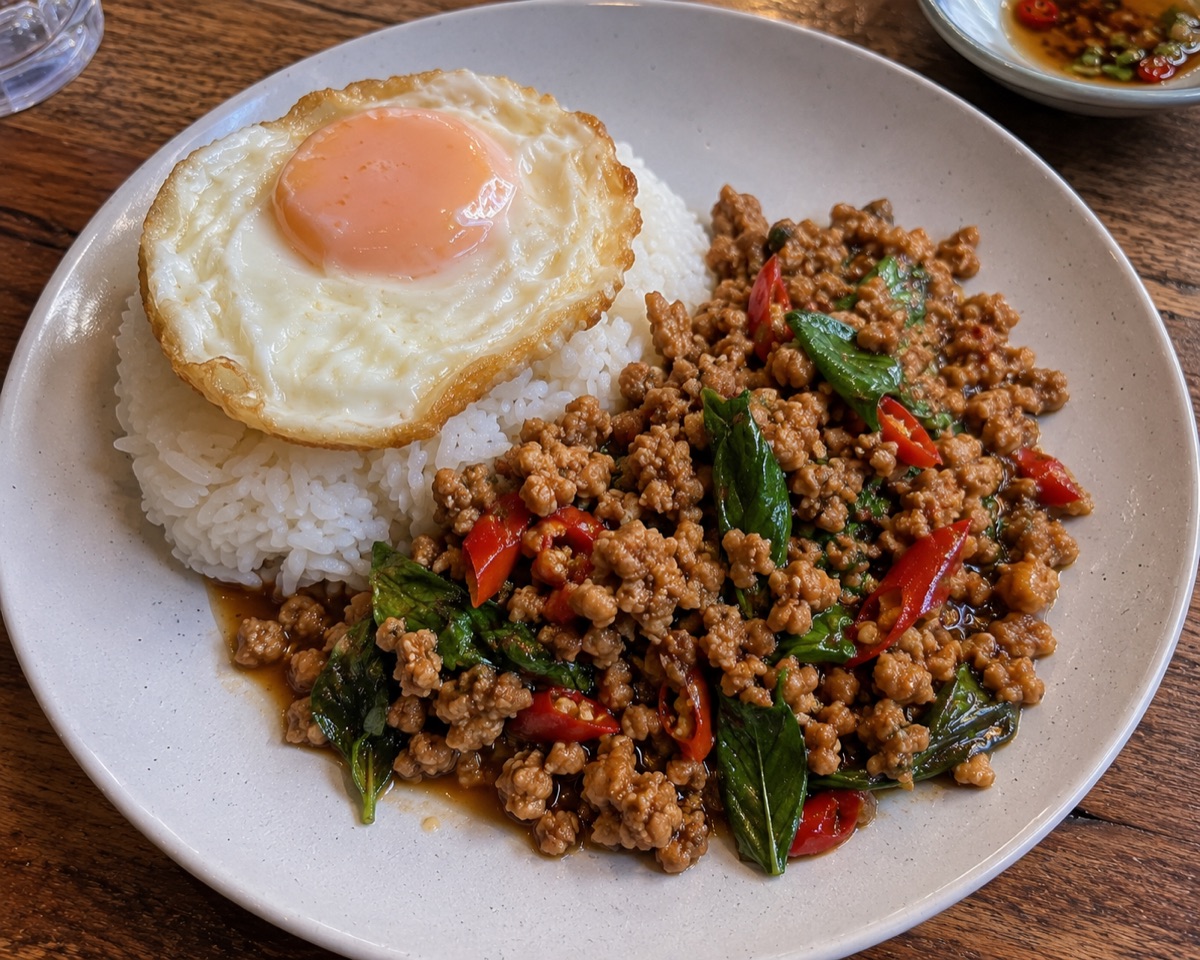
Pad krapow is meat stir-fried with holy basil, garlic and bird's eye chillies, served on rice, often under a fried egg. It appeared under King Rama VII (1925–1935), when Chinese immigrants began selling it in restaurants, and became widespread after 1957.
In our pad krapow moo recipe, pork mince is pressed flat in a smoking wok to catch colour, sauced with oyster, soy and fish sauce, and the basil goes in only after the heat is off, so it wilts without losing its peppery scent. The egg is fried in very hot oil until the edges blister and the yolk stays soft.
Other dishes to know from Thailand
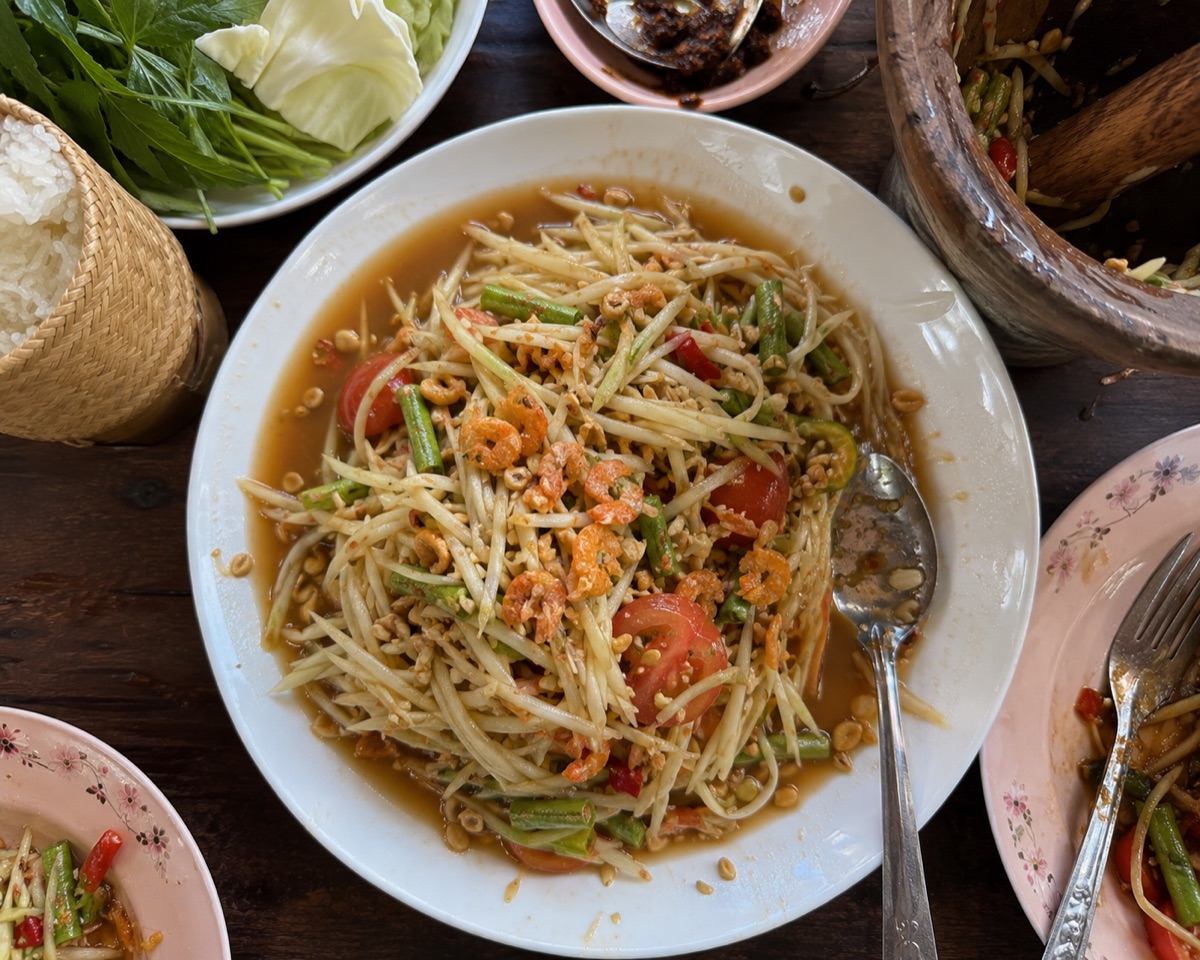
Som tam, green papaya salad, is pounded in a mortar with garlic, chilli, palm sugar, lime and fish sauce, then long beans, tomatoes, peanuts and dried shrimp. The shredded papaya is soaked 15 minutes in iced water first so it stays crisp, and pounded gently so it drinks the dressing without turning to mush. It is believed to have been created by the Lao people and reached Thai cooking through Isan, the northeast. Laos counts it among its own national dishes; see the national dish of Laos.
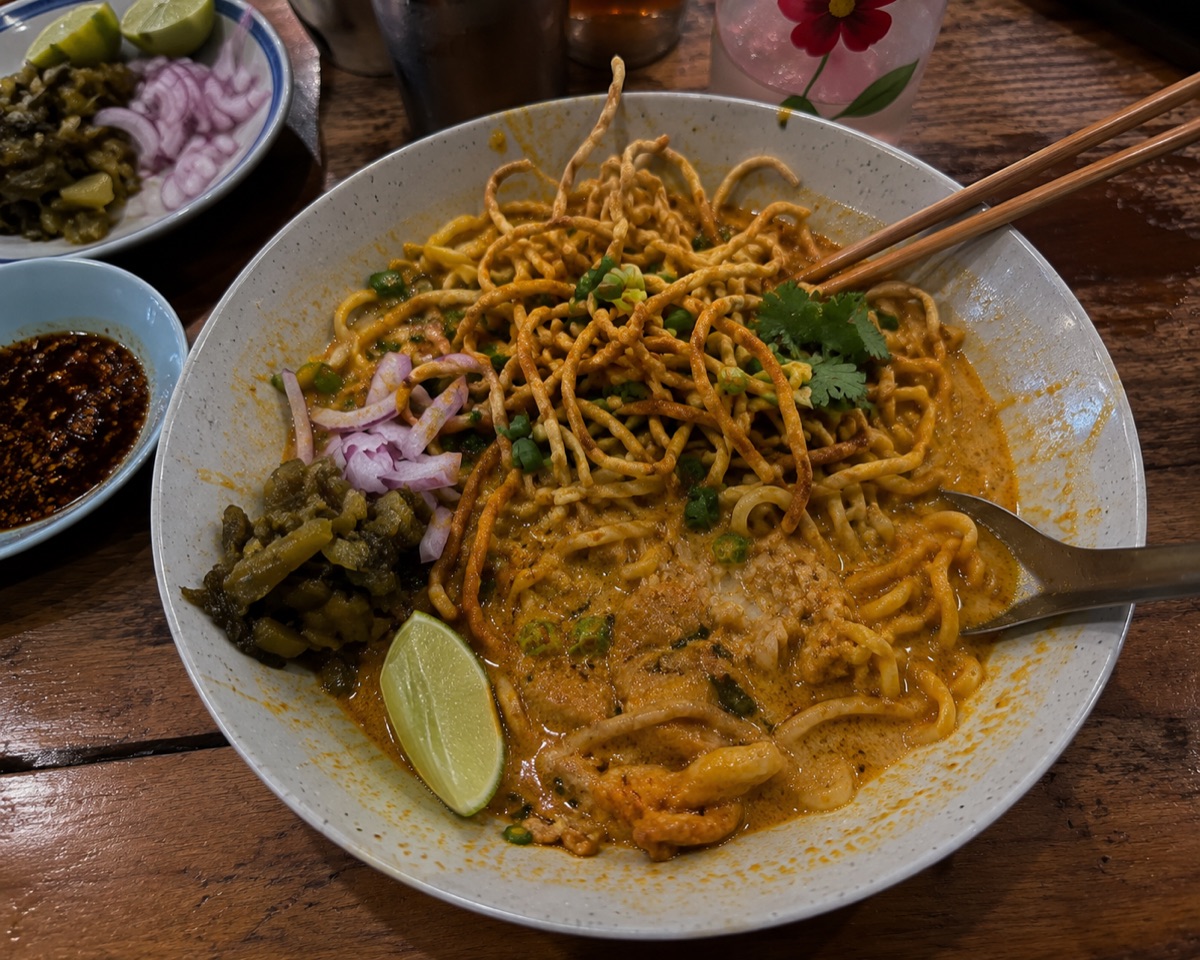
Khao soi is the curry noodle soup of Chiang Mai, with the same egg noodles used twice: boiled underneath, fried crisp on top. It is believed to have come with Chin Haw, Chinese Muslim traders from Yunnan who travelled the caravan routes through the region, and it is served with sliced shallots, pickled mustard greens and lime on the side. A close relative, ohn no khao swè, is eaten in Myanmar.
Thai food sits within the wider Southeast Asian kitchen. You will find all three recipes, with ingredients and step-by-step methods, on our page about the food of Thailand.
The recipes
 Som tam
 Khao soi
Questions people ask
Is pad thai the official national dish of Thailand?
No. Thailand has no official national dish. Pad thai is the most often named because the government promoted it in the 1930s and 1940s, but tom yum kung is the only contender with formal heritage status.
Is tom yum a UNESCO heritage dish?
Yes. Tom yum kung was inscribed on UNESCO's Representative List of the Intangible Cultural Heritage of Humanity on 3 December 2024, after being registered as Thai National Cultural Heritage in 2011.
Is som tam from Thailand or Laos?
Green papaya salad is believed to have been created by the Lao people and spread through Thailand from the Isan region, where most people are ethnically Lao. Both countries now consider it their own.
What is the difference between pad thai and pad krapow?
Pad thai is stir-fried rice noodles with tamarind, egg and peanuts. Pad krapow is minced meat stir-fried with holy basil, garlic and chilli, served on rice with a fried egg.
How do you pronounce pad krapow?
It is roughly "pat ka-prao", from the Thai phat kaphrao, meaning stir-fried holy basil.
Keep reading
- Traditional food of Thailand: 13 dishes to know
- What is the national dish of Brunei?
- What is the national dish of Cambodia?
- What is the national dish of Indonesia?
- What is the national dish of Laos?
- What is the national dish of Malaysia?