 COPPER
What is the national dish of India?
India has no official national dish. In 2017, reports that khichdi, a one-pot dish of rice and lentils, would be declared the national dish led the food processing minister to say the government had no such plan. Khichdi, biryani, dal, butter chicken, chaat, idli and dosa are the dishes most often suggested, but each belongs to a region more than to the whole country.
Does India have a national dish?
No. India has never designated one, and the question came up publicly only once. In 2017 the Indian government was promoting khichdi abroad as the "queen of all foods", and Indian media began calling it the national dish. Opposition politicians mocked the idea.
The Minister of Food Processing Industries, Harsimrat Kaur Badal, then clarified that khichdi was considered a nutritious, healthy food but that the government had no plans to designate a national food. That is still the position today.
Food reference works say the same thing. India is usually given as an example, alongside Mexico and China, of a country whose populations and regional cuisines are too varied for a single national dish, even an unofficial one.
The dishes most often named
When people do try to pick one, the same handful of names comes back:
Khichdi has the strongest claim to being everyday food. In several regions, especially in the north, it is one of the first solid foods babies eat, and it was the model for the Anglo-Indian dish kedgeree. In the south the same idea takes other names, such as pongal in Tamil Nadu.
- Khichdi: rice and lentils cooked together. The traveller Ibn Battuta described it in India around 1350, and the 16th-century Ain-i-Akbari gives seven versions of it.
- Biryani: rice cooked with spices and meat, the dish some Indian travel magazines put forward as the national dish.
- Dal: spiced lentils, the pulse dish that sits next to rice or bread at most everyday meals.
- Dosa and idli: South Indian breads made from a fermented batter of rice and black gram.
- Butter chicken and chaat: a North Indian restaurant curry and a family of savoury street snacks.
Why one dish cannot speak for India
The cook Madhur Jaffrey points out that India is larger than Europe without Russia, and that its states have cuisines as different from one another as those of European countries. The climate runs from coconut palms in the tropical south to the Himalayas in the north.
What the regions share is a structure rather than a recipe. The food writer Alan Davidson describes Indian meals as a cereal, rice or wheat, eaten with savoury dishes that often contain pulses and vegetables. Religion also shapes the table: many Hindu communities do not eat beef, and many dishes are vegetarian by default.
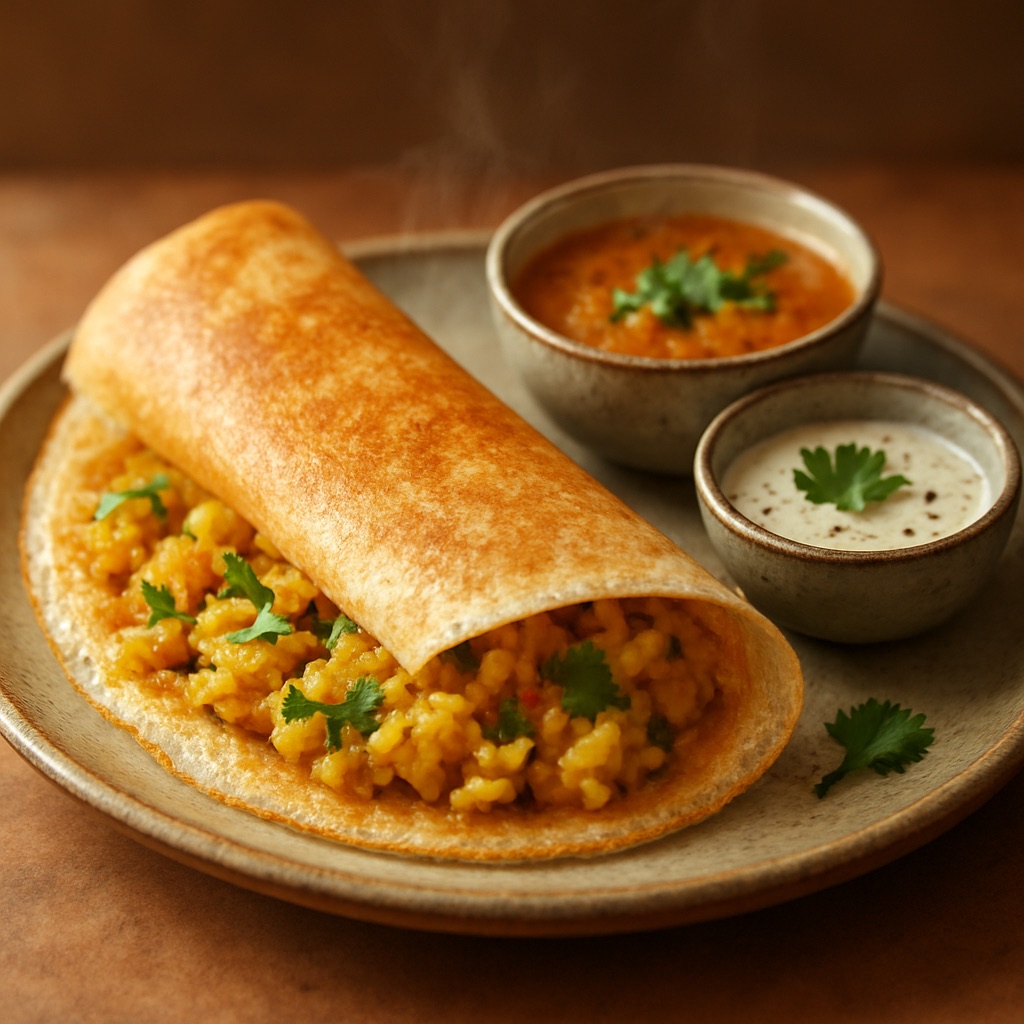
That is why the three Indian dishes in Copper come from three different parts of the country: a dosa from the south, pav bhaji from Mumbai in the west and rajma from the north.
Masala dosa: the South Indian candidate
A dosa is a thin crepe of fermented rice and black gram batter. Its origin is debated: historians cite early Tamil literature, while popular tradition links it to the town of Udupi in Karnataka. The masala version, folded around spiced potatoes, is credited to the restaurateur K. Krishna Rao in Madras (now Chennai) in the 1930s.
The technique is precise. A ladle of about 100 ml of batter goes on a hot griddle and is spread thin in a spiral from the centre outwards. It is cooked on one side only, never flipped, until the underside is golden and the edges lift. The filling is boiled potato tempered with popping mustard seeds, curry leaves, ginger, green chilli and turmeric. Our masala dosa recipe gives every step.
It is eaten with coconut chutney and sambar, mostly at breakfast in the south, though it is served all day. A popular variant, the paper masala dosa, uses a thinner batter for an almost paper-thin crepe.
Dosas reached Mumbai with the Udupi restaurants of the 1930s, and after independence in 1947 South Indian food spread across the north.
Other dishes to know from India
Pav bhaji started as a quick lunch for Mumbai's textile mill workers. Potatoes, cauliflower and peas are boiled soft, then mashed straight into a buttery tomato and onion masala and simmered 8 to 10 minutes until thick. It is eaten with soft rolls toasted in butter, raw onion and lime. Variants include cheese, paneer and Jain pav bhaji, the last made without onion or garlic.
Rajma chawal is everyday food in North India: red kidney beans, a crop that came from Mexico, soaked at least 8 hours, boiled about 45 minutes, then simmered in an onion and tomato masala cooked until the fat separates, and served over basmati.
Khichdi is eaten well beyond India's borders, in Pakistan, Bangladesh, Nepal and Sri Lanka. Compare with the national dish of Pakistan and the rest of South Asian food, or browse all three recipes on our page about the food of India.
The recipes
- Masala dosa🇮🇳 India · 45 minutes
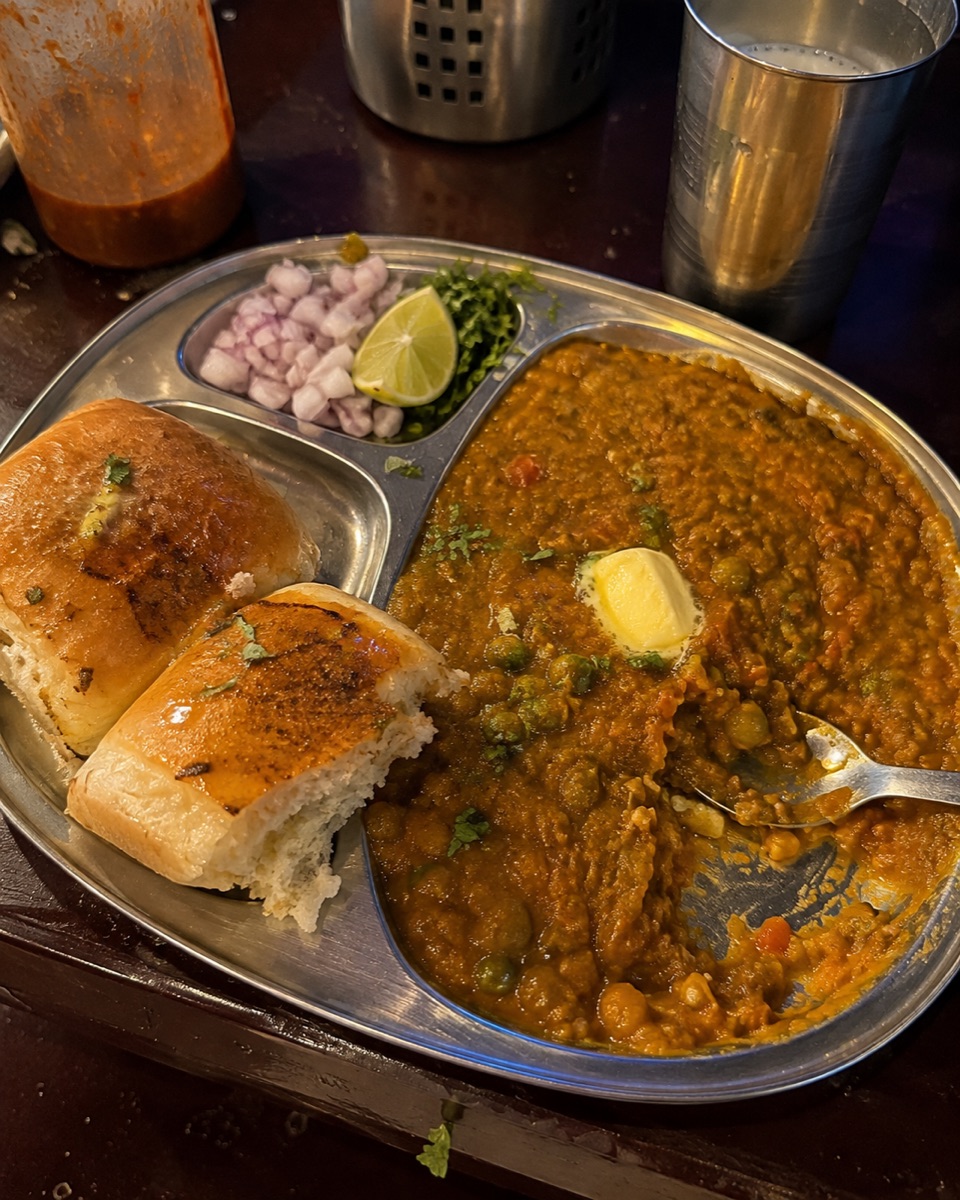 Pav bhaji🇮🇳 India · 45 minutes
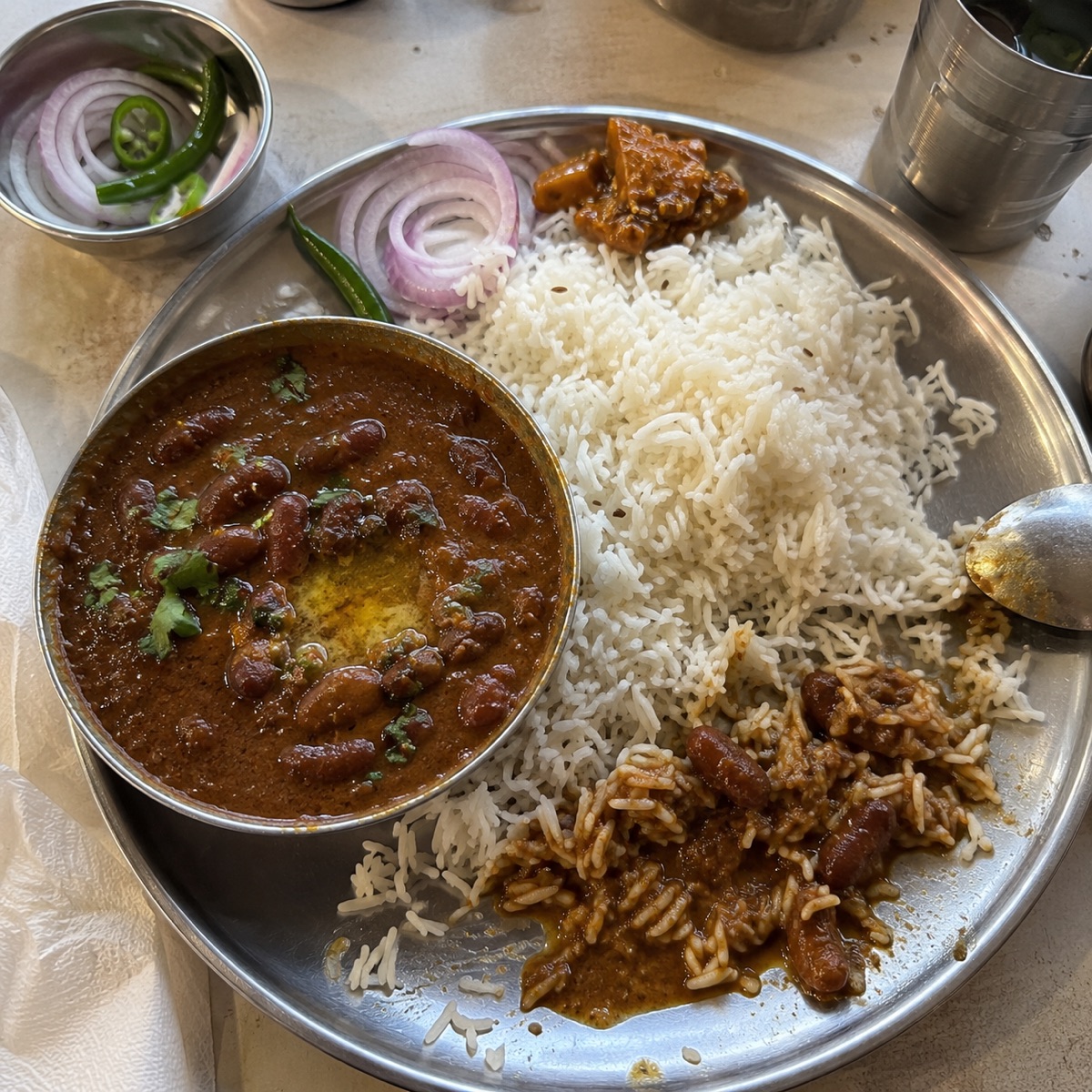 Rajma chawal🇮🇳 India · 9 hours and 30 minutes
Questions people ask
Is khichdi the national dish of India?
No. Indian media called it that in 2017, but the Minister of Food Processing Industries said the government had no plans to designate a national food.
Is biryani India's national dish?
Biryani is often suggested, but it has no official status. India has no national dish at all.
Is chicken tikka masala Indian?
It belongs to British Indian restaurant cuisine, and it is in Britain, not India, that it has been described as a national dish.
Where does masala dosa come from?
Masala dosa is South Indian. It is credited to the restaurateur K. Krishna Rao, who popularised it in Madras (now Chennai) in the 1930s. See our masala dosa recipe.
Why doesn't India have a national dish?
Its regional cuisines are as different from one another as those of European countries, so no single dish is eaten and recognised everywhere.
Keep reading
- Traditional food of India: 13 dishes to know
- What is the national dish of Bangladesh?
- What is the national dish of Bhutan?
- What is the national dish of the Maldives?
- What is the national dish of Nepal?
- What is the national dish of Pakistan?