 COPPER
What is the national dish of Spain?
Spain has no official national dish. The two most often cited are paella, a rice dish from the Valencia region cooked in a wide, shallow pan, and tortilla de patatas, a thick omelette of eggs and potatoes slow-cooked in olive oil and sold in almost every bar in the country. Paella is the better known abroad; the tortilla is eaten everywhere in Spain.
Why Spain has no single national dish
Spanish cooking is so regional that some authors speak of the "cuisines of Spain" in the plural. No law or decree picks one dish to represent the country, and none has ever settled the question.
The idea is not new. In the late 19th century the gastronome Dr. Thebussem proposed that olla podrida, a rustic stew of meat, legumes and vegetables, be served at official banquets as Spain's national dish, partly to break with the French cooking that dominated Europe at the time.
Today, Wikipedia's list of national dishes gives tortilla de patatas for Spain and paella for the Valencia region. Most English-language answers name paella, because it is the Spanish dish best known abroad. Both answers are defensible, which is why this page covers both.
Paella: Valencia's rice, Spain's best-known dish
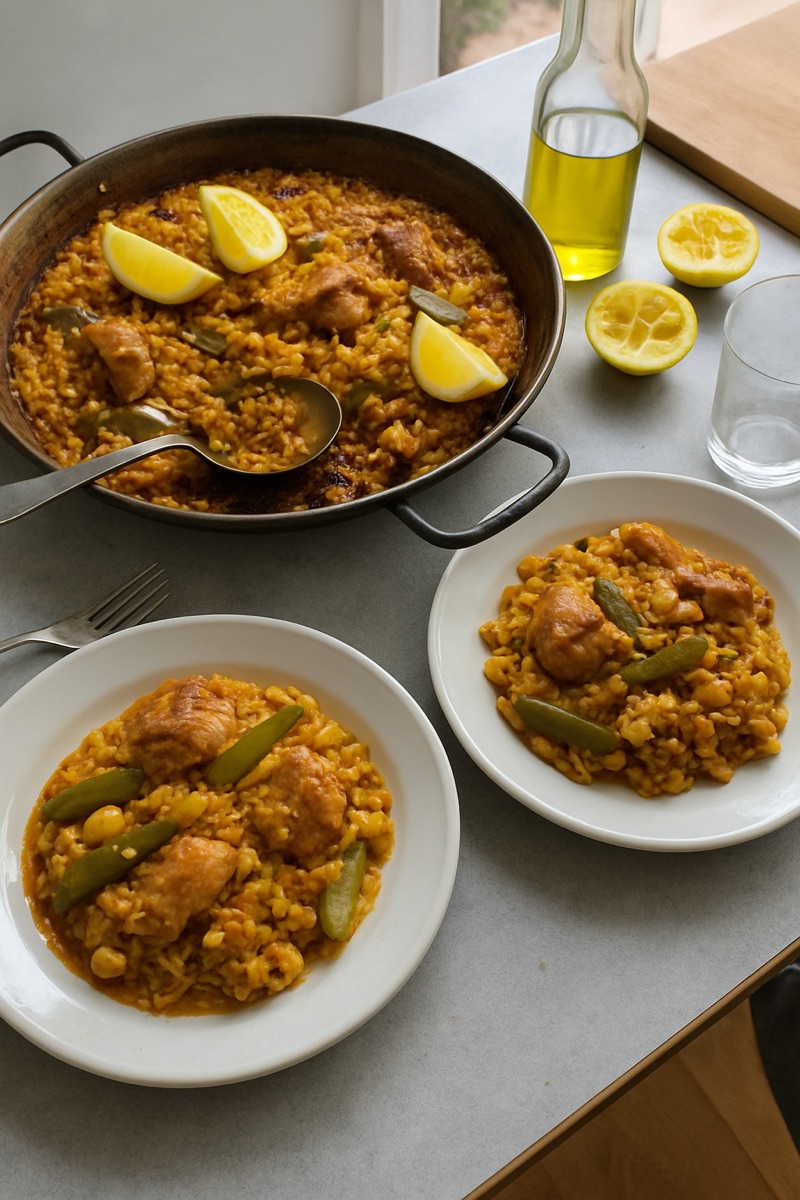
Paella comes from the Valencian Community, where it is regarded as one of the region's identifying symbols. The word means frying pan in Valencian, from the Latin *patella*, and the dish is named after the wide, shallow pan with two handles it is cooked in.
In its modern form it is traced to the mid-19th century, in the farmland around the Albufera lagoon next to Valencia, where rice was grown. Valencians recognise three versions, and insist only the first is the real thing:
- Paella valenciana: rabbit, chicken, sometimes duck and snails, flat green beans and garrofó beans.
- Paella de marisco: seafood.
- Paella mixta: a mix of meat and seafood.
How paella valenciana is made
Rabbit and chicken, cut into small bone-in pieces, brown in salted olive oil for about 20 minutes in a 50 cm pan. Flat green beans and garrofó, the large flat white bean of the Valencian huerta, fry for 5 minutes, then grated tomato and sweet paprika for barely a minute, since paprika burns in seconds.
Water goes in with saffron and a sprig of rosemary and boils hard for about 40 minutes. Only then is the bomba rice scattered evenly across the pan. From that moment nobody stirs and nobody covers it: 10 minutes on a strong fire, 8 on a low one.
At the end the rice starts to crackle. That sound is the socarrat forming, the toasted layer on the bottom of the pan, and it is the point of the dish. Follow the full method in our paella valenciana recipe.
Many Valencians hold that nothing beyond the classic list belongs in a paella valenciana, and that fish and shellfish are out of the question. The yellow colour traditionally comes from saffron, artichokes can stand in for green beans in winter, and most cooks use bomba rice, though a local variety called senia is also grown around Valencia. In Spain, restaurants traditionally put paella on the menu on Thursdays.
Tortilla de patatas: the omelette eaten all over Spain
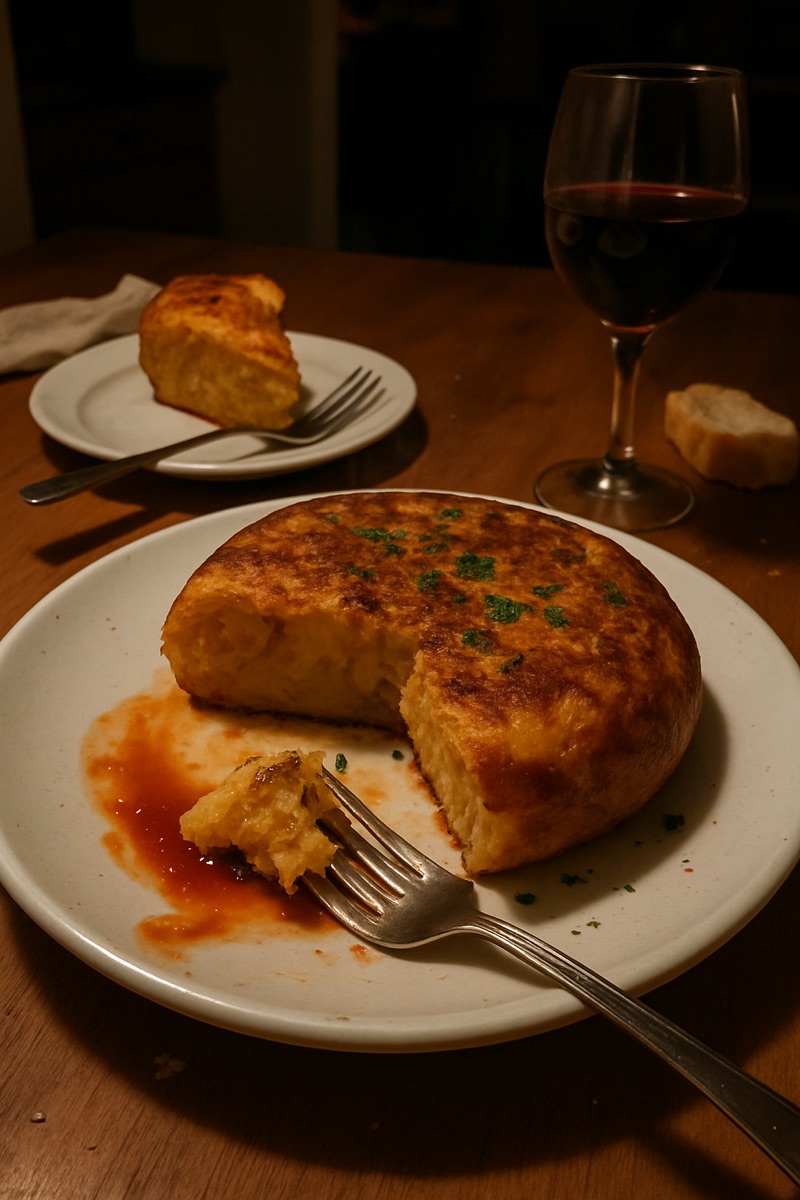
A tortilla de patatas, also called tortilla española, is an omelette of eggs and potatoes, often with onion, cooked thick and served hot, at room temperature or cold, often as a tapa. In Spain a plain egg omelette is called a *tortilla francesa*, a French omelette, to tell it apart.
The first written reference is in a Navarrese document from 1817. A popular legend credits the Carlist general Tomás de Zumalacárregui with inventing it during the 1835 siege of Bilbao, but nobody has shown that to be true.
The method is simple and slow: sliced potatoes and onion cook gently in olive oil until soft but not brown, are drained, mixed with beaten eggs and returned to the pan, then flipped with a plate to set the other side. See our tortilla española recipe.
Whether onion belongs in it divides Spain into *concebollistas* and *sincebollistas*. In a 2021 survey by the newspaper El Mundo, 72.7% of respondents preferred it with onion. The purists have their own rule: since 2018 the town of Betanzos in Galicia, which holds an annual tortilla competition, has allowed entrants only potatoes, oil, egg and salt. Galicia's own potatoes, especially the firm Kennebec variety, are often called the best for the job.
Other dishes to know from Spain
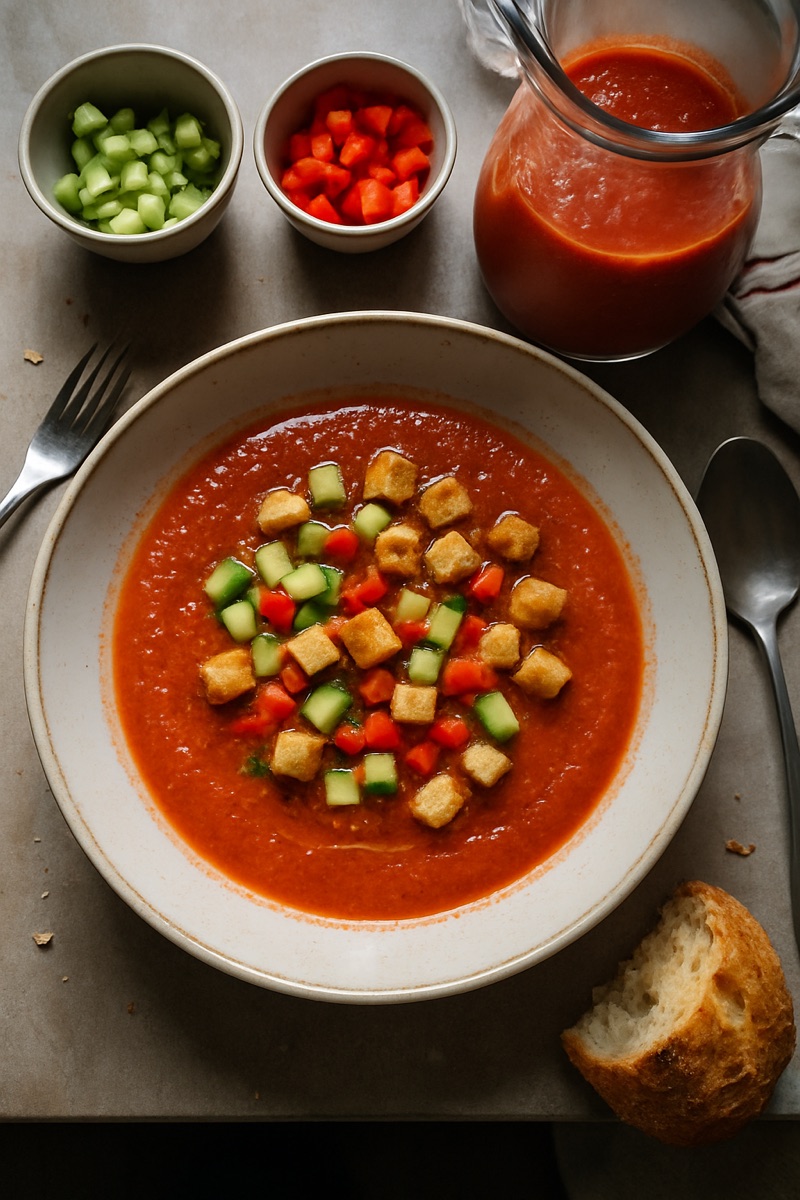
Gazpacho is the Andalusian dish that has travelled furthest: a cold soup of ripe tomatoes, green pepper, cucumber and garlic, thickened with soaked stale bread. Olive oil poured in a thin stream while the blender runs emulsifies it, which is why a proper gazpacho is pale orange rather than tomato red. It is chilled at least 2 hours and served very cold.
You will find all three dishes, with ingredients and step-by-step methods, on our page about the food of Spain. Next door, see how Portugal answers the same question.
For the neighbouring kitchens, see our guide to Western European food.
The recipes
- Paella valenciana🇪🇸 Spain · 1 hour and 50 minutes
 Tortilla española🇪🇸 Spain · 40 minutes
 Gazpacho🇪🇸 Spain · 3 hours and 35 minutes
Questions people ask
Is paella the national dish of Spain?
Not officially. Paella is a Valencian dish and Spain's best-known dish abroad, but Spain has no official national dish, and tortilla de patatas is named just as often.
Where does paella come from?
Paella comes from the Valencia region. Its modern form is traced to the mid-19th century, around the Albufera lagoon next to the city of Valencia.
Does Spanish tortilla have onion?
It depends who makes it. The question splits Spain into concebollistas and sincebollistas; in a 2021 El Mundo survey, 72.7% preferred their tortilla with onion.
What is the difference between a Spanish tortilla and a Mexican tortilla?
A Spanish tortilla is a thick potato omelette. A Mexican tortilla is a thin flatbread of corn or wheat, which is why the Spanish dish is often called tortilla española or Spanish omelette in English.
How do you pronounce paella?
In Spanish it is said roughly pa-EH-ya, and in Valencia with a soft palatal l, close to pa-EH-lya. English speakers often say py-EL-ə or pah-AY-yə.
Keep reading
- Traditional food of Spain: 12 dishes to know
- What is the national dish of Andorra?
- What is the national dish of Austria?
- What is the national dish of Belgium?
- What is the national dish of Cyprus?
- What is the national dish of France?