 COPPER
What is the national dish of Mauritius?
Mauritius has no official national dish, but dholl puri is the one most often cited: a thin, soft flatbread filled with yellow split peas ground to a dry powder, cooked on a flat griddle and sold in pairs at street stalls with bean curry, achar and chutney. It grew out of the paratha brought by Indian immigrants.
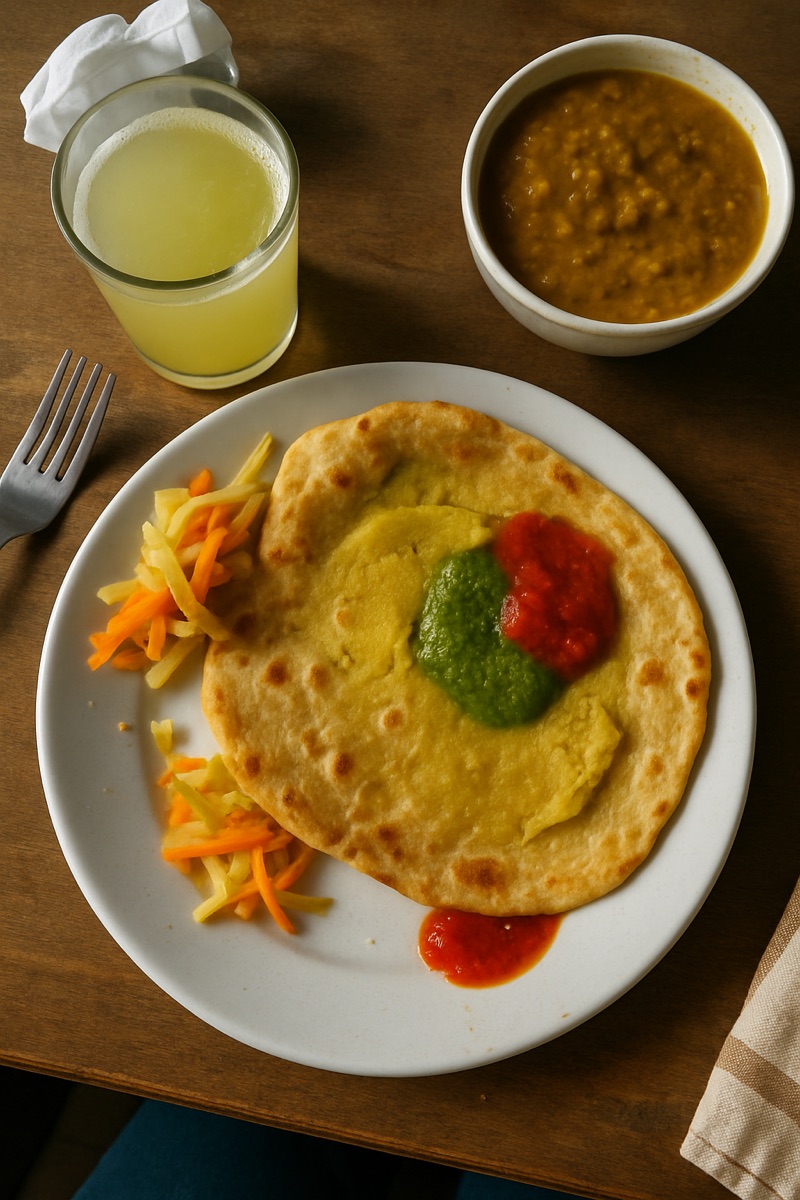
What is dholl puri?
Dholl puri (also spelled dhal puri or dalpuri) is a flatbread with the filling inside the dough. The filling is not a paste but yellow split peas, boiled with turmeric and ground with cumin into a dry, crumbly powder. Turmeric also goes into the dough, which is why both are pale yellow.
The peas are soaked overnight, boiled 30 to 40 minutes with turmeric until tender but whole, then cooled completely before grinding. That cooling is the trick: a wet paste tears the dough and leaks out. The dough is made with some of the pea cooking water, rested 30 minutes, divided into balls, filled with a heaped spoonful of powder and rolled out to about 18 cm.
It is cooked on a dry *tawa*, an Indian flat griddle, 1 to 2 minutes per side with a light brush of oil. A good dholl puri stays soft and foldable, with only small brown spots, never crisp. You can follow each step in our dholl puri recipe.
How dholl puri is eaten
In Mauritius dholl puri is street food. Stalls all over the island sell them hot, usually in a pair, folded around a few spoonfuls of accompaniment:
Getaway's food writer named Dewa, in Rose-Hill, as the place to find the best ones.
- Bean curry: butter bean or *gros pois* curry, the standard filling.
- Rougaille: a thick tomato sauce scented with thyme.
- Achar: pickled vegetables in oil and spices.
- Chutney: fresh and sharp, with chilli.
Where dholl puri comes from
Dholl puri is generally traced to the Indian paratha. Indian immigrants, many of whom came as indentured labourers in the 19th century, could not find all the ingredients they used at home, and the split-pea-filled flatbread is the version that took shape on the island.
Those communities arrived in layers: French settlers, enslaved Africans, Indian indentured labourers and, in the 19th century, Chinese migrants. Each kept some dishes of its own and borrowed others. That is why a Mauritian lunch counter can sell dholl puri next to fried noodles, *bol renversé* (rice topped with a stir-fry, turned out of a bowl), *boulettes* (fish and meat balls in broth) and *halim*, a spiced lentil and meat soup.
Mauritian cooking grew out of French, African, Indian and Chinese kitchens, and many dishes are now shared across communities. Street stalls selling dholl puri are found all over the island, which is why travel writers say that if Mauritius had a national dish, it would probably be this one.
The island's other everyday flatbread is *farata*, a layered bread close to the paratha, eaten with curry. A plain *roti* with tomato sauce and pickles is just as common, and a *sept-cari* (seven curries served together, like an Indian thali) is the festive spread.
Is dholl puri the official national dish?
No. There is no law or government declaration naming a Mauritian national dish. Dholl puri's status comes from usage and from how often guides and food writers single it out. French-language references list several "national dishes" side by side: dholl puri, faratha, biryani, mines (fried noodles), vindaye and rougaille.
The same mix shows in the neighbouring islands: Seychelles, also Creole, has no single national dish and leans more on fish and coconut.
Other dishes to know from Mauritius
Rougaille is the Creole base of the island: tomatoes cooked down with onion, garlic, ginger, thyme and curry leaves, then simmered with meat, fish or, most often, smoked sausages. Mauritian curries rarely use coconut milk and often use European herbs like thyme. Our rougaille recipe uses smoked Creole sausages.
A plain version, *rougaille touni* ("naked rougaille"), is just the tomato sauce served as a side dish.
Briani, the Mauritian biryani, comes from the island's Muslim community. Its signature is fried potatoes cooked inside the marinated meat under parboiled rice, in a pot sealed so no steam escapes. See our Mauritian biryani recipe. The chicken marinates 4 hours in yoghurt, garlic, ginger and biryani masala, and the sealed pot cooks 35 to 40 minutes on the lowest heat without the lid ever being lifted.
Vindaye is another dish you will meet everywhere: fish or vegetables in a sharp mixture of vinegar, mustard seeds and turmeric, a Mauritian take on vindaloo. Rice remains the staple underneath almost everything, boiled, fried or cooked into one-pot dishes.
You will find all three dishes on our page about the food of Mauritius, and the neighbouring islands in our guide to East African food.
The recipes
- Dholl puri🇲🇺 Mauritius · 14 hours and 30 minutes
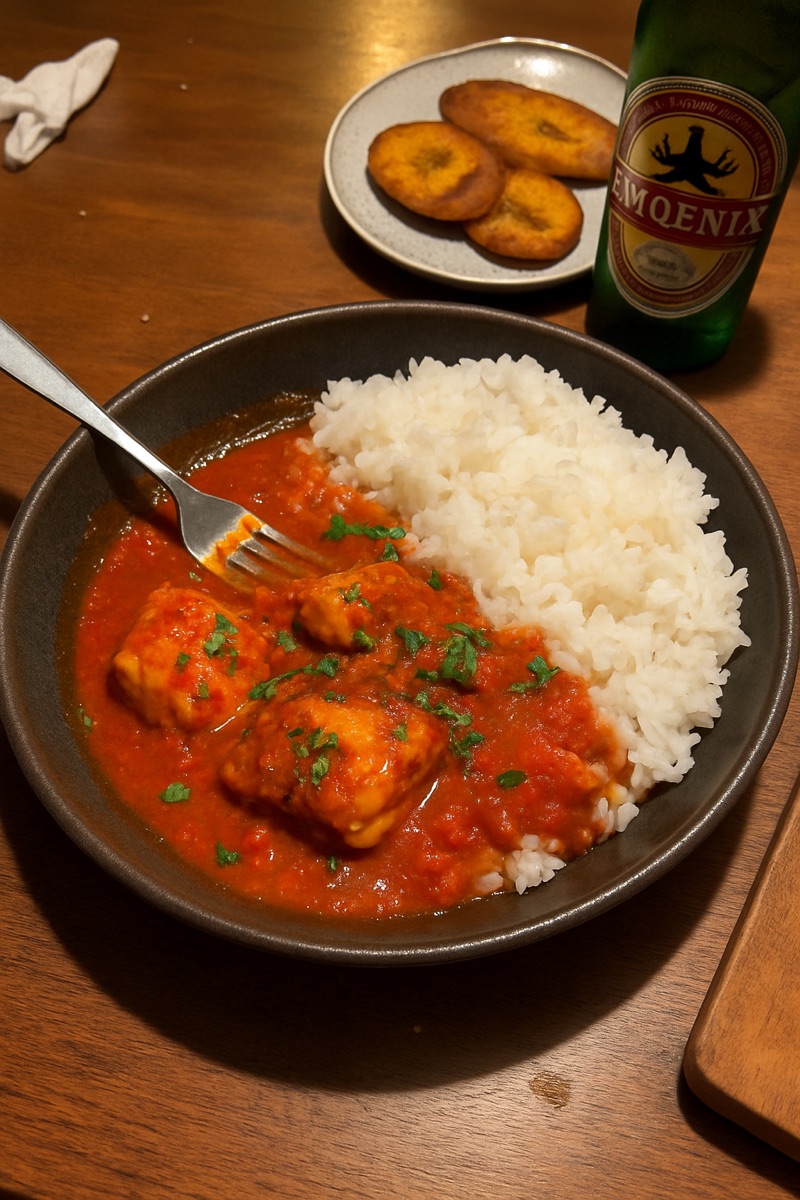 Rougaille🇲🇺 Mauritius · 55 minutes
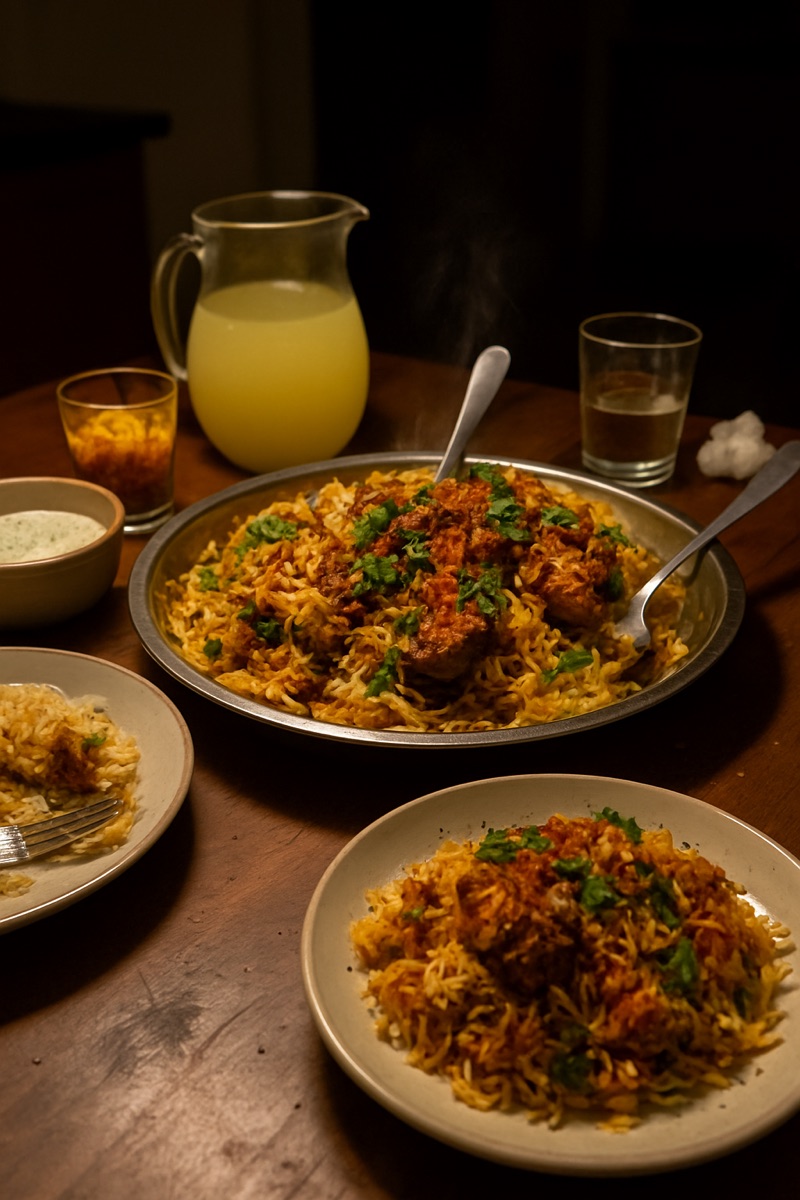 Biryani🇲🇺 Mauritius · 6 hours
Questions people ask
Is dholl puri Indian or Mauritian?
It comes from the Indian paratha, but the split-pea-filled version sold in pairs with bean curry is a Mauritian creation, made by Indian immigrants with what the island offered.
What is the difference between dholl puri and farata?
Dholl puri is filled with ground yellow split peas. Farata (faratha) is a plain layered flatbread close to the Indian paratha, with no filling.
What is served with dholl puri?
Bean curry, tomato rougaille, achar and chutney, folded inside the bread.
Does Mauritius have an official national dish?
No. Dholl puri is the dish most often cited, but no law or decree gives it official status.
Is Mauritian food spicy?
Chilli is used generously, often served on the side as a paste or in chutneys, so you can control the heat.
Keep reading
- Traditional food of Mauritius: 14 dishes to know
- What is the national dish of Burundi?
- What is the national dish of Comoros?
- What is the national dish of Djibouti?
- What is the national dish of Eritrea?
- What is the national dish of Ethiopia?