 COPPER
What is the national dish of South Sudan?
The dish most often named as the national dish of South Sudan is kisra: a paper-thin, slightly sour flatbread made from fermented sorghum batter, swept across a hot griddle and cooked on one side only. It is folded and used to scoop up stews such as molokhia. It has no official status and is shared with Sudan, where it is just as central.
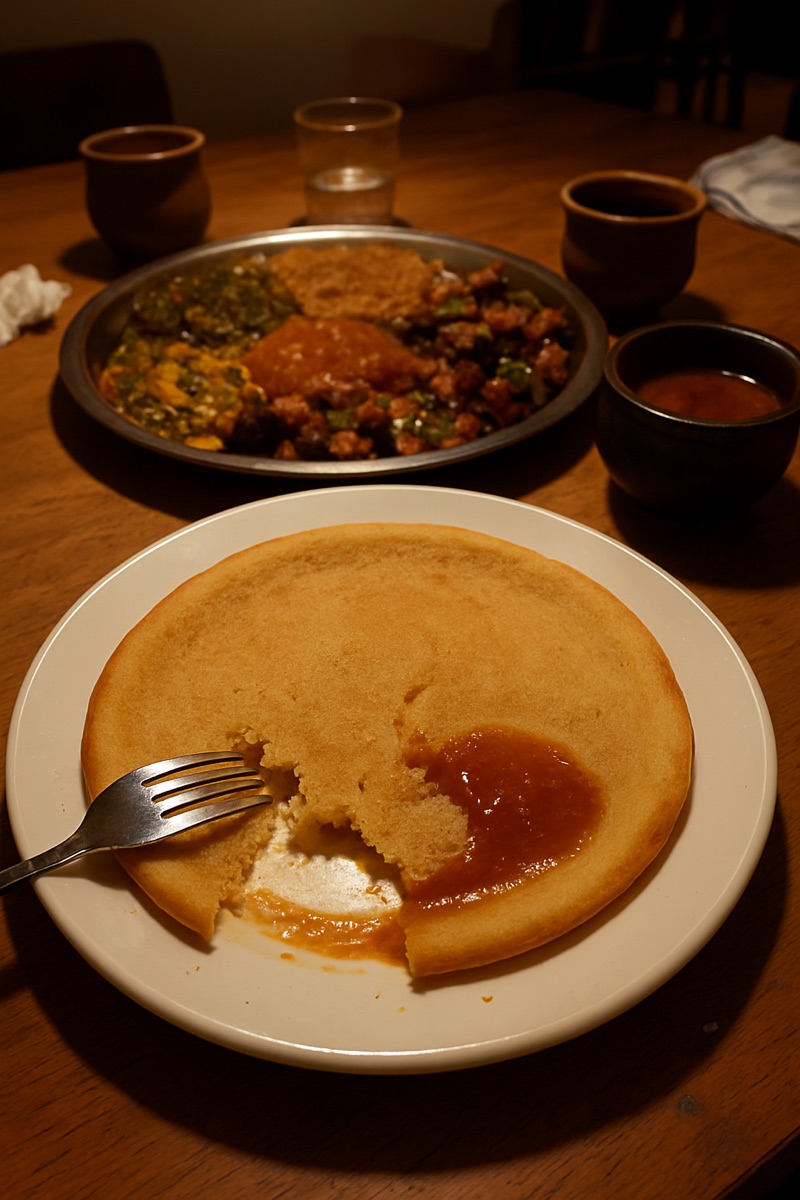
What is kisra?
Kisra (also spelled kissra) is a fermented bread made from sorghum, called *durra*, or sometimes wheat. It is eaten in Sudan, South Sudan and Chad, and as far as Algeria and parts of Uganda and Kenya. South Sudanese cooking rests on grains, maize and sorghum above all, and kisra is the sorghum staple.
It comes in two forms: *kisra rhaheefa*, the thin baked sheets, close to Ethiopian injera, and *kisra aseeda*, a thick porridge from the same flour. When people say kisra, they usually mean the sheets.
The wider pantry is broad: yams, potatoes, beans, lentils and peanuts, okra, goat, mutton and chicken, and fish near the rivers and lakes. Meat is boiled, grilled or dried. Arab cooking has also left its mark, visible in dishes like ful (stewed fava beans) and tamia (falafel).
How kisra is made
Kisra-making is traditionally women's work and is done early in the morning. Sorghum flour is mixed with water and left to ferment overnight into a sour batter; a ladle of an older batch or a little yoghurt speeds up the starter.
Traditionally, sorghum is soaked in water for an hour, then ground up to three times on a saddle quern into a fine flour, which is dried in the sun. In cities, families can buy machine-ground flour at the market. Fermentation does more than add sourness: it helps suppress the growth of bacteria in the batter.
The batter is then poured onto an oiled griddle, the *saj* or *douka*, and swept across it with a flat scraper into a layer as thin as paper. It cooks in about 30 seconds to 2 minutes, on one side only, until it dries and the edges lift. Our kisra recipe gives the quantities for a home griddle.
Two sorghum varieties, *feterita* and *tabat*, are commonly milled for the fermented flour. The scale is large: in 1995, the then-undivided Sudan was estimated to eat 20,000 to 30,000 short tons of sorghum flour a year as kisra.
What is served with kisra?
Kisra is never eaten alone. The sheets are stacked, folded into quarters, and torn to pick up stews, about 2 to 3 sheets per person:
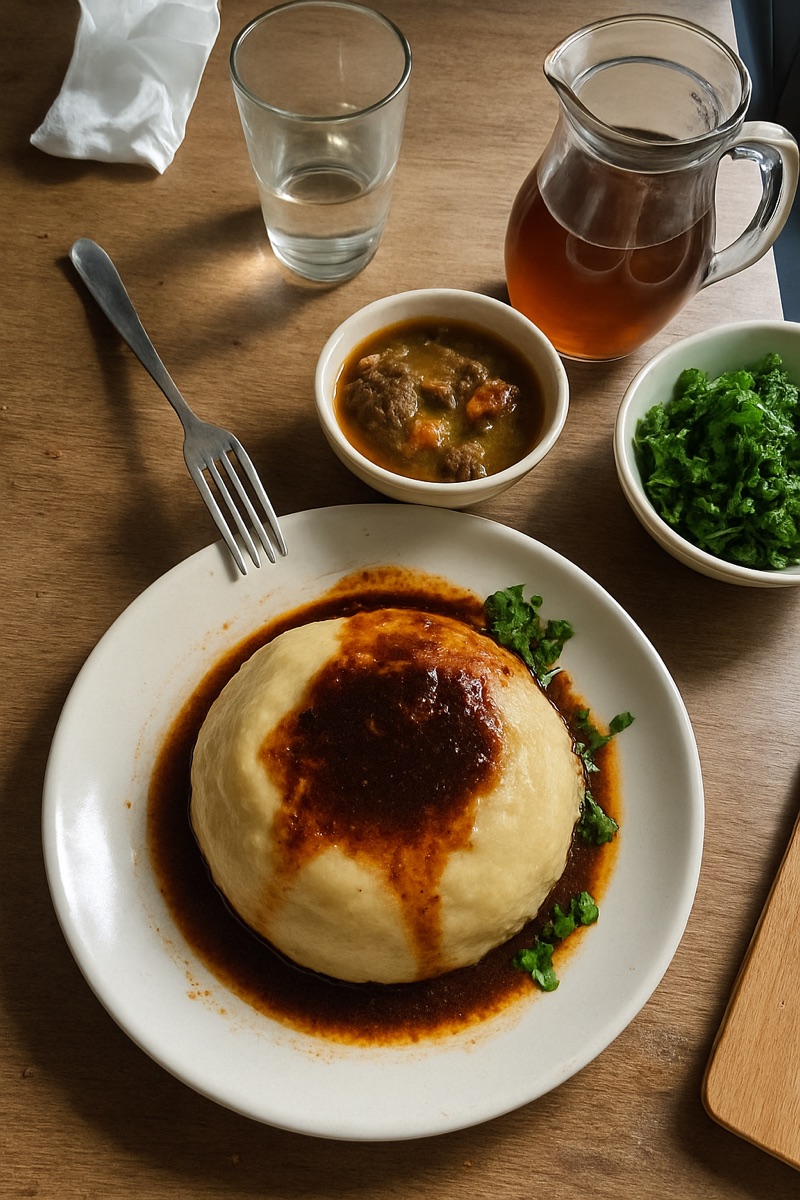
With the porridge form, asida, the rule is to eat from the edge: you cut into the dome where it meets the stew and work inward. Peanuts thread through the whole table, as a sauce, as a thickener and even as a dressing for a simple tomato salad, and *salaat zabadi* mixes carrot, cucumber and tomato with local yoghurt.
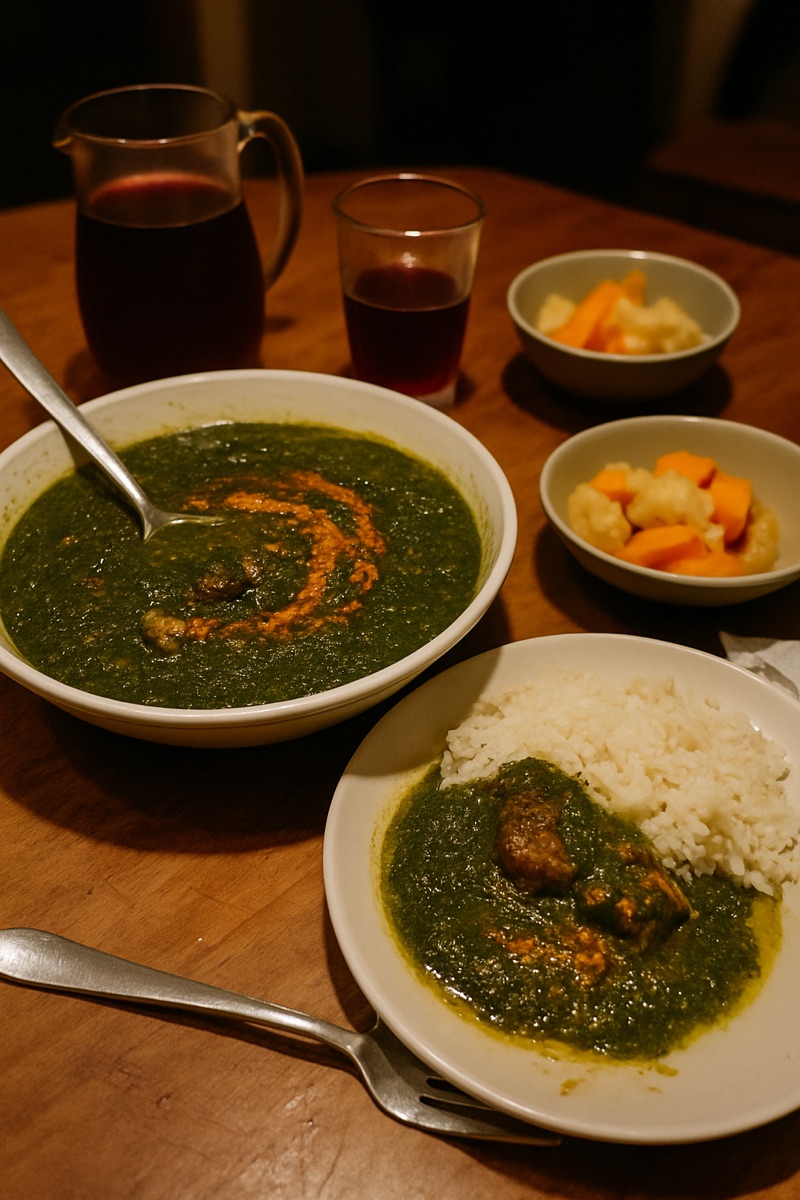
- Molokhia: jute mallow leaves stewed in lamb broth until slippery and green, finished with garlic and dill.
- Mullah: a meat and tomato or okra stew, the classic partner of kisra in Sudan and South Sudan.
- Combo: spinach cooked with peanut butter and tomato, sometimes with meat.
- Goat stew: chunks of goat with onion and a touch of chilli.
Is kisra really the national dish?
There is no law or decree naming a South Sudanese national dish. Kisra is the dish most often given, including in Wikipedia's article on South Sudanese cuisine, but several travel guides simply list it as one staple among others, alongside *wala-wala*, balls of millet porridge.
It is also shared: kisra is the everyday bread of Sudan, from which South Sudan separated, so the national dish of Sudan story overlaps closely. Any honest answer is that kisra is the most cited, not an official, national dish.
Other dishes to know from South Sudan
Asida (aseeda) is the porridge side of the same sorghum: a fermented batter stirred hard into boiling water until it forms a thick mass, set in an oiled bowl, turned out as a dome and surrounded with stew. It is eaten savoury, without sugar. See our asida recipe.
Molokhia is the green stew most often eaten with kisra; it must stay at a bare tremble, or the leaves separate from the broth. Our molokhia recipe explains why garlic and dill go in only at the end. Peanuts also run through the cuisine, as sauce, thickener and dressing.
Other names to look for: *gurassa*, a thicker yeasted pancake; *kajaik*, a fish stew; *mandazi*, a fried pastry; and *ful sudani*, a peanut sweet. Coffee and *karkade*, a hibiscus tea, are the everyday drinks. In 2025, CNN listed kisra among the world's 50 best breads.
All three recipes are on our page about the food of South Sudan, and the neighbouring kitchens are covered in our guide to East African food.
The recipes
- Kisra🇸🇸 South Sudan · 18 hours and 20 minutes
 Asida🇸🇸 South Sudan · 12 hours and 40 minutes
 Molokhia🇸🇸 South Sudan · 1 hour and 40 minutes
Questions people ask
Is kisra from Sudan or South Sudan?
Both. Kisra is eaten across Sudan, South Sudan and Chad, and the dish predates South Sudan's independence.
Is kisra the same as injera?
They are close: both are fermented flatbreads cooked on one side. Injera is made from teff, while kisra is made from sorghum and spread paper-thin.
What is the difference between kisra and asida?
They use the same sorghum flour. Kisra is a thin sheet cooked on a griddle; asida is a thick porridge stirred in boiling water and served as a dome with stew.
How do you eat kisra?
Fold the sheets into quarters, tear off a piece and use it to scoop up stews such as molokhia or mullah.
Is kisra gluten-free?
When made only from sorghum flour, yes, since sorghum contains no gluten. Some versions use wheat, which does.
Keep reading
- Traditional food of South Sudan: 12 dishes to know
- What is the national dish of Burundi?
- What is the national dish of Comoros?
- What is the national dish of Djibouti?
- What is the national dish of Eritrea?
- What is the national dish of Ethiopia?