 COPPER
What is the national dish of Senegal?
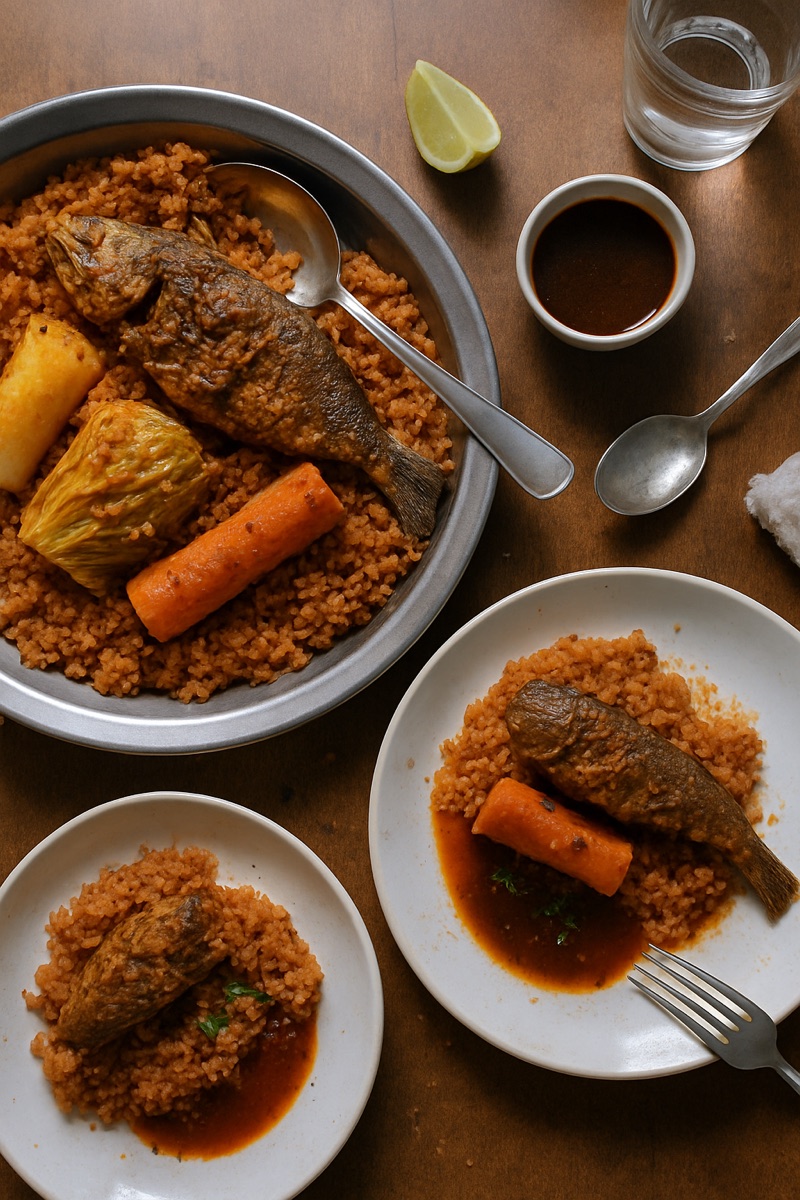
The national dish of Senegal is thieboudienne, in Wolof ceebu jën (rice and fish): whole fish stuffed with a parsley, garlic and chilli paste, vegetables, and broken rice cooked in the same tomato and fish broth. No law names it, but it is universally called the national dish, and UNESCO inscribed it in 2021 as a culinary art of Senegal.
What is thieboudienne?
The name says it all: in Wolof, ceeb means rice and jën means fish. Thieboudienne is the French spelling, and in Senegal it is often shortened to thieb or tieb. It is a one-pot dish, what the Wolof call been cin: the fish, the vegetables and the rice all cook in the same broth, one after another.
The classic fish is white grouper, known locally as thiof. It is slashed and stuffed with rof, a rough green paste of parsley, garlic, chilli and salt pounded in a mortar. Broken rice, rather than whole grains, absorbs the broth and turns red from the tomato.
How thieboudienne is made
Our thieboudienne recipe follows the traditional order. The stuffed fish is fried in peanut oil, 6 minutes a side, then set aside; that oil stays in the pot. Onions and tomato paste cook in it for 10 minutes, then nététou (fermented locust bean), a small dried fish and 2 litres of water go in.
Carrots, cabbage and cassava cook in this broth for 25 to 30 minutes and are lifted out one by one as they turn tender. Then the broken rice goes into what is left of the broth, about 2 cm of liquid above it, for around 30 minutes. A few extra minutes on low heat let the bottom layer toast: that crust, the xoonq, is served alongside rather than scraped away.
The rice is turned onto a large platter and the fish and vegetables are arranged on top. UNESCO's description lists what can go into the pot beyond the basics: dried fish, molluscs, eggplant, sweet potato, okra and bay leaf. Ethnic groups and regions have their own touches: in southern Senegal cooks add bissap leaves, while Dakar and Saint-Louis use soul, a nététou sauce. The main versions:
- Ceebu jën bu xonq: the red version, the one most people know.
- Ceebu jën bu weex: the white version, where the rice stays white, served with sauces such as soul (nététou) or tamarind.
- Thiebou yapp: a similar dish made with meat instead of fish.
- Ceebu jaga: red rice with fish, served with a sauce of fish balls.
Is thieboudienne officially Senegal's national dish?
There is no law that designates it, but every reference calls it the national dish of Senegal. The strongest recognition came in December 2021, when UNESCO inscribed Ceebu jën, a culinary art of Senegal on the Representative List of the Intangible Cultural Heritage of Humanity, on a file submitted by Senegal.
UNESCO's description stresses the social side: the quality of the fish and the choice of vegetables depend on the importance of the occasion and the guest. Thieboudienne is eaten from one large shared platter, by hand or with a spoon, and is a symbol of teranga, Senegalese hospitality. The skill is traditionally passed from mother to daughter over several years, and mastering it is regarded as a mark of excellence.
Where thieboudienne comes from
According to UNESCO, the dish originated in the fishing communities of the island of Saint-Louis, in northern Senegal, and it is usually dated to the 19th century. French-language sources attribute its creation to Penda Mbaye, a cook from the Guet-Ndar fishing quarter. The broken rice was imported from French Indochina.
The dish spread across West Africa. It is eaten in Mauritania and in the Gambia, where it is called benachin, and the jollof rice of Nigeria and Ghana is thought to descend from it. One modern problem: the collapse of white grouper stocks has made the classic version harder to cook. Across the Atlantic, the red rice of the Gullah communities of the American South-East resembles thieboudienne, a trace of West African cooking carried by enslaved Africans.
Other dishes to know from Senegal
Yassa poulet is built on a mountain of onions: chicken legs marinate overnight with five sliced onions, lime juice and mustard, are grilled, then simmer with the onions cooked down into a thick sauce and green olives.
Mafe is a beef stew thickened with pure roasted peanut paste, not sweetened peanut butter, and simmered about 1 hour 15 minutes, until a film of peanut oil floats on top. Both are served over plain white rice.
All three recipes are on our page about the food of Senegal, and the dishes of the neighbouring countries are in our guide to West African food.
The recipes
- Thieboudienne🇸🇳 Senegal · 2 hours and 35 minutes
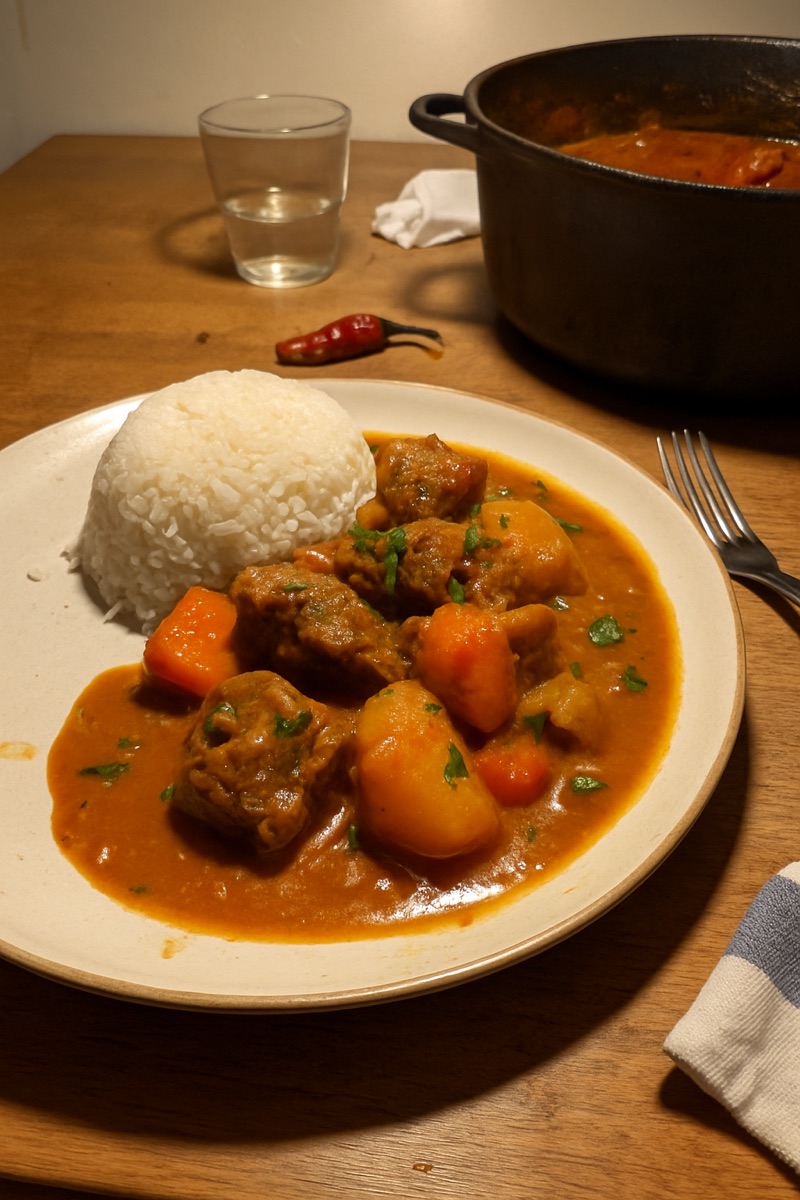 Mafe🇸🇳 Senegal · 1 hour and 40 minutes
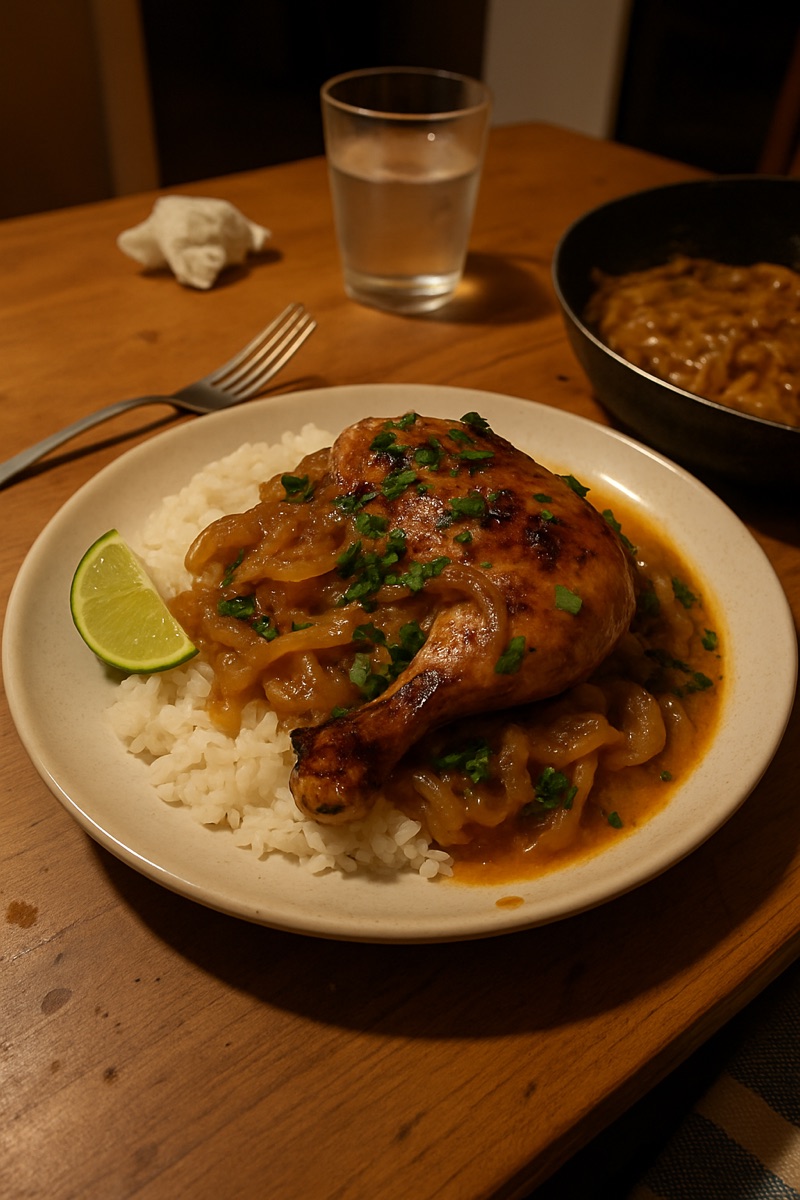 Yassa poulet🇸🇳 Senegal · 13 hours and 10 minutes
Questions people ask
How do you pronounce thieboudienne?
Roughly "CHEH-boo jen". The Wolof spelling is ceebu jën; thieboudienne is the French transcription.
What does ceebu jën mean?
Rice and fish in Wolof: ceeb means rice and jën means fish.
Is jollof rice the same as thieboudienne?
No. Jollof rice is thought to descend from thieboudienne, but it is usually made with meat rather than fish, and the rice is mixed into the other ingredients.
What fish is used in thieboudienne?
Traditionally white grouper, called thiof in Senegal. The collapse of white grouper stocks has made it harder to find.
When did UNESCO recognise thieboudienne?
In December 2021, when Ceebu jën, a culinary art of Senegal, was inscribed on UNESCO's Representative List of the Intangible Cultural Heritage of Humanity.
Keep reading
- Traditional food of Senegal: 12 dishes to know
- What is the national dish of Benin?
- What is the national dish of Burkina Faso?
- What is the national dish of Cabo Verde?
- What is the national dish of Côte d'Ivoire?
- What is the national dish of The Gambia?