 COPPER
Traditional food of Sri Lanka: 13 dishes to know
Sri Lankan food is centred on rice and coconut, with fish, vegetables and spice blends heavy in local cinnamon and black pepper, plus Maldives fish, goraka and kithul jaggery. Its cooking is close to South Indian food, with Malay, Dutch and Portuguese traces. The dishes to know first are rice and curry, hoppers, kottu roti and pol sambol, with tea to drink.
What Sri Lankan food is built on
Sri Lanka sat on the maritime silk road, and the island's traders, invaders and settlers all left something in its kitchen. The cooking of the Sinhalese and Tamils is close to that of South India, especially in Jaffna, while the Malay community, the Moors and the Dutch Burghers each brought dishes that are now eaten by everyone. Many varieties of rice are grown, including heirloom red rices, and rice is at the centre of almost every meal.
Coconut is the other constant: coconut milk and grated coconut are prepared fresh almost every day in most households. What sets the island's curries apart from its neighbours' is the spice blend, heavy in true cinnamon, which is native to Sri Lanka, and black pepper, and a set of local ingredients: goraka for sourness, pandan leaf, lemongrass, jaggery from kithul palm syrup and Maldives fish, a smoked and cured tuna used to add depth to vegetable dishes. The dish most often called the national one has its own article: the national dish of Sri Lanka.
Rice dishes and curries
Rice is eaten with curries at home, but it also takes festive and baked forms.
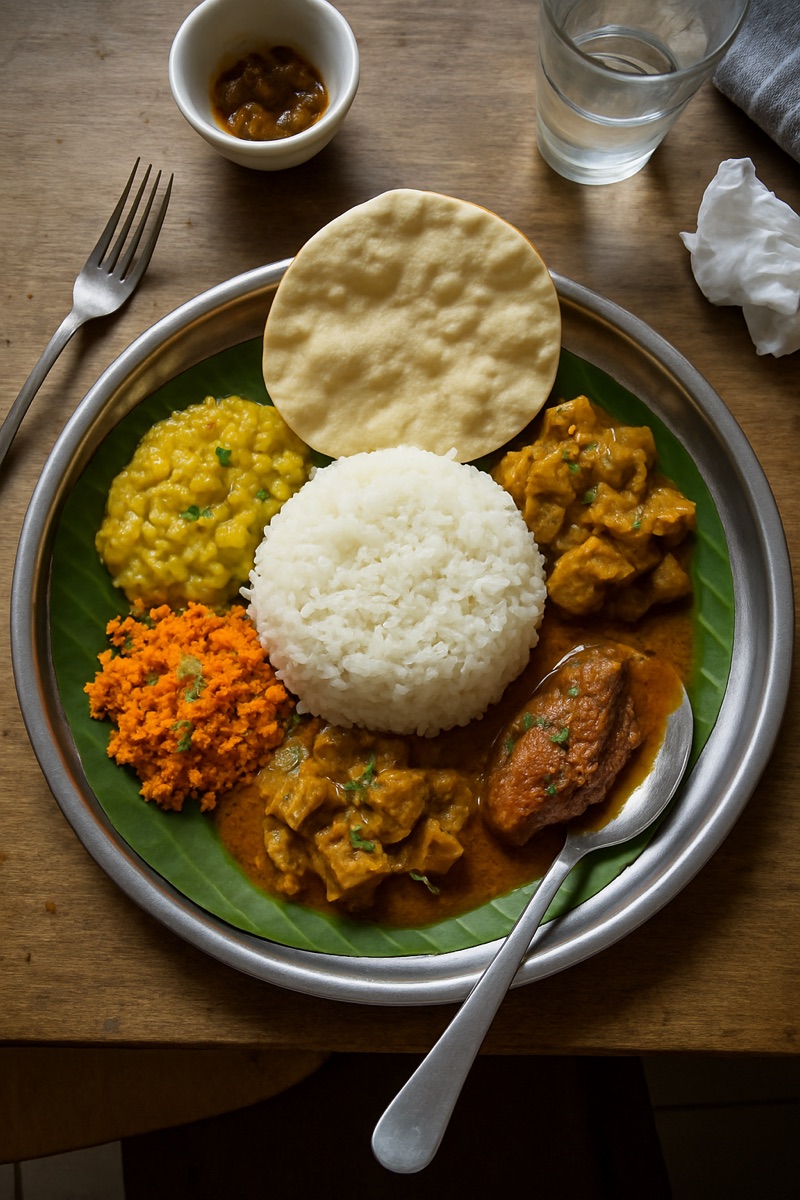
- Rice and curry — Boiled or steamed rice served with a curry of fish or meat and other curries of vegetables, lentils or fruit, with pickles, chutneys and sambols around them. It is the central feature of Sri Lankan food and the everyday home meal.
- Pol sambol — A relish of freshly grated coconut ground with shallots, dried chillies, lime juice and salt, often with Maldives fish. It is traditionally ground on a granite slab called a miris gala and served with rice, hoppers, string hoppers and curries.
- Kiribath — Rice cooked in thick coconut milk until soft, then pressed and cut into diamonds, served with lunu miris, a relish of red onion and chilli. It is eaten on the first day of each month and for every auspicious moment, and it is the first meal of the Sinhala New Year.
- Lamprais — Rice cooked in stock, a three-meat curry, an ash plantain and aubergine curry, seeni sambol and frikkadel meatballs, wrapped together in a banana leaf and baked. It was introduced by the Dutch Burghers, and because it takes so long to make, it is common at large gatherings.
- Kool — A seafood broth from Jaffna, in the Tamil north, made with crab, fish, cuttlefish and prawns, long beans, jackfruit seeds, cassava and tamarind, thickened with palmyra root flour.
Hoppers, roti and kottu
Breakfast and dinner often move away from plain rice towards fermented batters, rice-flour doughs and flatbreads.
- Egg hoppers — Hoppers, appa in Sinhala and appam in Tamil, are made from a fermented batter of rice flour and coconut milk, raised with palm toddy or yeast and swirled in a small round pan until the rim turns lacy. An egg cooked in the centre makes an egg hopper; sweet versions also exist. Spicy hoppers come with lunu miris.
- String hoppers — Called idiyappam in Tamil, they are made from a hot-water dough of rice meal or wheat flour pressed into circlets onto small wicker mats and steamed. They are not eaten plain but with a curry such as kiri hodi, and with pol sambol.
- Pittu — Cylinders of steamed or roasted rice flour mixed with grated coconut, eaten with curry. Babath, a curry of tripe associated with the Malay and Moor communities, is most famously served with pittu.
- Kottu roti — Godamba roti chopped on a hot griddle with two heavy metal blades, together with vegetables, egg, onions, chillies and the meat and gravy of a curry. Its name comes from the Tamil koththu, "chopped". It is generally thought to have started as cheap street food on the east coast, in Batticaloa and Trincomalee, in the 1960s or 1970s, and the clatter of the blades is its signature sound.
Sweets, short eats and drinks
Sweets are kept for the New Year and festivals, while short eats fill the gaps between meals.
- Watalappam — A steamed pudding of coconut milk, eggs and kithul jaggery, first introduced by Malay immigrants and now a common Sri Lankan dessert, eaten across all communities.
- Kavum — Also spelled kevum, an oil cake of rice flour and treacle deep-fried to a golden brown. Variants include mung kavum, made from mung bean flour paste shaped into diamonds. It is one of the sweets served with kiribath at the Sinhala and Tamil New Year, alongside kokis, a crisp rice-flour and coconut milk biscuit.
- Buffalo curd with kithul treacle — Curd made from buffalo milk, eaten with treacle from the kithul palm. It is a simple home dessert, and Sri Lanka's tourism board lists it among the island's desserts next to watalappam.
- Ceylon tea — Tea is an important drink across the country, and Sri Lanka is known for producing some of the world's finest. Other common drinks include king coconut water, wood apple juice, faluda, and toddy and arrack made from palm sap.
Regional and community cooking
On the coasts, seafood is a standard part of every meal. In the north, Jaffna Tamil cooking shares many traits with South Indian food and has dishes of its own, such as kool. Kandyan Sinhalese cooking in the hill country relies on local ingredients, including hill vegetables and fruits. Each community has added dishes that the whole island now eats: the Malay community gave watalappam and Malay achcharu pickle, and Indonesian influence gave sate and nasi goreng; the Dutch Burghers gave lamprais and bolo fiado layer cake; and Sri Lankan Chinese restaurants, common in Colombo since the 1940s, gave hot butter cuttlefish.
"Short eats" are a category of their own: patties, cutlets, Chinese rolls and fish buns, bought by the dozen from short eat shops and eaten on the go. Its cooking has close relatives in South India; compare with the traditional food of India, or explore the wider South Asian kitchen.
Cook Sri Lankan food at home
Rice and curry, egg hoppers and kottu roti each have a full recipe with quantities and step-by-step methods in the Copper app. You will find all three on our page dedicated to Sri Lankan recipes.
The recipes
- Rice and curry🇱🇰 Sri Lanka · 1 hour and 30 minutes
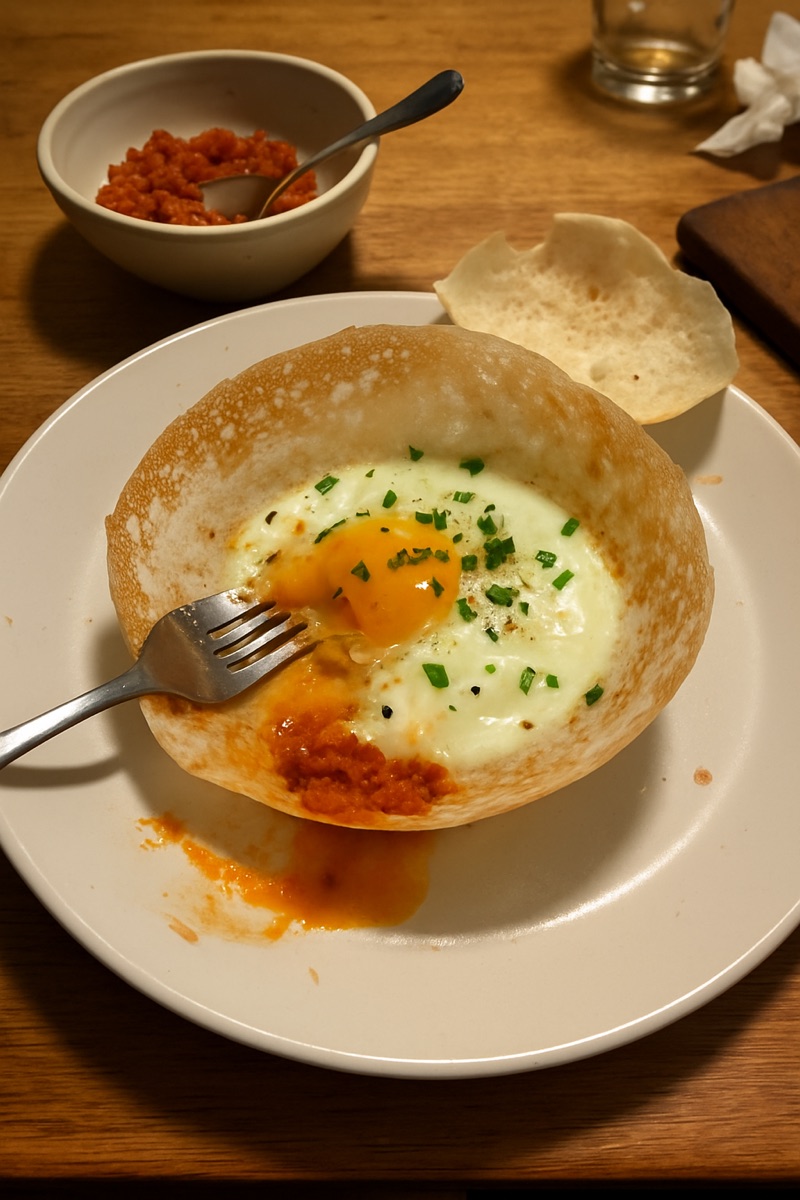 Egg hoppers🇱🇰 Sri Lanka · 11 hours
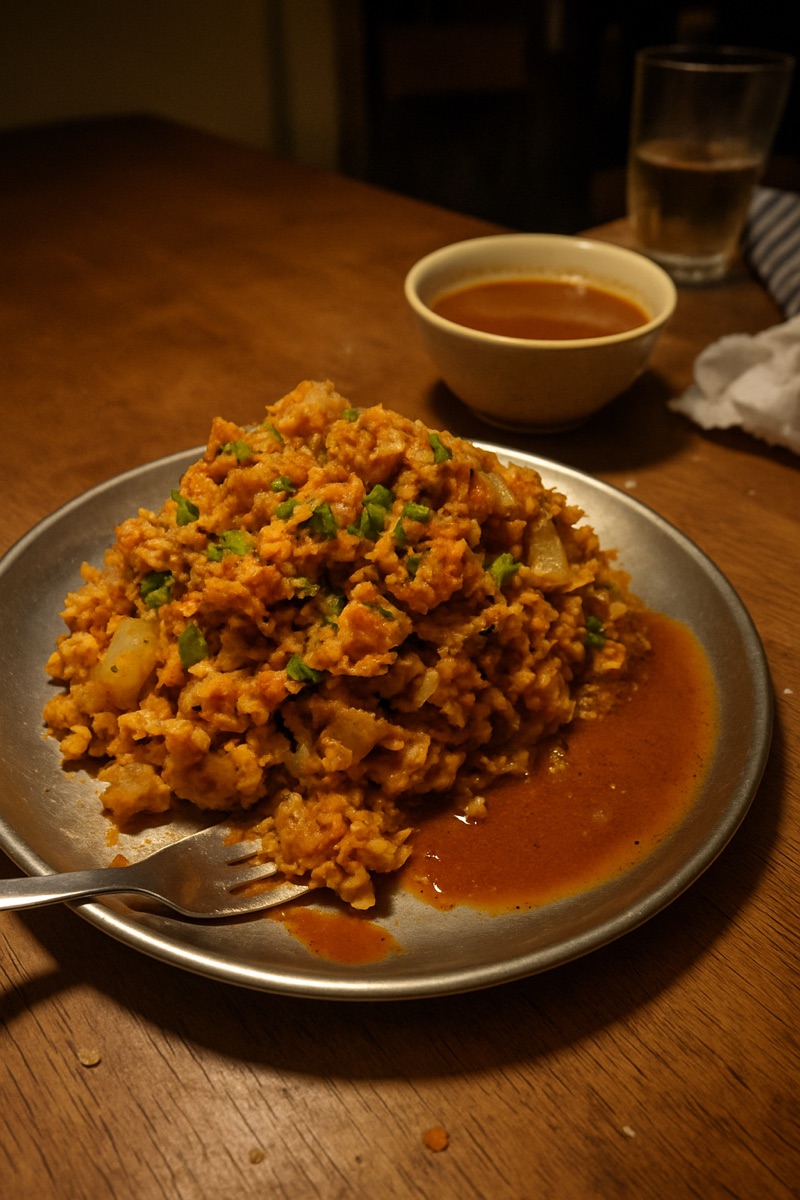 Kottu roti🇱🇰 Sri Lanka · 30 minutes
Questions people ask
What is the most popular food in Sri Lanka?
Rice and curry is the everyday meal and the dish most often named. Hoppers, string hoppers and kottu roti are the most popular alternatives, and kottu is the main street food.
What do Sri Lankans eat for breakfast?
Kiribath, rice cooked in coconut milk, is generally eaten for breakfast, especially on the first day of the month and at the New Year. Short eats, such as patties and fish buns, are also eaten mainly at breakfast or in the evening.
Is Sri Lankan food spicy?
Often, yes. Curries range from mildly spiced to very hot, and relishes such as lunu miris and pol sambol are built on chilli. The dhal served with rice and curry is mild and creamy.
What is the difference between Sri Lankan and Indian food?
Sri Lankan food is closest to South Indian cooking, but it uses more coconut and its own ingredients: true cinnamon, Maldives fish, goraka and kithul jaggery, plus roasted curry powders and dishes from Malay and Dutch Burgher cooking.
What are short eats in Sri Lanka?
Snacks such as patties, cutlets, Chinese rolls and fish buns, sold by the dozen in shops and bakeries and eaten on the go, mostly at breakfast or in the evening.
Keep reading
- What is the national dish of Sri Lanka?
- Traditional food of Bangladesh: 13 dishes to know
- Traditional food of Bhutan: 14 dishes to know
- Traditional food of India: 13 dishes to know
- Traditional food of the Maldives: 14 dishes to know
- Traditional food of Nepal: 13 dishes to know