 COPPER
What is the national dish of Jordan?
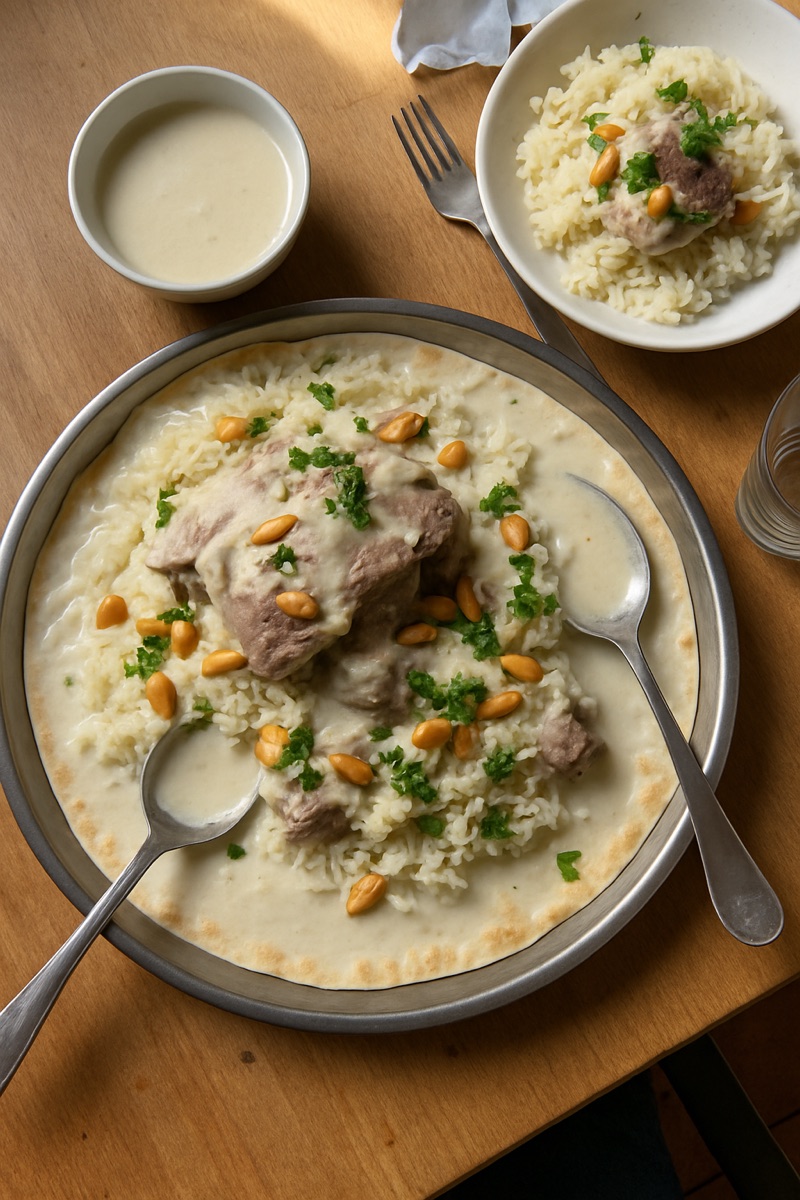
The national dish of Jordan is mansaf: bone-in lamb cooked in a sauce of jameed, a dried fermented yogurt, served over rice on a platter lined with thin shrak bread and scattered with almonds and pine nuts. No law makes it official, but it is the dish Jordan presents as national, and UNESCO inscribed the mansaf tradition on its heritage list in 2022.
Is mansaf officially Jordan's national dish?
There is no law or decree, but mansaf is the dish Jordanians and reference works name, and the Jordanian state has presented it as national since independence. In 2022, UNESCO inscribed "Al-Mansaf in Jordan, a festive banquet and its social and cultural meanings" on its Representative List of the Intangible Cultural Heritage of Humanity. UNESCO describes it as a symbol that evokes a deep sense of identity and social cohesion.
The scholar Joseph Massad notes that the state portrays mansaf as a Bedouin tradition, although it was also historically a dish of the peasants and Bedouins of southern Palestine and Syria. Mansaf is still the main festive dish of the central and southern West Bank: see the national dish of Palestine.
What is in mansaf?
The name comes from the Arabic for a large tray or large dish, the platter it is served on. Mansaf has few ingredients, and each one has a job:
- Jameed: a hard, dry yogurt made from fermented sheep's milk. Soaked and blended, it gives the sauce its salty sourness. Plain yogurt gives a different dish.
- Lamb on the bone, in large pieces, never shredded. Goat is also used.
- Shrak (or markook), a paper-thin flatbread that lines the platter and soaks up the sauce.
- Rice, which began replacing bulgur around the 1950s; bulgur is still sometimes used.
- Ghee, almonds and pine nuts, fried together and scattered on top.
- Hwajeh, a blend of spices and wild herbs used in many Jordanian versions.
How mansaf is made
In our mansaf recipe, 500 g of dried jameed soaks overnight in 1.5 litres of water before being blended and strained. Meanwhile 1.5 kg of bone-in lamb shoulder is browned in ghee and simmered with onion and cardamom for 1.5 to 2 hours, skimmed, with the pieces kept whole.
The key moment is the sauce. The jameed is brought up slowly with some of the lamb broth while being whisked constantly in one direction; once it has boiled, it will no longer split. It simmers 20 minutes, then the lamb goes in for 15 more to take on the sourness.
To serve, torn shrak is laid on a large platter and soaked with hot sauce, the rice goes on top, then the lamb, more sauce and the fried nuts. The rest of the sauce comes to the table in a jug. In northern Jordan, fried bulgur balls filled with minced meat are often set around the platter.
How mansaf is eaten
Mansaf is a dish for occasions: weddings, births, graduations, honouring a guest, Eid al-Fitr and Eid al-Adha, Christmas, Easter and Jordan's Independence Day. It also plays a part in settling tribal disputes. UNESCO notes that the cooking is a social event in itself, with the cooks talking, telling stories and singing, and that women generally pass the recipe down to their daughters and granddaughters, alongside culinary schools and universities.
It is eaten from the shared platter, traditionally standing or sitting around it, five to seven people to a platter, with the right hand and the left hand held behind the back. Today some people use plates and spoons. The towns of Al-Salt and Al-Karak are reputed to make the best mansaf in Jordan, and around Aqaba there is even a fish mansaf.
The dish has changed a lot. The original Bedouin mansaf was simply meat, camel or lamb, with broth or ghee and bread, and before 1945 it was still bread, meat and clarified butter. Until the 1970s it was cooked outdoors in a copper cauldron too large to fit in the kitchen. A recent street version, mansaf in a cup, was criticised by some Jordanians as inauthentic.
Other dishes to know from Jordan
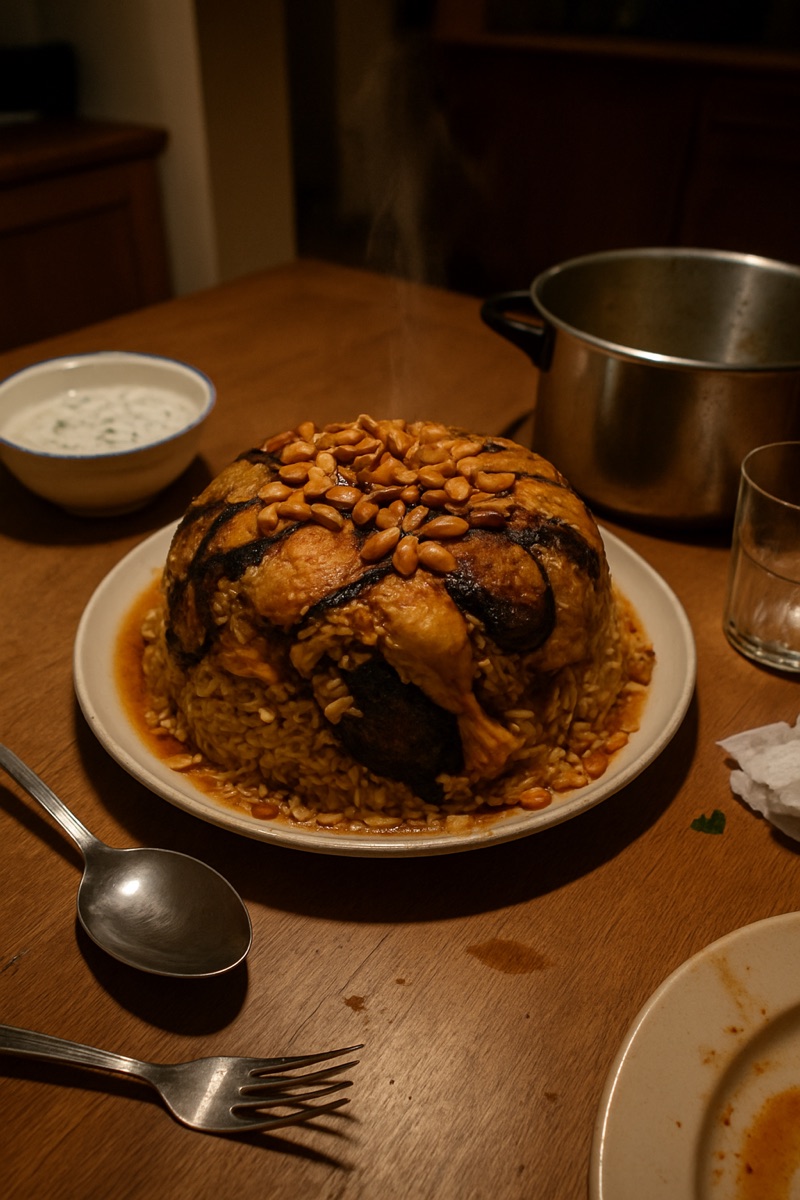
Maqluba, "upside-down" in Arabic, is the everyday counterpart to mansaf: chicken, deep-fried eggplant and cauliflower and spiced rice layered in a pot, cooked in the chicken broth and turned out onto a platter in one movement.
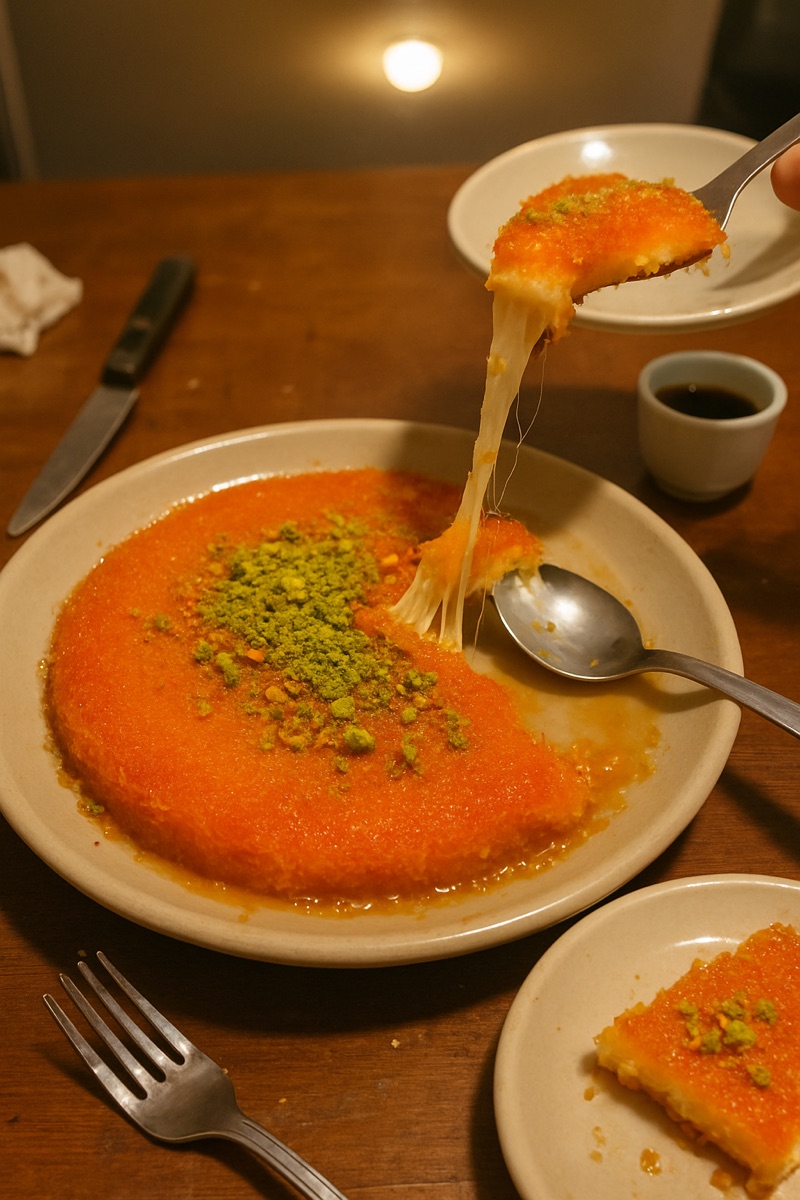
For dessert, knafeh in its Nablus style is the most common version in Jordan: brined white cheese soaked free of its salt for 8 hours, pressed over buttered kataifi pastry, baked, flipped and soaked in cold syrup.
All three recipes, with ingredients and step-by-step methods, are on our page about the food of Jordan. For the neighbouring kitchens, see our guide to Middle Eastern food.
The recipes
- Mansaf🇯🇴 Jordan · 14 hours and 50 minutes
 Maqluba🇯🇴 Jordan · 2 hours and 10 minutes
 Knafeh🇯🇴 Jordan · 9 hours
Questions people ask
Is mansaf Jordanian or Palestinian?
Both. Mansaf is Jordan's national dish and inscribed by UNESCO for Jordan, but it is also the main festive dish of the central and southern West Bank and was historically shared across southern Palestine and Syria.
What is jameed?
Jameed is a hard, dry yogurt made from fermented sheep's milk. Soaked and blended, it becomes the sour sauce of mansaf.
Can you make mansaf with regular yogurt?
You can, but it is a different dish. The urban version with fresh yogurt, often with chicken, is called shakreyyeh or laban emmo.
How do you eat mansaf?
Traditionally from a shared platter, with the right hand only, the left held behind the back.
When did UNESCO recognise mansaf?
In 2022, when "Al-Mansaf in Jordan, a festive banquet and its social and cultural meanings" was inscribed on the Representative List of the Intangible Cultural Heritage of Humanity.
Keep reading
- Traditional food of Jordan: 13 dishes to know
- What is the national dish of Bahrain?
- What is the national dish of Iran?
- What is the national dish of Iraq?
- What is the national dish of Israel?
- What is the national dish of Kuwait?