 COPPER
What is the national dish of the Solomon Islands?
The Solomon Islands has no official national dish, but poi is the one most often cited: cooked taro root pounded into a paste and left to ferment until it turns tangy. It is eaten as a side with fish, chicken or pork, or loosened like a porridge, and it is served at celebrations. Palusami and cassava pudding are the other dishes to know.
Is poi really the national dish of the Solomon Islands?
No law or government text names a national dish for the Solomon Islands, and the Solomons do not appear on Wikipedia's list of national dishes. The attribution comes from food references: Wikipedia's article on the cuisine of the Solomon Islands puts poi in its national dish field, and Travel Food Atlas calls poi "the national dish of the Solomon Islands". Wikivoyage's guide to the country lists poi first among local foods.
Two cautions. The Wikipedia claim carries no citation, and the word poi is best known from Hawaii, where pounded taro is also a staple. So treat poi as the dish most often named, not as an official symbol.
What is poi and how is it made?
Poi starts with taro root. The root is cooked, then mashed on a wooden board with a hand-carved pestle of basalt, coral or wood until it becomes a smooth paste. The paste is then left to ferment, which gives it its sour, tangy taste.
It is a starch, not a main course. Solomon Islanders serve it alongside fish, chicken or pork, or thin it into a porridge, and it turns up at every kind of celebration.
Like much of the country's food, it belongs to a kitchen built on root crops and the earth oven, called a motu: food wrapped in banana or taro leaves and cooked over heated stones.
Cooking in the Solomons relies on baking, boiling and frying, but the root crops that poi comes from, taro, cassava and sweet potato, are served with almost every meal, usually next to fish.
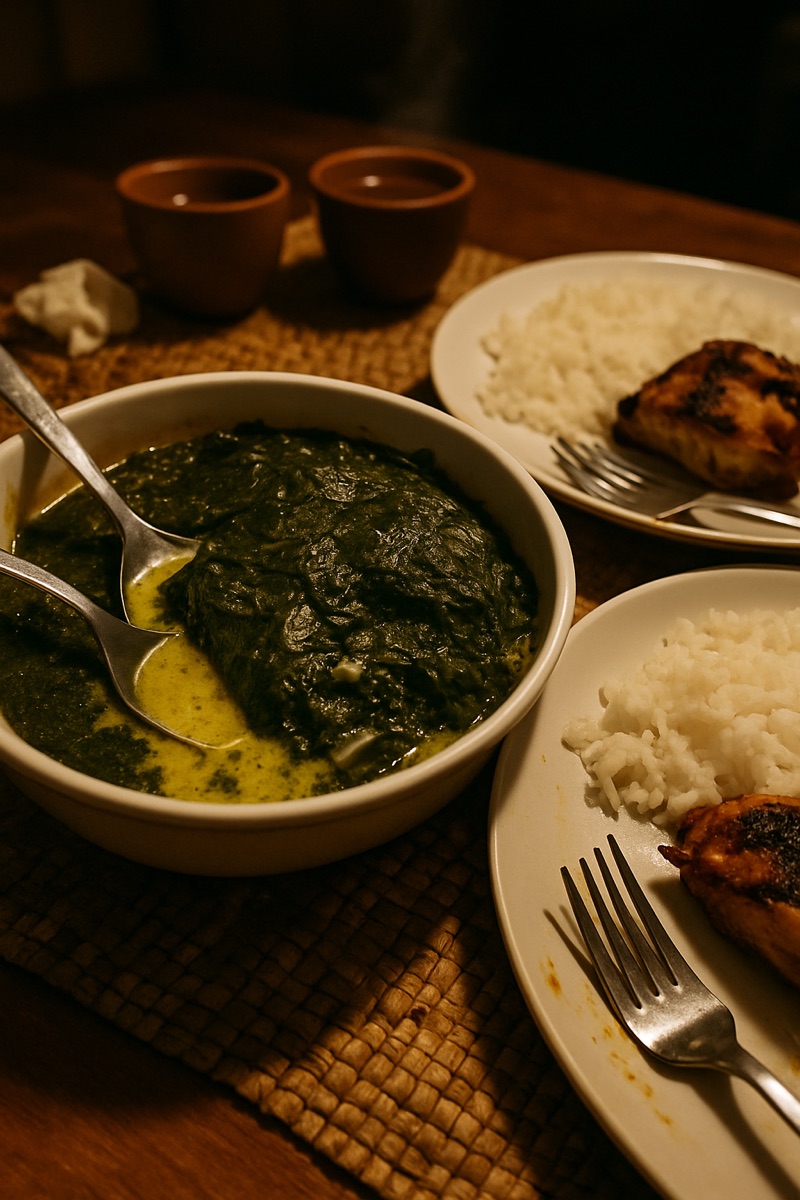
Palusami: taro leaves baked in coconut cream
Where poi uses the taro root, palusami uses the leaves. About 30 young leaves are stripped of their stalk and thick rib, stacked five or six at a time into a cup in the palm, and filled with roughly 100 ml of coconut cream mixed with chopped onion, salt and pepper. The leaves are folded shut and wrapped in flame-softened banana leaf.
In a stone-lined earth oven the parcels cook for two hours or more; in a home oven, 1 hour to 1 hour 30 at 200 °C. The time matters: raw taro leaf contains calcium oxalate and scratches the throat, so the leaves must end up dark and soft. The same dish is a classic of Samoa, covered in our article on the national dish of Samoa.
Cassava pudding, the dish of feasts
In the Solomons, "pudding" means a grated root mixture baked until it sets. Cassava pudding is the best-known one, made for weddings and religious holidays, in a savoury version and a sweetened one.
The savoury version is mostly work with a grater:
- About 1.4 kg of cassava is peeled, its woody central cord cut out, and finely grated with 450 g of white sweet potato.
- The gratings are squeezed hard in a cloth; after 15 to 30 minutes the liquid is poured off and the white starch that settled at the bottom goes back in.
- Coconut milk, 400 to 550 ml, is worked in until the mix looks like thick mashed potato.
- It bakes in banana leaves for about 3 hours 30 at 175 °C, or all afternoon in a motu.
- It is wobbly when hot and only firms up once completely cool, so it is cut into squares cold.
Other dishes to know from the Solomon Islands
Slippery cabbage in coconut milk is the everyday green. The leaves of aibika, the local slippery cabbage, cook for about three minutes in coconut milk squeezed from two freshly grated coconuts, then five more with tomato, spring onion and small red chillies until soft and silky. In villages it is cooked without a stove: stones heated in the fire for 20 to 35 minutes are dropped into the pot.
Fish is the main meat, served with sweet potato, rice, taro or cassava, and breadfruit, called ulu, goes with almost anything.
The kitchen also carries its history. Wikipedia credits the Spanish with bringing cattle, Asian and Indian traders with spices, vegetables and fruit, and the British with their own habits. Breadfruit is older, brought by Lapita seafarers. Modern everyday food includes chili Taiyo noodles, made with chillies, tomato, onion and tuna, often the canned Taiyo brand that gives the dish its name, and tapioca, or pearl cassava, served like a pudding at holidays.
All three recipes are on our page about the food of the Solomon Islands, and the wider region is covered in our guide to Pacific Island food. For the larger neighbour to the west, see the national dish of Papua New Guinea.
The recipes
- Palusami🇸🇧 Solomon Islands · 1 hour and 45 minutes
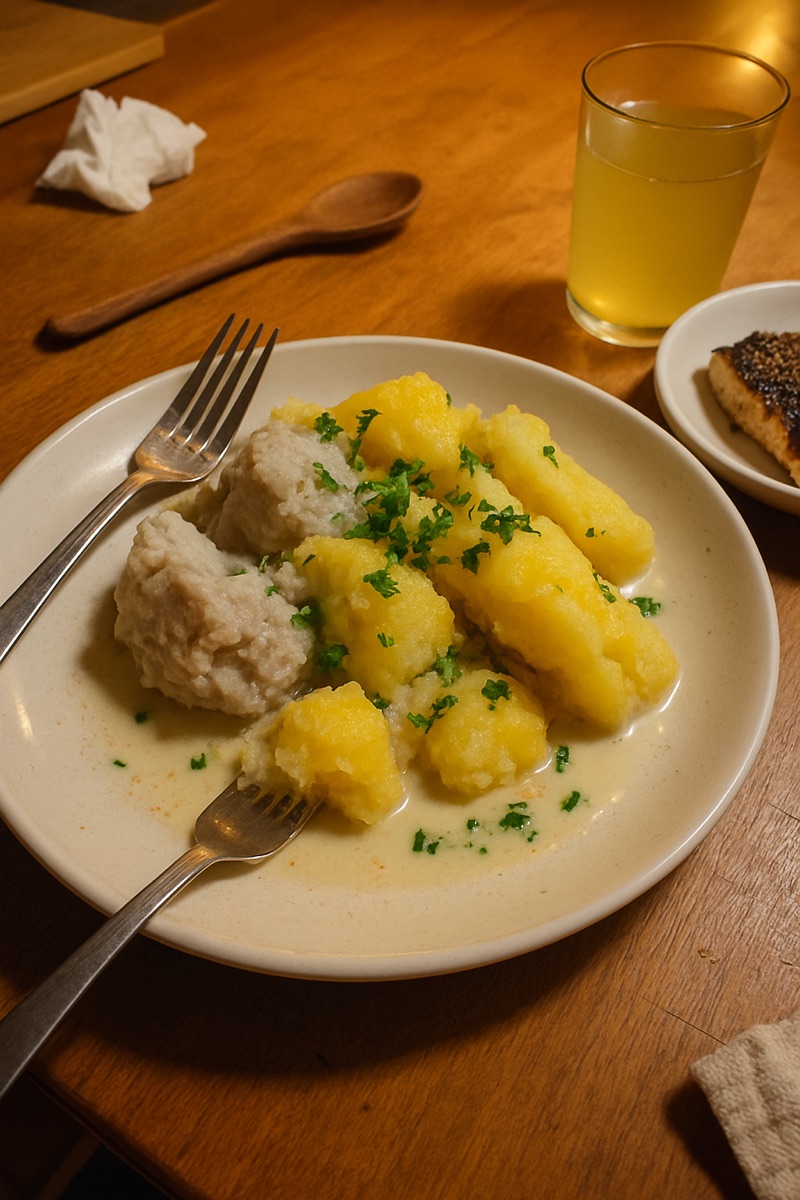 Cassava pudding🇸🇧 Solomon Islands · 5 hours and 30 minutes
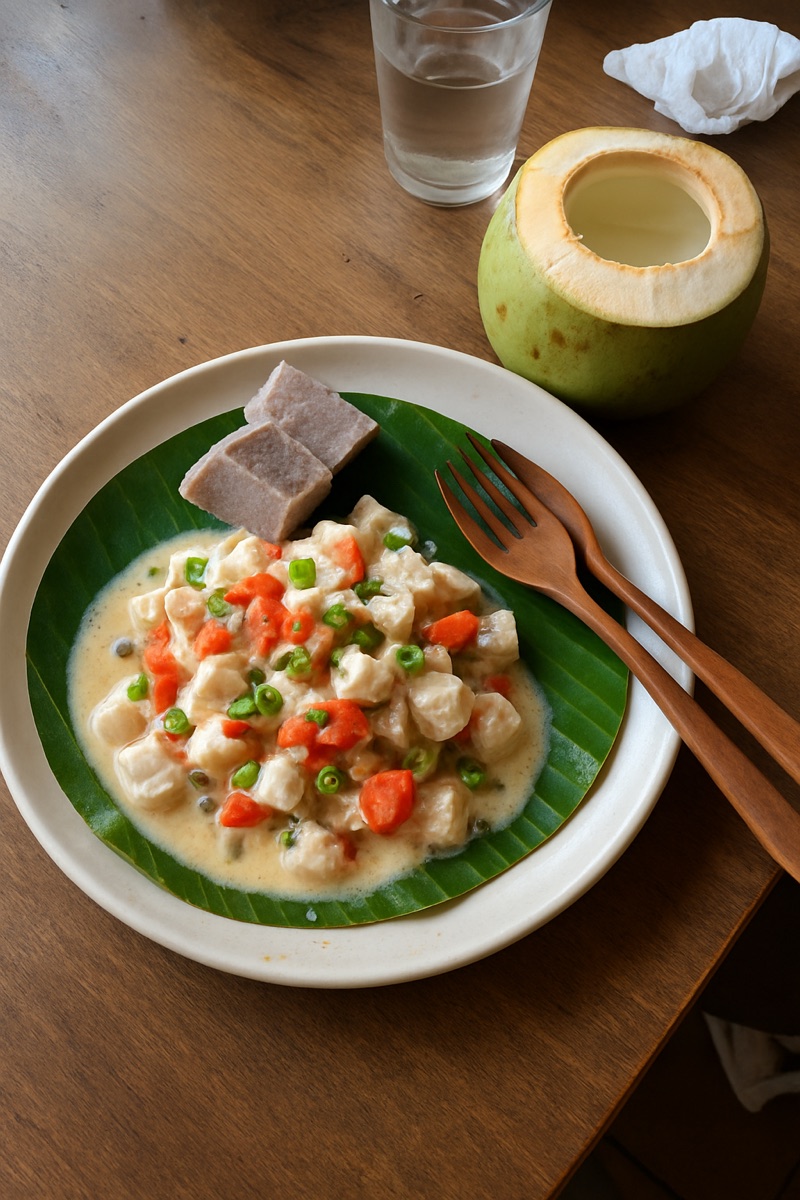 Slippery cabbage in coconut milk🇸🇧 Solomon Islands · 35 minutes
Questions people ask
Does the Solomon Islands have an official national dish?
No. No law or government declaration names one. Poi, fermented pounded taro, is the dish food references most often call the national dish.
Is poi from Hawaii or the Solomon Islands?
The name is best known from Hawaii, where pounded taro is a staple. Pounded, fermented taro is also eaten in the Solomon Islands, where it is served at celebrations.
What is served with poi in the Solomon Islands?
Poi is a side dish. It is eaten with fish, chicken or pork, or thinned and eaten like a porridge.
What is a motu?
A motu is the Solomon Islands earth oven: food wrapped in banana or taro leaves is cooked over heated stones, which is how cassava pudding is traditionally baked.
What is slippery cabbage?
It is aibika, a leafy green that turns soft and slippery when cooked. In the Solomons it is simmered for a few minutes in fresh coconut milk.
Keep reading
- Traditional food of the Solomon Islands: 9 dishes to know
- What is the national dish of Fiji?
- What is the national dish of Kiribati?
- What is the national dish of the Marshall Islands?
- What is the national dish of Micronesia?
- What is the national dish of Nauru?