 COPPER
What is the national dish of Kiribati?
Kiribati has no official national dish, but palusami is the one most often cited: young taro leaves cupped together, filled with thick coconut cream and onion, wrapped in banana leaf and baked in an earth oven until the leaves turn silky. The country's national crop is a different plant, bwabwai, a giant swamp taro traditionally kept for celebrations.
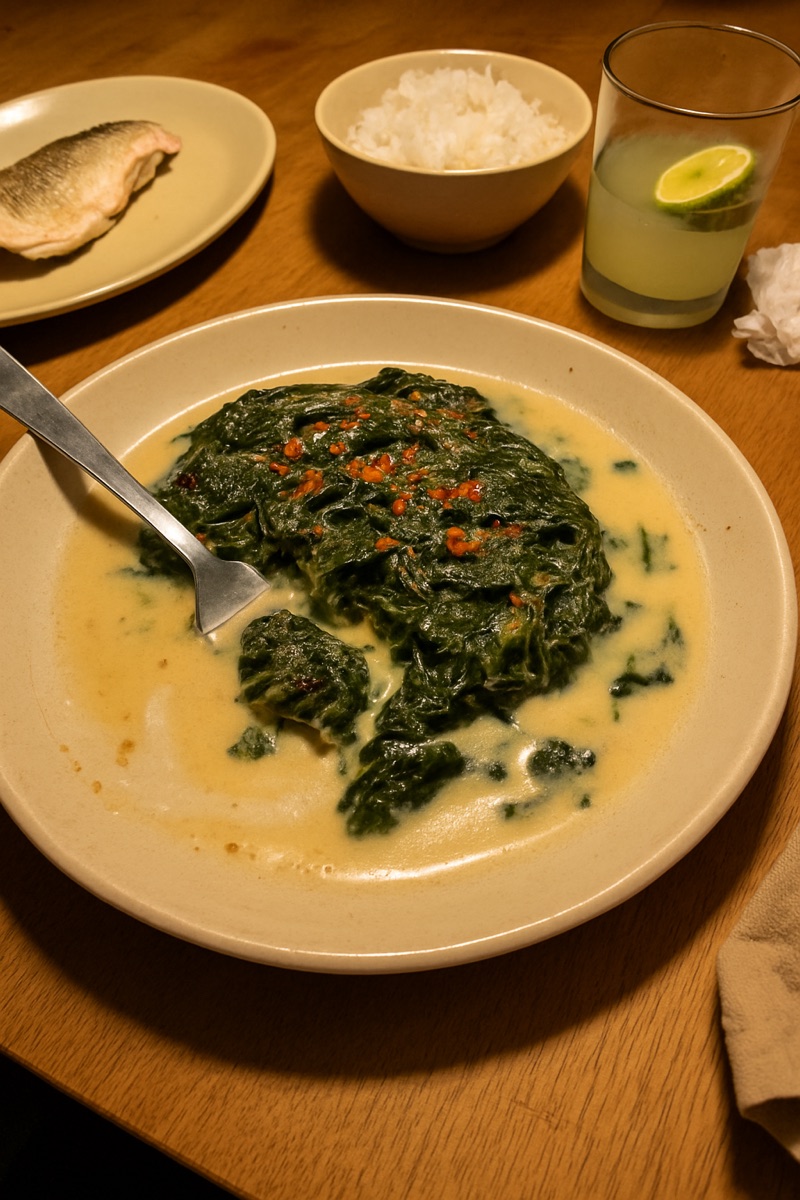
What is palusami?
Palusami is a parcel, not a stew. Five or six young taro leaves are overlapped in the palm of the hand to make a cup, a few spoonfuls of thick coconut cream with chopped onion and salt go inside, and the edges are gathered and closed. Each parcel is then wrapped in a square of banana leaf and tied.
Cooked slowly, the leaves soften completely and the cream thickens around them, so the parcel is eaten with a spoon. Wikipedia's list of national dishes gives palusami for Kiribati, and Travel Food Atlas describes it as considered the national dish. No law or government statement makes it official, and Kiribati has no single dish that every source agrees on.
How palusami is made
Our palusami recipe makes the parcels with 24 young taro leaves and 500 ml of thick coconut cream:
- Trim: strip out the stalk and thick central rib of each leaf. They stay tough and irritate the throat.
- Season: stir 1 finely chopped onion and 1 teaspoon of salt into the coconut cream, pressed from fresh grated coconut or from a good tin.
- Fill: cup 5 or 6 leaves, pour in the cream, close the parcel and wrap it in banana leaf.
- Cook: traditionally 1 hour to 1 hour 30 in an earth oven of hot stones. At home, bake at 200°C or steam for 1 hour.
- Check: the leaves must be completely soft. Undercooked taro leaves still contain calcium oxalate and sting the mouth.
Where palusami comes from
The name palusami is Samoan. It belongs to a family of taro-leaf dishes found across Polynesia: lū in Tonga, laulau in Hawaii, rourou in Fiji, rukau in the Cook Islands. The base recipe is vegetarian: the leaves, most often with coconut milk, and later meat or seafood.
Western navigators introduced onions, tomatoes and corned meats, and tinned corned beef became a prized filling across the Pacific.
Kiribati versions have their own touches. The recipe Travel Food Atlas gives for Kiribati adds breadfruit leaves, curry powder and black pepper to the taro leaves and coconut milk, bakes the parcels in an underground earth oven and serves them on a platter with garnishes. For the Samoan side of the story, see our article on the national dish of Samoa.
Bwabwai: Kiribati's national crop
If palusami is the dish most often named, bwabwai is the food Wikipedia's article on Kiribati describes as the national crop. Bwabwai, also written babai, is giant swamp taro (Cyrtosperma merkusii), and it was traditionally eaten only during special celebrations, along with pork.
Growing it on a coral atoll is hard work. It is planted in pits dug down to the freshwater lens beneath the island, and it can take up to 15 years to mature. The corms must be cooked for hours to remove their toxins. Rising sea levels now threaten the pits, because the plant does not thrive in brackish water.
It is the largest of the taro plants, with corms that can reach 80 kg. Left in the ground, it can be stored for decades, which made it an emergency food in times of natural disaster and food scarcity; the cooked corms can also be dried in the sun and kept.
Tuvalu grows the same plant under the name pulaka: see the national dish of Tuvalu.
Other foods to know from Kiribati
Atoll soils make starches scarce, so the traditional diet was built on seafood and coconut, with the northern atolls the only ones suited to steady farming. After the Second World War rice became a daily staple, and it still is in most households.
Most fish is eaten raw, sashimi-style, with a dressing of coconut sap, soy sauce or vinegar, often with chilli and onion. Coconut crabs and mud crabs are traditionally given to breastfeeding mothers.
Pandanus and coconut fill the gaps. The I-Kiribati turn them into:
- Te karewe: fresh coconut sap, tapped daily.
- Te kamaimai: coconut sap boiled down to a syrup.
- Te tuae: dried pandanus paste, cooked in an earth oven, sun-dried and rolled, which keeps for years.
- Te kabubu: pandanus paste dried further and pounded into a flour, mixed with water as a drink.
Where to go next
Our page about the food of Kiribati has the full recipe with every step, and our guide to Pacific Island food covers the neighbouring kitchens, from Nauru's coconut fish to Fiji's lovo.
The recipes
Questions people ask
Is palusami from Kiribati or Samoa?
The name is Samoan, and taro-leaf parcels are made across Polynesia. Palusami is also eaten in Kiribati, where it is the dish most often listed as the national dish.
What is bwabwai?
Bwabwai, or babai, is giant swamp taro, Kiribati's national crop. It grows in pits dug to the freshwater lens and was traditionally eaten at celebrations with pork.
Why does undercooked palusami sting?
Taro leaves contain calcium oxalate, which irritates the mouth and throat until the leaves are fully cooked. Remove the central rib and never shorten the cooking time.
What do people in Kiribati eat every day?
Rice and fish. Rice has been a daily staple since the Second World War, and fish is mostly eaten raw with a coconut sap, soy or vinegar dressing.
What is te tuae?
Te tuae is dried pandanus paste: the fruit pulp is cooked in an earth oven, dried in the sun for several days, then rolled and wrapped in pandanus leaves.
Keep reading
- Traditional food of Kiribati: 12 dishes to know
- What is the national dish of Fiji?
- What is the national dish of the Marshall Islands?
- What is the national dish of Micronesia?
- What is the national dish of Nauru?
- What is the national dish of New Zealand?