 COPPER
What is the national dish of Vanuatu?
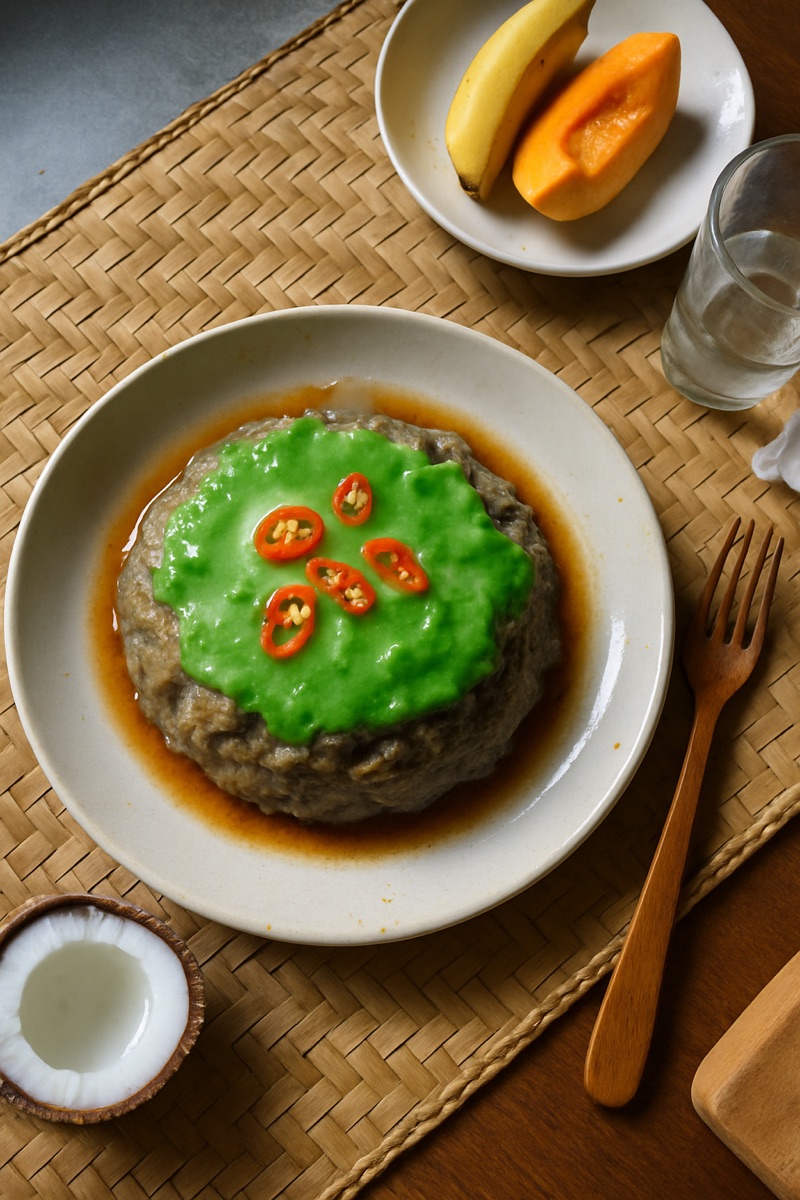
The national dish of Vanuatu is laplap: grated taro, yam, manioc, breadfruit or banana worked into a paste, soaked in fresh coconut cream, wrapped in banana leaves and cooked on hot stones in an earth oven. Pork, chicken, beef or flying fox can go on top. No law declares it, but Wikipedia, French Wikipedia and Wikivoyage all name it the national dish.
What is laplap?
Laplap is a baked pudding of root vegetables. Taro, yam or manioc is grated, or breadfruit or banana are used instead, and the paste is mixed with coconut cream and salt, wrapped in banana leaves and cooked in an earth oven or on hot volcanic stones. It comes out as a dense, sliceable cake.
Meat is optional: pork, beef, chicken or flying fox. Market stalls sell it by the piece with toppings such as chicken, beef, octopus or fried fish, and the style changes from island to island.
There is no law or decree behind its status. It is simply the dish every reference names: English and French Wikipedia and Wikivoyage all call laplap Vanuatu's national dish.
How laplap is made
In our laplap recipe, 1 kg of peeled taro is grated into a smooth paste. Four large banana leaves are softened over a flame and laid crosswise to make a base that will not leak. The paste is spread about 3 cm thick and salted, 300 g of pork goes on top, and 400 ml of fresh coconut cream is poured over everything.
The leaves are folded into a tight parcel and tied. Traditionally it goes on stones heated in a fire pit, covered with leaves and earth, and left for a few hours until the paste is firm. A home oven does not reproduce that slow, steamy heat.
Laplap is traditionally women's work and takes several hours, unlike nalot, a close dish that is rather prepared by men. At big occasions it is served on carved wooden dishes, in large portions to share or small individual ones.
Laplap sosor and the other variations
Each island has its own laplap. The best documented variants:
- Laplap sosor (Malekula): a glowing hot volcanic stone goes in the centre of the raw pudding, topped with chicken wings, onion and tomato, then coconut milk is squeezed over and the whole is wrapped and baked. Afterwards the stone is removed and more coconut milk fills the hollow as a dipping sauce.
- Tuluk: the laplap paste rolled into a cylinder around a meat filling, sold warm at markets.
- Simboro: a steamed roll of grated banana, manioc, yam or taro, wrapped in leaves and covered in coconut milk, usually without meat.
- Bunia or bunya: a feast dish of meat, vegetables and coconut milk bundled in banana leaves and steamed on hot stones.
Where the name laplap comes from
Laplap is a Bislama word, from the national language of Vanuatu. It goes back to some of the country's Oceanic languages, such as Dorig lablab and Nume labalam, from a Proto-Torres-Banks form reconstructed as *labalaba. Wikipedia notes that the spelling "lap lap" is incorrect.
Most of Vanuatu's many indigenous languages use other words for it: loko in Mota, loḡo in Raga, na-tgop in Mwotlap, ureeje in Araki.
The dish is old enough to appear in legend. French Wikipedia records that the chief Roymata is said to owe his name to a failed laplap: mata means "badly cooked".
Other dishes to know from Vanuatu
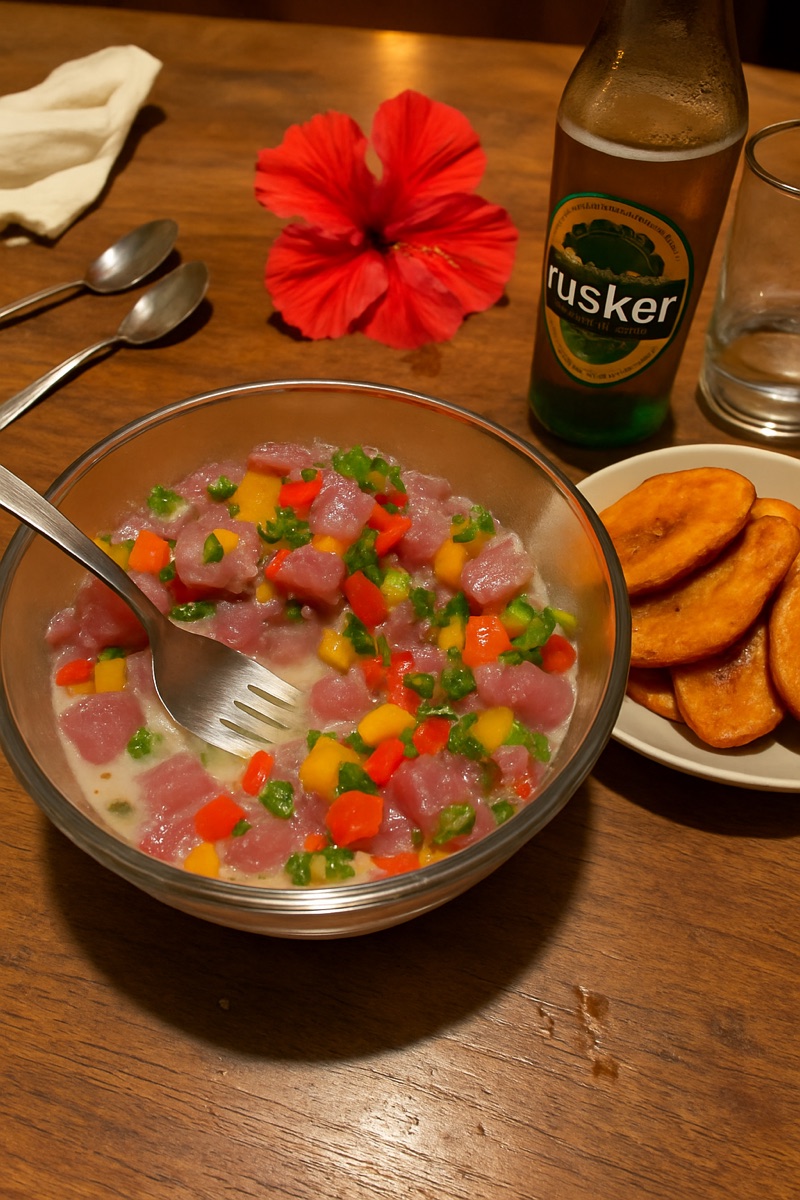
The Pacific raw fish dish is made here too, best known by its Fijian name kokoda. In our tuna kokoda recipe, 500 g of sashimi-grade tuna cures 2 to 3 hours in about 150 ml of lime juice until opaque right through. The juice, now bitter, is thrown away before coconut cream, red onion, tomato, chilli and spring onion go in.
Kava, drunk at dusk before dinner in the nakamal, is the national drink. Coconut crab is a delicacy, though many restaurants have stopped serving it because the species is at risk.
Town food tells the colonial story: Vietnamese spring rolls, known locally as nems, French bread, and gateau huit, a doughnut fried in the shape of an 8. On some islands flying foxes are kept in cages and eaten as a stew, and coastal villages eat red emperor, parrotfish, trevally, lobster and sand crab.
Both recipes are on our page about the food of Vanuatu, and the region is covered in our guide to Pacific Island food. Vanuatu's bunia is close to the bougna of its neighbour: see the national dish of New Caledonia, and the national dish of Fiji for kokoda.
The recipes
 Tuna kokoda
Questions people ask
Is it laplap or lap lap?
Laplap, in one word, is the standard Bislama spelling. "Lap lap" is common in English but Wikipedia describes it as incorrect.
What is laplap made of?
Grated taro, yam, manioc, breadfruit or banana, mixed with coconut cream and salt, wrapped in banana leaves. Pork, chicken, beef or flying fox can be added.
How is laplap cooked?
Traditionally on hot stones in an earth oven, covered with leaves and earth, for several hours until the paste is firm.
What is laplap sosor?
A Malekula variant in which a hot volcanic stone is set in the middle of the pudding with chicken wings, onion and tomato on top, so the meat cooks in the steam of the coconut milk.
What do people drink in Vanuatu?
Kava, made from the root of *Piper methysticum*, is the national drink, usually shared at dusk in a nakamal before dinner.
Keep reading
- Traditional food of Vanuatu: 12 dishes to know
- What is the national dish of Fiji?
- What is the national dish of Kiribati?
- What is the national dish of the Marshall Islands?
- What is the national dish of Micronesia?
- What is the national dish of Nauru?